Axolote Suite Announces Open-Source Developer Preview for Windows Powered by Rust and Iced

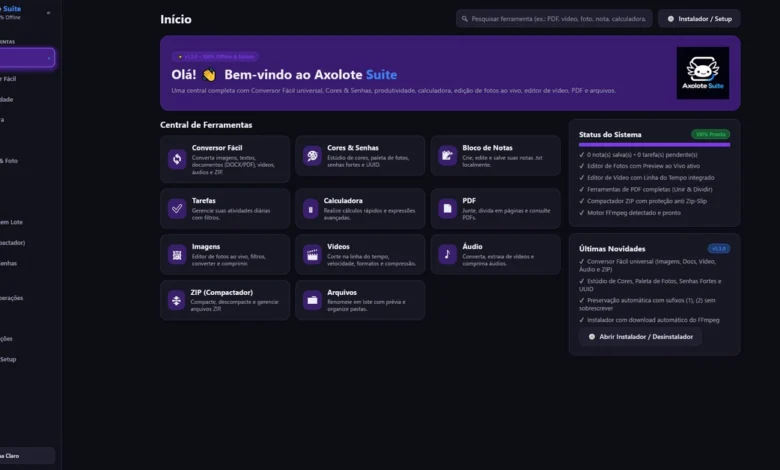
The software development community is witnessing a continuous evolution in native application design, largely driven by the demand for high-performance, memory-safe, and visually consistent cross-platform utilities. In a significant development for the ecosystem, the project maintainers behind the Axolote Suite have officially launched an early-access developer preview targeted specifically at Windows users and software engineers. Built from the ground up using the Rust programming language and the Iced GUI library, Axolote Suite represents a modern approach to desktop utility design, aiming to merge the raw computational efficiency of systems programming with a clean, reactive user interface.
The release of this open-source toolkit marks a crucial milestone in the project’s lifecycle, transitioning from closed internal testing to a community-driven public beta phase. Developers and tech enthusiasts are now invited to download the software, stress-test its capabilities, scrutinize its codebase, and contribute actionable feedback. As the open-source landscape increasingly favors languages that eliminate entire classes of concurrency and memory management bugs, Axolote Suite positions itself as a prime example of how modern toolkits can deliver robust performance without sacrificing aesthetic presentation.
Main Facts of the Release
The core architecture of Axolote Suite relies heavily on two foundational technologies: Rust, renowned for its strict compile-time memory safety guarantees and zero-cost abstractions, and Iced, a cross-platform GUI library inspired by Elm that emphasizes a reactive programming model. By leveraging Rust, the development team has ensured that the suite operates with minimal resource overhead, making it an attractive option for power users and developers who monitor CPU and RAM consumption closely.
The initial Windows rollout is designed to evaluate how the application handles varied system environments, diverse hardware configurations, and multi-threaded operations. According to project documentation, the primary objectives of this preview phase are bug reporting, feature validation, and performance benchmarking. Users can access the complete source code, audit its dependencies, and submit contributions via the official GitHub repository hosted at https://github.com/axolotesuite/axolotesuite. Additionally, a dedicated project portal has been established at https://axolotesuite.github.io/axolotesuite/ to provide installation guides, documentation, and release notes.
Despite the enthusiasm surrounding the launch, the maintainers have adopted a measured approach, explicitly framing the current build as a work-in-progress. The utility currently invites users to explore its baseline features, test edge cases, and report any unexpected behaviors directly through community channels. While the feature set will expand over subsequent iterations, the immediate focus remains on stability, responsiveness, and establishing a reliable foundation for future extensions.
Chronology and Development Timeline
The journey toward the Axolote Suite Windows preview reflects a deliberate, engineering-first trajectory typical of modern open-source software initiatives. While precise historical timestamps for the earliest private commits remain internal, the project’s public emergence follows a structured timeline focused on core stability before user-interface refinement.
In the early phases of conceptualization, the core contributors identified a gap in the Windows desktop ecosystem for lightweight, highly secure productivity toolkits that bypass the hefty resource footprint associated with Electron-based applications. The decision to adopt Rust provided a dual benefit: safeguarding against memory leaks and buffer overflows while enabling seamless integration with native system APIs.
Following months of internal prototyping, the development team integrated the Iced GUI framework, which allowed them to construct a modular layout capable of scaling across different display resolutions and scaling factors commonly found on Windows hardware. This architectural choice facilitated a unidirectional data flow, significantly reducing state-management bugs during high-frequency user interactions.
The culmination of these engineering efforts led to the current public preview phase. By opening the repository to the global developer community, the project has entered a collaborative feedback loop. The timeline moving forward is expected to be dictated heavily by community-submitted issues, pull requests, and telemetry gathered during manual testing by early adopters.
Supporting Data and Technical Architecture
To understand the operational scope of Axolote Suite, one must examine the technological stack underpinning its design. Rust has experienced exponential growth over the past decade, topping the Stack Overflow Developer Survey as the most admired programming language for multiple consecutive years. Its adoption in desktop toolkits like Axolote Suite is driven by the necessity to eliminate garbage collection pauses, which often plague applications built on higher-level runtimes.
Iced, on the other hand, provides a modern alternative to older GUI frameworks such as WinForms, WPF, or even cross-platform heavyweights like Qt and GTK. Modelled after the Elm Architecture, Iced enforces a strict separation between state, messages, and updates. This architecture guarantees that UI rendering remains predictable, modular, and easy to debug—qualities that are exceptionally valuable when building complex, multi-panel developer toolkits.
+-------------------------------------------------------+
                Axolote Suite Architecture
+-------------------------------------------------------+
|  User Interface Layer (Iced GUI Framework)            |
|  - Reactive components, Elm-inspired architecture     |
|  - Cross-platform layout scaling & rendering          |
+-------------------------------------------------------+
|  Business Logic & State Management                    |
|  - Unidirectional data flow                           |
|  - Safe concurrency models                            |
+-------------------------------------------------------+
|  Systems Core (Rust Language Foundation)              |
|  - Memory safety without garbage collection           |
|  - Zero-cost abstractions & low resource footprint    |
+-------------------------------------------------------+
Performance benchmarks for applications built with Rust and Iced typically demonstrate significantly lower memory consumption compared to web-tech wrapper frameworks. While quantitative benchmarks specific to Axolote Suite’s release will be finalized as community testing progresses, preliminary developer observations indicate rapid startup times and fluid window resizing under standard Windows 10 and Windows 11 environments.
Official Responses and Community Engagement
The reception from the open-source community during the initial rollout has been characterized by cautious optimism and active participation. Because the maintainers have opened direct channels for bug reporting and feature requests, early testers have begun evaluating the software’s error-handling capabilities and edge-case resilience.
Project maintainers have emphasized that community involvement is not merely encouraged but essential for the roadmap’s success. In statements accompanying the release documentation, the team noted that user perspectives on workflow ergonomics will directly influence the prioritization of upcoming features. By encouraging transparent dialogue via GitHub issues, the project aims to foster an inclusive environment where both seasoned systems programmers and casual Windows users can shape the direction of the software.
Furthermore, the decision to host the project openly aligns with broader industry trends toward transparent software supply chains. Developers auditing the repository can verify that dependencies are minimized and securely managed, addressing growing enterprise concerns regarding software security and third-party risk.
Broader Impact and Implications
The release of Axolote Suite carries several broader implications for the desktop software landscape, particularly regarding the ongoing shift away from resource-heavy web wrappers and toward native, memory-safe alternatives. As operating systems evolve, users increasingly demand utilities that respect system resources while offering modern, distraction-free interfaces.
- Ecosystem Maturation: The successful deployment of Rust and Iced in consumer-facing toolkits demonstrates that these technologies are ready for broader enterprise and consumer adoption, moving beyond niche backend servers and command-line tools.
- Resource Efficiency: By maintaining a lean memory footprint, applications like Axolote Suite contribute to extended battery life on portable Windows devices and smoother multitasking on resource-constrained hardware.
- Open-Source Collaboration: Providing an accessible codebase invites educational engagement, allowing students and junior developers to study clean, idiomatic Rust code applied to graphical user interfaces.
As the preview period progresses, the metrics gathered from bug trackers, feature requests, and stability reports will serve as a bellwether for the toolkit’s long-term viability. For developers and Windows users seeking a high-performance, community-driven utility built on cutting-edge systems principles, Axolote Suite offers a compelling platform to explore, test, and help refine.