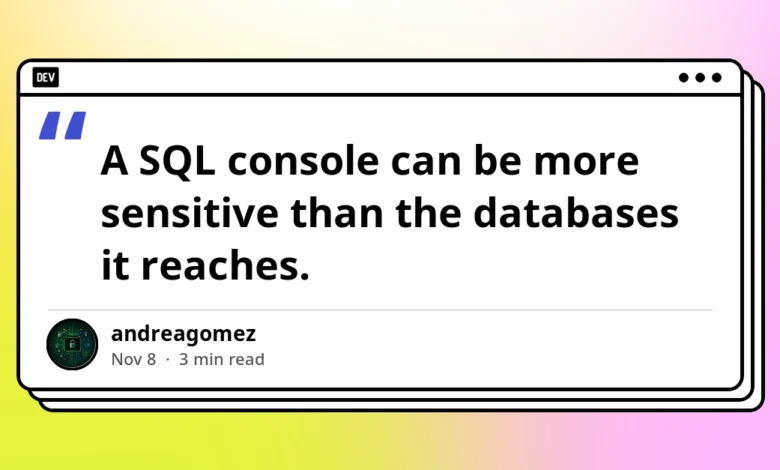
SQLPad, a widely utilized open-source web-based SQL query editor, presents significant administrative and security challenges regarding how connection definitions and service credentials are managed. In modern enterprise environments, centralized database query tools often act as a double-edged sword: while they provide developers, data analysts, and administrators with streamlined, browser-based access to complex data stores, they can inadvertently become high-value targets for attackers. Because SQLPad stores comprehensive connection strings and permits users to execute arbitrary queries, the application itself can rapidly become more sensitive and critical than the underlying databases it reaches.
Security researchers and infrastructure auditors have increasingly focused on the mechanics of SQLPad’s administrative privileges and, specifically, the generation and lifecycle of service tokens. When an administrator creates a service token within the application, a routine browser-based convenience is effectively transformed into a durable, long-lived API credential possessing broad, sweeping database reach. Without rigorous oversight, these persistent tokens can bypass standard session expirations, creating profound vulnerabilities if left unmonitored or improperly secured within automated CI/CD pipelines and microservice architectures.
Understanding the foundational architecture of SQLPad requires examining its default authentication frameworks. Out of the box, the application relies primarily on local authentication utilizing email and password combinations. To protect these credentials, user passwords are encrypted and securely stored within its embedded database using robust bcrypt hashing. Initial deployment configuration is governed by environment variables, notably SQLPAD_ADMIN alongside an optional SQLPAD_ADMIN_PASSWORD, which provisions the first administrative account. Subsequent user onboarding is handled directly through the administrative interface.
Currently, SQLPad’s permission model is structured around two distinct operational roles: Admin and Editor. Users assigned the Admin role possess the authority to create, modify, or delete database connections, manage user accounts, and generate powerful programmatic artifacts. According to official project documentation, service tokens are explicitly designed to be generated by logging into the platform with administrative privileges and navigating to the dedicated Service Tokens page. Because these tokens are engineered to facilitate automation and integration scripts, they intentionally bypass standard browser session constraints. Consequently, they demand separate, rigorous security reviews to ensure they do not outlive their utility or fall into unauthorized hands.
To gauge the public footprint and internet exposure of SQLPad instances, recent threat intelligence gathering has utilized search engines like ZooEye to map deployed nodes. In probing operations conducted on November 9, 2026, researchers executed multiple distinct count-only queries using uniform parameters—specifying sub_type=all, page 1, and a page size of 1—to evaluate the prevalence of the software across globally reachable networks.
The application-fingerprint query targeting app="SQLPad" successfully matched 1,067 instances. Concurrently, a title-based query targeting title="SQLPad" identified 1,022 matching web pages, while a broader body-content query targeting http.body="SQLPad" returned 1,084 results. While these three distinct counting methods yielded closely aligned figures, security analysts emphasize that raw discovery metrics do not definitively prove that every identified match represents an active, vulnerable, or misconfigured SQLPad deployment. Rather, the application fingerprint serves as the strongest discovery signal, highlighting the sheer volume of web servers exposing the interface. Crucially, these surface-level counts cannot determine whether authentication mechanisms are actively enforced, what specific database backends are tethered to each instance, or which external entities hold valid service tokens.
Mitigating the risks associated with centralized database tools requires a comprehensive review of connection authority across the entire organization. System administrators must maintain an exhaustive inventory of every database connection defined within SQLPad, documenting its specific database role, underlying network path, and designated owner. A critical nuance of the platform is that a SQLPad administrator may possess the capability to modify or redirect a connection string even if they do not know the underlying database password. Furthermore, if a connection is configured to utilize a highly privileged database account, SQLPad’s internal role-based access control ceases to be the sole authorization boundary protecting the data.
To enforce the principle of least privilege, security teams strongly recommend provisioning dedicated, read-only database accounts for routine analytic and exploratory work. Operations requiring write capabilities should utilize entirely separate, tightly constrained connections. Under no circumstances should standard Editors share a generalized connection whose underlying credentials possess administrative or multi-tenant modification rights. Core database-level controls, including granular roles, schema restrictions, and row-level security policies, must remain vigorously enforced regardless of whether a query originates from a native client or a web-based console like SQLPad.
Configuration hygiene is equally vital regarding user provisioning and authentication toggles. System operators must carefully review environment configurations such as SQLPAD_USERPASS_AUTH_DISABLED and default-role assignments. Official documentation explicitly warns that disabling local user-password authentication requires the establishment of a fallback default role for users authenticated through external identity providers. If this default role is mistakenly configured as Admin, any successful authentication event from an external source will inadvertently grant the user full administrative authority over the entire SQLPad instance.
API security and the governance of service tokens represent another critical frontier in hardening SQLPad deployments. While the platform documents standard HTTP Basic authentication for users and traditional password access (unless local authentication has been explicitly disabled), service tokens operate entirely outside this standard paradigm. Organizations should never store plain-text service tokens in source code repositories or accessible configuration files; instead, they must be securely managed within enterprise-grade secret managers. Each token should be strictly scoped to a dedicated system operator or automated service, with comprehensive metadata recording its exact business purpose and accountable owner.
Best practices dictate regular auditing of API access. Security teams should routinely test the API using tokens that ought to be explicitly denied, confirming that access restrictions are enforced concurrently by both SQLPad and the downstream database account rather than relying solely on user interface controls. Token creation logs and last-use timestamps must be systematically reviewed, and stale or orphaned tokens must be immediately revoked following integration updates or personnel transitions.
Network architecture and data storage security further reinforce the posture of any SQLPad deployment. Web and API endpoints should be strictly restricted to internal management networks or placed behind secure reverse proxies equipped with robust multi-factor authentication and enforced Transport Layer Security (TLS). Additionally, the application’s embedded database must be heavily protected, as it houses sensitive data including bcrypt password hashes, plaintext or encrypted connection strings, and active session states. Administrators must ensure this database is backed up with encryption at rest and that access to restore points is tightly restricted.
Effective monitoring and incident response strategies are indispensable for detecting unauthorized access or lateral movement stemming from compromised SQLPad installations. Logging systems should capture critical metadata including user identifiers, connection names, query identifiers, row counts, and result statuses, while strictly avoiding the logging of raw query text or returned business data to prevent secondary data leaks. Automated alerts should be configured to flag anomalous behavioral patterns, such as queries reading unusually large volumes of data, unexpected database connection modifications, the sudden creation of new administrator accounts, or the generation of new service tokens.
In the event of an administrative account compromise, immediate containment actions must be executed. Organizations should disable the compromised account, immediately revoke all active sessions and associated service tokens, and initiate a comprehensive review of recent database connection changes. Incident responders must determine which database credentials were exposed during the compromise and rotate them immediately. Because SQLPad may not comprehensively log every individual statement or granular data access event, security teams must cross-reference application alerts with the native audit logs of the connected databases.
Ultimately, while external discovery metrics such as global search engine counts provide a high-level overview of the application’s internet exposure, they cannot replace rigorous internal auditing. A public count cannot reveal whether a specific console faces the open internet, what critical databases lie behind it, or which automated scripts possess broad API authority. Organizations running SQLPad must transition from passive awareness to active verification, mapping every connection, securing every service token, and ensuring that browser-based convenience never compromises core database security.