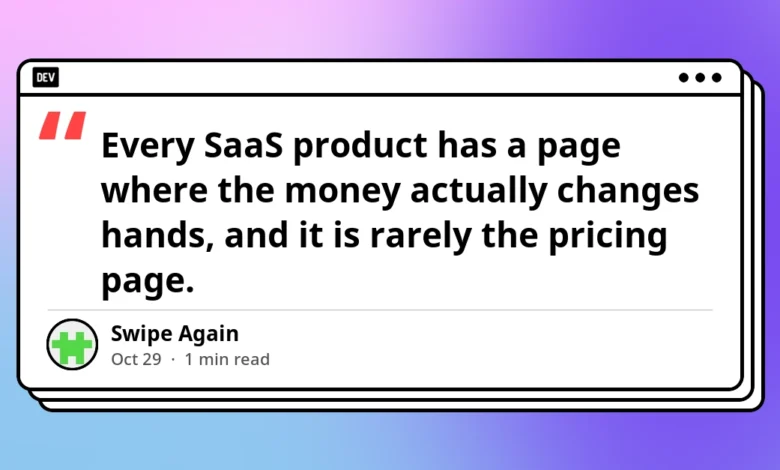
For years, software-as-a-service (SaaS) companies have obsessed over their pricing pages, meticulously A/B testing typography, color psychology, tier naming, and feature comparison matrices in the pursuit of higher conversion rates. However, user experience (UX) researchers and product strategists are increasingly pointing to a different, often neglected threshold as the true fulcrum of digital commerce: the connection or integration page.
In the modern ecosystem of specialized SaaS applications—particularly those dealing with financial infrastructure, data analytics, and automated operations—the pricing page represents mere intention. The product dashboard represents delivery. But the connect page serves as the vital hinge where a user transitions from a prospective customer into an active, revenue-generating account.
The Anatomy of the Conversion Hinge
The significance of the connect page is magnified in niche technical sectors, such as payment recovery tools, churn mitigation software, and automated accounting platforms. In these domains, signing up for an account, completing a 14-day trial, and inputting credit card billing information does not mean the user is fully onboarded. The critical moment occurs when the merchant must grant the platform API access, OAuth permissions, or webhook integration to the core systems where their actual business operations and revenue reside.

Industry analysts note that friction at this exact juncture is responsible for a disproportionate amount of trial abandonment. When a merchant stalls on a connect page, it is rarely because they have lost faith in the software’s value proposition. Rather, they stall because the interface temporarily forces them to adopt the cognitive load of a software developer.
When integration pages are cluttered with technical jargon—such as demanding raw API keys, explaining security scopes, or referencing cryptographic tokens—conversion rates plummet. To counteract this, leading product teams are applying rigorous UX discipline to their integration flows. This includes stripping away unnecessary choices, providing sequential, plain-language instructions, enforcing a strict one-action-per-step rule, and explicitly defining what a successful connection looks like in real time.
Evolving Onboarding Strategies: Card-First vs. Connect-First
Historically, product-led growth (PLG) companies debated whether to prompt users to integrate their data sources before or after capturing payment details. Increasingly, data from modern SaaS billing cycles suggests that a "card-first, connect-second" model yields stronger long-term retention.
By securing billing information upfront, companies filter out low-intent users, ensuring that those reaching the integration phase are commercially qualified. Yet, the velocity at which these qualified users complete the connection phase remains a core business vital sign. Companies are now tracking metrics such as the "percentage of trials connected within 24 hours" with the same intensity traditionally reserved for monthly recurring revenue (MRR) or churn rates.

Product architects emphasize that reducing friction during this phase often relies on leveraging native ecosystem integrations. For instance, utilizing streamlined authorization windows—such as direct OAuth flows provided by major payment gateways like Stripe, where users can authenticate with a few clicks rather than manually generating and pasting API keys—dramatically accelerates time-to-value. Transparency also plays a pivotal role; explicitly guiding merchants toward the most seamless integration pathways ensures they experience an early win, setting a positive trajectory for product adoption.
Industry Implications and the Future of SaaS UX
The realization that the integration page functions as the ultimate revenue gatekeeper has broader implications for web development and software architecture. UX designers are no longer treating onboarding as a linear checklist, but as a critical user journey that requires the same continuous optimization historically dedicated to checkout funnels.
As software ecosystems become more interconnected, platforms that fail to abstract away technical complexity risk losing users who have little patience for complicated setup procedures. The overarching lesson for modern tech enterprises is clear: regardless of how sophisticated the underlying algorithm or recovery flow may be, it cannot generate value for a client who remains trapped on the integration screen. Consequently, the most unglamorous page in the application architecture is increasingly recognized as the foundation upon which commercial success is built.