Amazon S3 Tables Introduces Managed Migration Pathways for Apache Hive to Apache Iceberg Data Lakes

Data lake modernization has historically represented one of the most resource-intensive engineering initiatives for enterprise data architecture teams. Organizations seeking to transition legacy analytical environments from traditional formats to modern open standards frequently encountered complex operational hurdles, custom pipeline development, and prolonged maintenance windows. Addressing this industry-wide engineering bottleneck, Amazon Web Services has officially announced the rollout of native, fully managed migration capabilities for Amazon S3 Tables. This new functionality enables seamless, API-driven transitions of Apache Hive tables directly into Apache Iceberg format. By eliminating the necessity to construct custom ETL pipelines or provision auxiliary compute infrastructure, the service allows organizations to upgrade their underlying data architectures while maintaining active production workloads.
The Shift Toward Open Analytic Standards
Over recent years, Apache Iceberg has solidified its position as the de facto open standard for managing petabyte-scale analytics datasets. Modern data architectures increasingly rely on Iceberg due to its advanced structural capabilities, which include schema evolution, hidden partitioning, and time-travel querying. These features grant data engineers granular control over massive repositories without locking the organization into proprietary storage formats, ensuring that data remains universally queryable across any Iceberg-compatible compute engine.
Concurrently, Amazon S3 Tables were engineered specifically to provide high-performance, cost-effective storage layers optimized for Apache Iceberg tables. As data volumes expand, S3 Tables automate critical administrative overhead through built-in maintenance routines, automated compaction, replication policies, and native integration with S3 Intelligent-Tiering. Despite the clear long-term advantages of adopting Iceberg, the practical execution of migrating legacy workloads—particularly massive Apache Hive implementations registered within the AWS Glue Data Catalog—remained a significant operational deterrent.

Overcoming Historical Engineering Complexities
Prior to the introduction of this managed service, migrating an enterprise-grade Apache Hive table to Apache Iceberg required weeks, and occasionally months, of dedicated engineering effort. Technical teams were forced to manually architect robust translation frameworks, handle intricate data type conversions, build comprehensive data validation checks, and establish fail-safe rollback capabilities. Furthermore, these migrations typically required scheduled maintenance windows that disrupted downstream analytical workflows and business intelligence dashboards.
The newly deployed S3 Tables migration utility fundamentally re-architects this workflow by transforming a historically manual, custom-coded project into an automated, API-driven operation. S3 Tables now assume complete responsibility for the end-to-end migration lifecycle. This comprehensive management encompasses automated data validation, rigorous compatibility checks, precise data type conversions, file recompression, and optimized table compaction.
Operational Workflow and Execution Mechanics
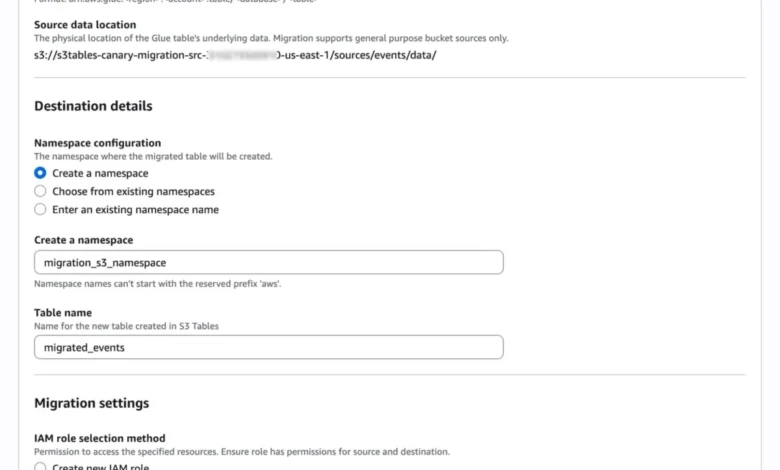
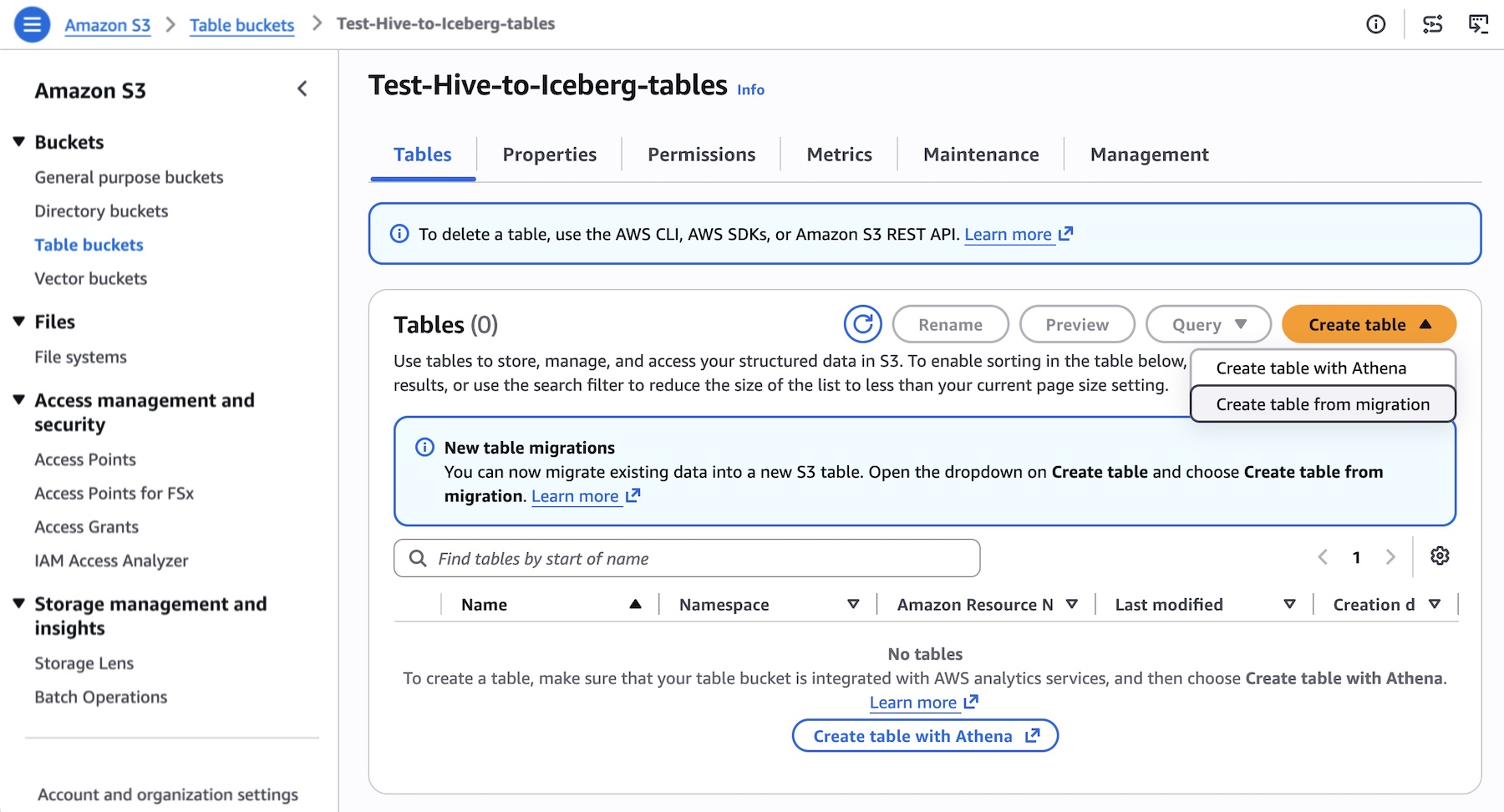
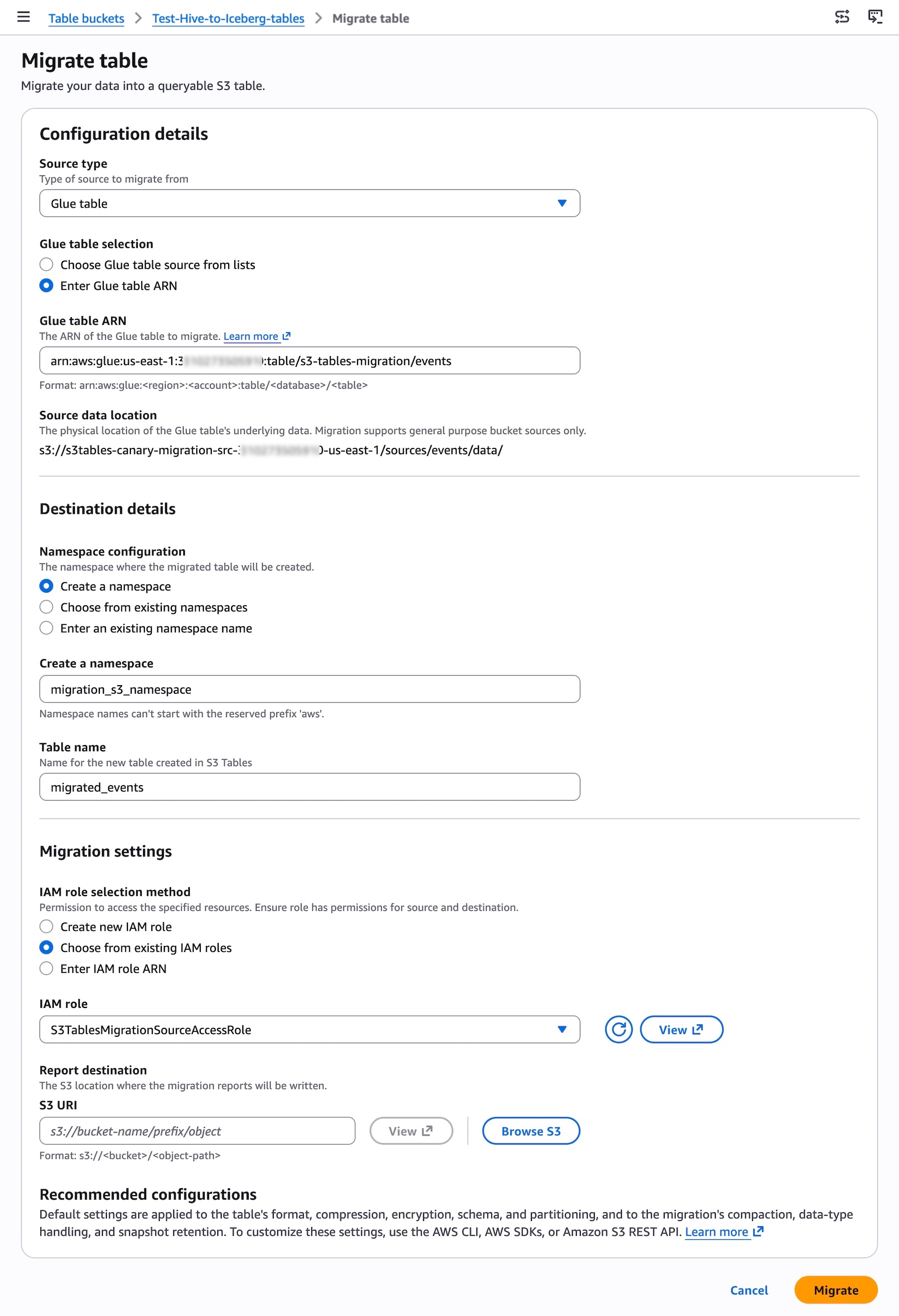
The migration sequence begins directly within the Amazon S3 console or through programmatic interfaces such as the AWS Command Line Interface (AWS SDKs) and the Agent Toolkit for AWS. Users initiate the process by designating an existing Parquet-formatted Apache Hive table registered in the AWS Glue Data Catalog as the source, followed by the selection of an appropriate destination S3 Table bucket.

Upon receiving the migration command, S3 Tables execute a comprehensive diagnostic sweep of all source objects within scope. Rather than indiscriminately copying data, the service first generates a detailed table and object compatibility report, identifying potential discrepancies or schema mismatches before any storage transfer occurs.
During the primary data transfer phase, the destination Iceberg table operates in a read-only state while the source table remains fully accessible to active production workloads. To maintain data synchronization between the actively writing source and the migrating destination, administrators can repeatedly invoke a dedicated synchronization command. Each iterative sync operation intelligently isolates and copies only the delta changes that occurred since the previous snapshot, dramatically minimizing the final cutover window. According to technical specifications, production workloads experience only a brief, negligible interruption during the final promotion of the destination table to read-write status.
Economic Efficiencies and Cost Structures
From a financial perspective, the managed migration framework has been designed to remove economic penalties associated with large-scale architectural updates. Organizations incur charges solely for the volume of data explicitly copied during the migration process. AWS has waived any conversion-specific processing fees for translating Hive metadata and structures into Iceberg format.
Additionally, for enterprises utilizing S3 Intelligent-Tiering, source objects remain within their current access tiers throughout the migration cycle, preventing unexpected cost spikes associated with artificial data retrieval or tier shifting. This transparent pricing model lowers the barrier to entry for resource-constrained engineering teams seeking to modernize stagnant data architectures.
Global Availability and Initial Scope
At launch, the managed migration capability is available across a broad spectrum of major global AWS regions, ensuring compliance with data residency and latency requirements. Supported deployment zones at launch include US East (N. Virginia, Ohio), US West (Oregon), Asia Pacific (Mumbai, Singapore, Sydney, Tokyo), and Europe (Frankfurt, Ireland, Stockholm).
The initial release specifically supports AWS Glue-registered Hive tables stored in Parquet format residing within the same AWS account and geographic region. Integration with developer ecosystems is robustly supported; engineers can orchestrate migrations using standard AWS SDKs, the AWS CLI, or leverage specialized skills within the Agent Toolkit for AWS, such as the dedicated Kiro-backed coding agent guidelines designed to provide secure, guardrail-protected migration pathways.
Broader Industry Implications and Future Outlook
The introduction of native Hive-to-Iceberg migration tools reflects a broader industry trend toward reducing operational friction in data lake governance. As data volumes continue to swell across global enterprises, the maintenance overhead of legacy formats like Apache Hive has become an unsustainable drag on productivity. By streamlining the path to open table formats, cloud providers are accelerating the transition toward modular, interoperable data stacks.
Industry analysts note that reducing the migration timeline from weeks of custom software development to a few configuration steps will likely encourage widespread enterprise adoption of Apache Iceberg. Organizations that previously deferred modernization projects due to staffing constraints or risk aversion can now execute architectural upgrades with minimal operational exposure. As AWS and other cloud infrastructure providers continue to refine automated data management services, the friction of transitioning between generations of data lake technologies is expected to diminish further, establishing a more agile foundation for enterprise analytics and artificial intelligence workloads.
Related posts: