StrongVPN Review 2024: A Veteran Service Struggling to Keep Pace with Modern Privacy and Performance Standards

Founded nearly two decades ago in 2005, StrongVPN has long maintained a recognizable presence in the virtual private network industry. As one of the early providers to offer commercial encryption and geo-spoofing tools to everyday consumers, the company built a reputation on straightforward, no-frills functionality. However, the digital landscape has transformed radically since the mid-2000s. Today’s consumers demand high-speed connections, ironclad privacy guarantees backed by independent third-party audits, advanced routing options like multi-hop connections, and seamless streaming unblocking capabilities.
A comprehensive evaluation of StrongVPN’s current infrastructure, pricing models, application usability, and performance metrics reveals a service that has largely stagnated. While it still delivers basic connectivity across major operating systems and bundles helpful bonuses like StrongDNS and an aloSIM eSIM mobile data allowance, its outdated software components, sluggish download speeds, and limited feature set place it at a distinct disadvantage when compared to modern market leaders.
Pricing Models and Subscription Tiers
StrongVPN utilizes a standard subscription model split between monthly and annual commitments, following the industry-wide trend of offering steep discounts for longer-term sign-ups. Customers opting for month-to-month flexibility face a steep charge of $11.99 per month. Meanwhile, the annual plan lowers the average cost to $3.97 per month, totaling $47.69 for the first year.
However, consumers must exercise caution regarding the service’s auto-renewal policies and introductory pricing structures. Following the conclusion of the first year, the annual subscription rate jumps significantly to $89.99—effectively raising the monthly cost to $7.50. This pricing structure places StrongVPN in direct competition with elite providers such as Surfshark, CyberGhost, and Private Internet Access. Many of these competitors routinely offer superior feature suites, larger server networks, and faster speeds at comparable or lower price points. Additionally, while StrongVPN does offer a 30-day money-back guarantee, this refund policy applies exclusively to annual subscriptions, leaving monthly subscribers without a safety net if the service fails to meet their expectations.
Infrastructure, Server Networks, and Privacy Concerns

At the core of any reliable VPN is its underlying network infrastructure and jurisdiction. According to information hosted on StrongVPN’s official website, the provider maintains a relatively modest network consisting of approximately 950 servers spanning 30 countries and 46 locations. This footprint is notably smaller than those of top-tier competitors; for context, CyberGhost boasts servers across 125 locations in 100 countries, while Surfshark matches a similar global spread. Furthermore, industry analysts have noted that StrongVPN’s published network statistics have remained static for years, raising questions regarding the current accuracy and maintenance of its server inventory.
Privacy-conscious users must also evaluate the company’s geographical jurisdiction. Based in New York, United States, StrongVPN operates within a heavily scrutinized legal framework subject to federal intelligence gathering and data retention directives. While the company maintains a stated zero-logs policy regarding user web traffic, its actual data collection practices include logging incoming IP addresses and outgoing VPN IP addresses. Compounding these privacy concerns is a total lack of public, independent third-party security audits. While top-tier VPN providers regularly invite external cybersecurity firms to audit their infrastructure and verify their no-logs claims, StrongVPN offers no such cryptographic or procedural verification.
Performance, Speed Benchmarks, and Protocol Limitations
In rigorous speed testing, StrongVPN’s download capabilities consistently lag behind modern competitors, placing it near the bottom of performance benchmarks. Speed evaluations using the legacy OpenVPN protocol yielded results of approximately 128 Mbps. Upgrading to the newer WireGuard protocol pushed speeds to a range between 234 Mbps and 353 Mbps.
While these speeds are technically sufficient for basic web browsing and standard-definition video consumption, they pale in comparison to rival services operating on identical consumer fiber connections. For comparison, similarly priced competitors like Surfshark and Windscribe regularly record download speeds exceeding 2,000 Mbps under identical testing conditions. Industry experts attribute StrongVPN’s lackluster performance to its use of older, unoptimized implementations of both OpenVPN and WireGuard. Continued failure to deploy updated software components creates efficiency bottlenecks that severely limit network throughput.
Streaming Compatibility and Torrenting Performance
The modern VPN consumer frequently relies on these services to bypass geo-restrictions imposed by global streaming platforms and to secure peer-to-peer (P2P) file sharing. StrongVPN’s performance in this arena yields mixed results. During testing, the service successfully unblocked major international platforms including Netflix, Disney+, and DAZN. It also proved capable of accessing regional services such as the United Kingdom’s BBC iPlayer and Australia’s 9Now.

Conversely, the provider struggled with other major streaming giants. Testers were repeatedly unable to stream content from YouTube Premium or Amazon Prime Video, regardless of the server location selected. For users whose primary motivation for purchasing a VPN is uninterrupted global streaming access, StrongVPN’s inconsistency makes it a risky investment. On the other hand, torrenting and P2P file sharing functioned without administrative interference. StrongVPN does not restrict torrenting to specific servers, and downloads proceeded smoothly across its general network infrastructure, albeit constrained by the aforementioned speed limitations.
Applications, Usability, and Feature Sets
StrongVPN provides client applications for a broad array of operating systems, including Windows, macOS, Android, iOS, and Amazon Fire TV, alongside browser extensions for Google Chrome and manual setup guides for Linux distributions. However, the user experience across these applications is notably rudimentary.
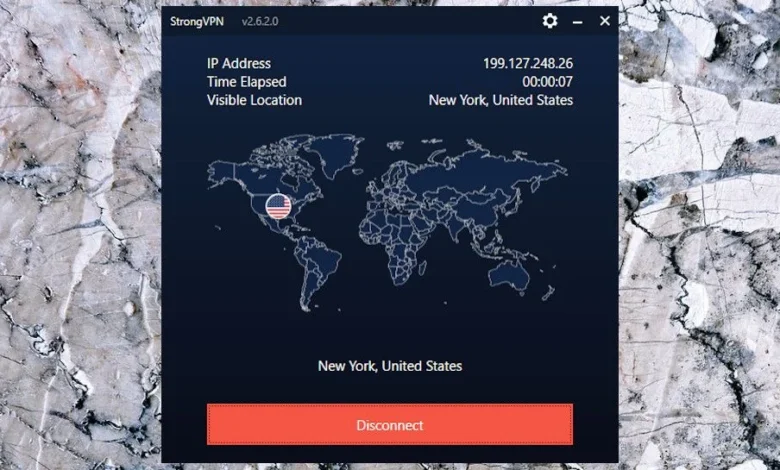
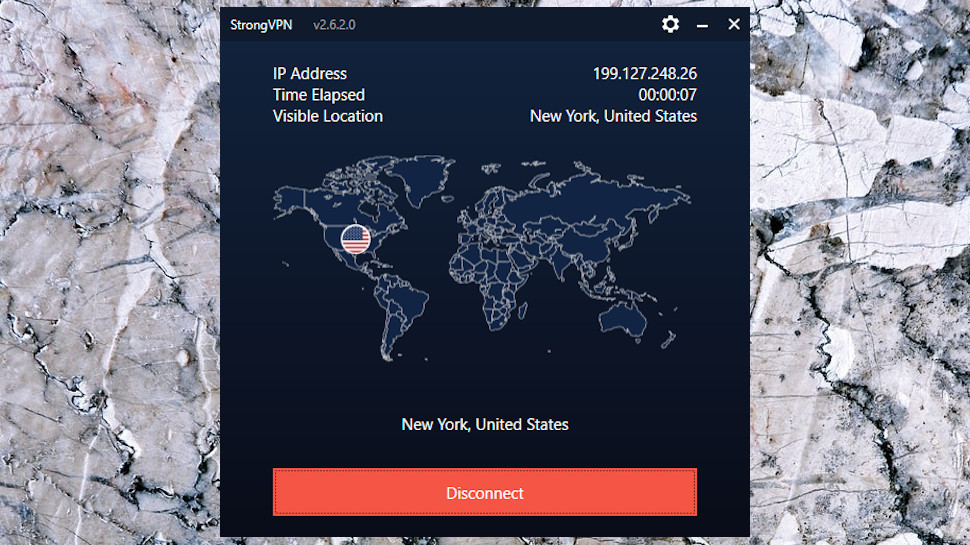
The Windows client, for instance, features a minimalist interface dominated by a static, non-interactive map, connection status indicators, a location read-out, a connection toggle, and a settings menu. While locations are organized alphabetically with a search bar functionality to quick-jump to specific cities, the app lacks essential modern conveniences. Users cannot save a list of "Favorites," view a "Recently Used" history, or check server latency metrics in real time to identify the fastest connection option. Furthermore, during performance testing, the Windows client occasionally experienced frustrating launch delays, occasionally hanging at the login screen for over 30 seconds while executing background tasks.
Advanced security features are implemented unevenly across platforms. A kill switch—designed to sever internet access if the encrypted tunnel unexpectedly drops—is available on Windows, but macOS users are restricted to an OpenVPN-only kill switch, and Android and iOS implementations vary. Notably, StrongVPN’s kill switch design takes a heavy-handed approach: rather than simply blocking traffic during a drop, it blocks all internet access unless the user is actively connected to the VPN.
This design choice creates friction due to the complete absence of split-tunneling functionality on Windows applications (though split-tunneling is available on Android). Without split-tunneling, users cannot designate specific apps or local websites to bypass the VPN tunnel. Consequently, accessing a local service that blocks VPN traffic requires manually disabling the entire VPN connection.
Value-Added Extras: StrongDNS and aloSIM Integration
To offset its bare-bones application feature set, StrongVPN bundles a few value-added extras. Subscribers receive access to StrongDNS, a private DNS service designed to help users bypass basic regional blocks without encrypting all traffic. Additionally, the company includes a complimentary eSIM mobile data allowance of 3GB provided by aloSIM. This inclusion serves as a practical perk for international travelers needing mobile data abroad, though it remains a niche benefit for desktop-centric users.
Customer Support and Accessibility Shortcomings
Customer support channels for StrongVPN include a web-based knowledge base, email support, and an automated chatbot. Interestingly, telephone support exists but is intentionally obscured, accessible only by logging directly into a user’s account dashboard rather than being publicly advertised.
The support chatbot represents a particular point of user friction. Operating without modern Large Language Model (LLM) integration or human escalation pathways, the bot routinely fails to resolve anything beyond the most elementary queries. Furthermore, the desktop applications exhibit noticeable accessibility shortcomings. Navigation via keyboard shortcuts fails to adhere to standard software conventions; pressing the Enter key while browsing the server location list scrolls the user down to the next entry rather than selecting the highlighted location, impeding efficient navigation for power users and individuals relying on assistive technologies.
Market Position and Strategic Implications
When evaluating StrongVPN within the broader context of the contemporary cybersecurity market, the service occupies a difficult position. It remains a stable, functional tool capable of basic IP masking and moderate file downloading, backed by a long history in the industry. However, the lack of continuous software updates, the absence of independent privacy audits, a restrictive United States jurisdiction, and sub-par connection speeds leave it far behind contemporary market standards.
With robust alternatives such as Surfshark, CyberGhost, Windscribe, and VyprVPN offering vastly superior connection speeds, advanced security protocols, comprehensive zero-logs audits, and modern feature sets for virtually identical subscription costs, StrongVPN struggles to justify its price point. For consumers prioritizing cutting-edge privacy, lightning-fast streaming, and refined software usability, industry consensus strongly points toward these modernized competitors as vastly superior alternatives.