Norton VPN Review: A Formidable Security Contender Emerges After Years of Rebuilding


Norton VPN has undergone a radical structural and functional transformation, positioning itself as a serious competitor against industry leaders like NordVPN and Surfshark. Following years of playing catch-up after its initial launch as Norton WiFi Privacy in 2017, the cybersecurity giant has leveraged its deep antivirus pedigree over the past eighteen months to deliver a revamped product. Recent evaluations demonstrate that the service now boasts chart-topping speeds, streamlined cross-platform applications, robust unblocking capabilities, and advanced protocol integration, scoring an impressive 79 out of 100 in comprehensive testing.
A Chronology of Transformation: From Lagging Utility to High-Performance VPN

The evolution of Norton VPN has accelerated significantly since 2024. For much of its early history, the service suffered from a limited feature set, occasional DNS leaks, and restrictive protocol options that left it trailing behind dedicated privacy solutions. However, the formation of Gen Digital in 2022—the parent company resulting from the merger of Avast and Norton—acted as a crucial catalyst. By pooling best-of-breed technologies from the merger, Norton began rapidly overhauling its digital infrastructure.
By April 2025, the platform introduced several advanced tools, including Double VPN routing, automated IP rotation, a Pause VPN function, and a high-performing ad-blocking browser extension. Early 2026 brought further critical updates, most notably the integration of the WireGuard protocol across all Apple operating systems (macOS and iOS) and native application support for Amazon Fire TV devices. These systematic upgrades have addressed historical complaints regarding feature disparity across devices, turning a once-basic utility into a feature-rich security suite.
Under the Hood: Protocols, Encryption, and Future-Proof Security Architecture
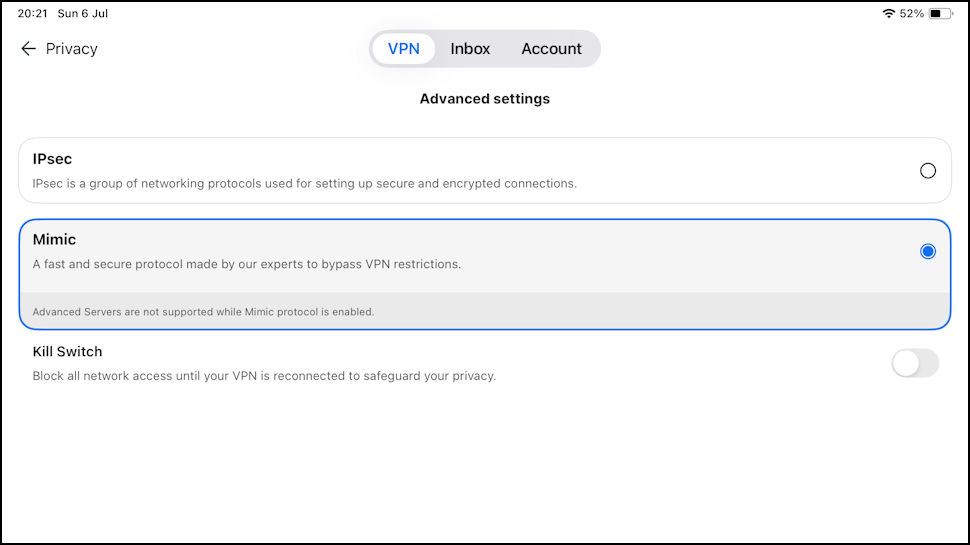
Security and privacy form the bedrock of any credible virtual private network, and Norton has invested heavily in modern cryptographic standards. The service offers a diverse selection of protocols, including OpenVPN, WireGuard, IPSec, and Mimic—Norton’s proprietary obfuscation protocol designed to bypass deep packet inspection and network censorship in restrictive regions like China.
Significantly, Norton has positioned itself at the cutting edge of cybersecurity by integrating post-quantum cryptography. Both its proprietary Mimic protocol and the newly implemented WireGuard support on Apple devices utilize ML-KEM-1024 post-quantum key encapsulation mechanisms. This forward-looking implementation ensures that encrypted traffic remains secure even against theoretical quantum computing decryption attacks, a feature currently absent from many mainstream competitors. Standard connections rely on industry-standard ciphers such as AES-256-GCM and ChaCha20-Poly1305.
Despite these cryptographic strengths, privacy-conscious consumers scrutinize logging policies closely. Norton enforces a strict no-logs policy, which was independently audited by cybersecurity firm VerSprite in August 2024. While the audit ultimately confirmed the integrity of the policy after minor remediation, Norton does collect limited, anonymized diagnostic data. This includes platform details, time zones, crash logs, and general application interaction events retained for up to 18 months. Industry analysts note that while adequate for day-to-day privacy, users seeking absolute anonymity without telemetry collection may still lean toward zero-logs purists like Proton VPN. Furthermore, the absence of RAM-only server infrastructure—which automatically wipes data upon reboot—remains a notable omission compared to market leaders.
Unprecedented Speed Benchmarks and Server Infrastructure Expansion
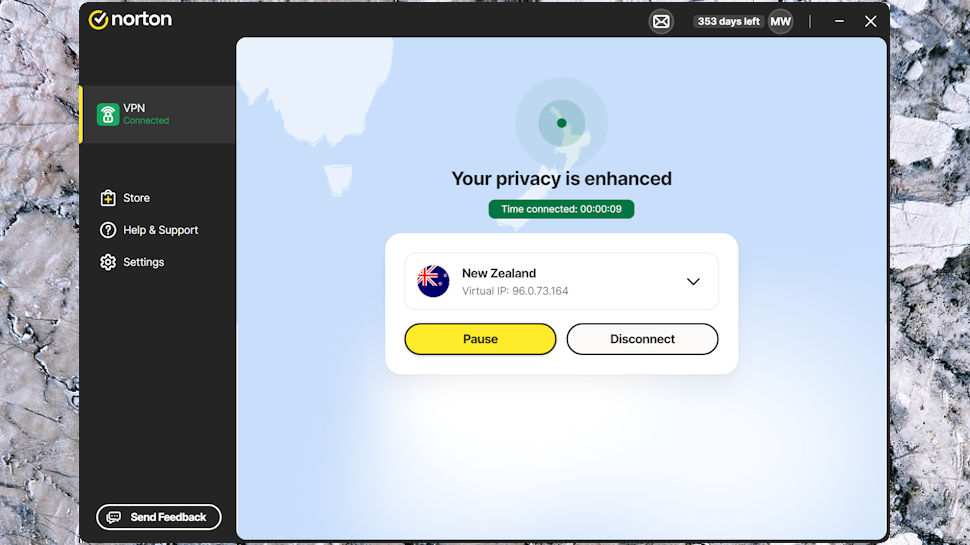
Performance testing reveals staggering improvements in connection speeds. Utilizing a standardized testing environment with a 10 Gbps connection, reviewers recorded an average local speed of 2,406 Mbps over WireGuard from an East USA testing post. This figure currently ranks among the highest recorded in modern VPN benchmarks. Long-distance speeds similarly impressed, with trans-Atlantic connections between the US and the UK averaging 1,730 Mbps—a dramatic leap from previous performance metrics. OpenVPN performance followed a similar upward trajectory, occasionally outperforming localized expectations. When engaging multi-hop (Double VPN) servers, speeds experienced a predictable drop of approximately 42%, yet retained more than enough bandwidth for intensive tasks.
This performance is supported by an expanding global network. Norton VPN now operates servers across 143 locations spanning 101 countries, an increase from 74 countries during prior evaluations. Recent geographic additions include Bangladesh, Ethiopia, Kazakhstan, Malta, and Sri Lanka. However, network distribution remains heavily concentrated in North America and Europe, which account for roughly 63% of total locations. While virtual server locations generally route traffic effectively, some anomalies persist; for instance, routing a Brunei virtual connection through a physical server located in London introduces unnecessary latency.

Streaming, Torrenting, and Real-World Usability
For entertainment consumers, Norton VPN delivers reliable unblocking for major streaming platforms, including Netflix, Disney Plus, and Amazon Prime Video. While minor localized blocks—such as regional YouTube libraries in Australia and Canada—were noted during testing, the overall unblocking success rate remains high.
Torrenting capabilities are supported via five dedicated P2P-optimized servers, alongside an auto-connect feature that engages the VPN upon launching compatible peer-to-peer applications. However, advanced power users may lament the continued lack of port forwarding support, a feature prioritized by competitors like Private Internet Access and ExpressVPN.

Usability remains one of Norton’s strongest selling points. Benefiting from decades of consumer software design experience, the applications across Windows, macOS, Android, and iOS feature clean, intuitive interfaces. Advanced features like Wi-Fi auto-connection, kill switch protection, and manual or automatic IP rotation are integrated smoothly without overwhelming novice users.
Pricing, Packaging, and Market Implications
Norton structures its service around tiered pricing models, starting at an introductory rate of roughly $2.49 per month for a two-year Standard plan, before renewing at $99.99 annually. Higher tiers, such as Norton VPN Plus ($3.49/month introductory) and Norton Ultimate ($4.49/month introductory), bundle additional cybersecurity tools such as antivirus protection, dark web monitoring, password management, and up to 150GB of encrypted cloud storage.

A notable point of friction for power users is the device allocation model. Rather than offering traditional simultaneous connection limits, Norton restricts coverage to a set number of installed devices (ranging from 10 to 20 depending on the tier), requiring manual uninstallation from a device before registering a new one. Nevertheless, an industry-leading 60-day money-back guarantee and a genuine 7-day free trial mitigate financial risk for prospective buyers.
Broader Industry Impact and Future Outlook
The aggressive modernization of Norton VPN signals a broader shift in the cybersecurity landscape. Traditional antivirus vendors are increasingly recognizing that standalone protection is insufficient for modern digital threats, prompting the convergence of comprehensive privacy and endpoint security tools.
While certain limitations—such as the lack of native Linux support and reliance on disk-based rather than RAM-only servers—prevent Norton VPN from capturing the absolute top tier of the market, its trajectory is undeniable. If Gen Digital maintains its current pace of technological integration and infrastructure expansion, Norton VPN is well-positioned to evolve from a bundled afterthought into a dominant, standalone powerhouse in the global privacy sector.
Related posts: