
Shokz, a prominent innovator in the open-ear audio space, has successfully navigated the challenging landscape of budget-friendly electronics with the introduction of its OpenDots Air earbuds. Launched on June 4, 2026, alongside the more premium OpenDots 2, the OpenDots Air emerges as a compelling option for consumers seeking the signature Shokz open-ear experience without the top-tier price tag. Positioned strategically below its flagship predecessors, the OpenDots One and OpenDots 2, these clip-style earbuds demonstrate that affordability does not necessarily equate to significant compromise, offering a robust fit, commendable battery life, and an audio profile remarkably similar to its pricier siblings.

The Evolution of Open-Ear Audio and Shokz’s Market Dominance
The market for open-ear headphones has witnessed substantial growth in recent years, driven by increasing consumer demand for situational awareness during activities, enhanced comfort for extended wear, and a preference for hygiene over traditional in-ear designs. Unlike conventional earbuds that seal the ear canal, open-ear models allow users to remain connected to their surroundings, a critical feature for runners, cyclists, and commuters navigating busy urban environments. Shokz, formerly known as AfterShokz, has been a trailblazer in this category, initially popularizing bone conduction technology before expanding into more conventional open-ear designs like the OpenDots series. Their reputation for durable, comfortable, and performance-oriented audio solutions has solidified their position as a market leader.
The release of the OpenDots Air represents a calculated move by Shokz to capture a broader segment of this expanding market. Historically, the brand’s offerings, while praised for their quality, often commanded a premium price. The OpenDots One, lauded as a benchmark for clip-style open earbuds, debuted at $199.95 / £179.99 / AU$339. The subsequent OpenFit Pro, a more "traditional" shell-like open earbud featuring ‘noise reduction’ (an ANC-adjacent technology), further pushed the price ceiling at $249.95 / £219 / AU$399 upon its January 2026 launch. Introducing the OpenDots Air at a significantly lower price point of $129.95 / £129.99 / AU$219, approximately 25% less than the OpenDots 2, signals Shokz’s intent to democratize access to its acclaimed open-ear technology. This strategy directly addresses a common industry pitfall where budget versions of flagship products often disappoint in core performance areas. The OpenDots Air, however, largely sidesteps these compromises, offering a value proposition that, for many users, surpasses even its technically superior OpenDots 2 sibling. The OpenDots One, while initially priced similarly to the OpenDots 2, has seen its price decrease over the year following its release, making it another competitive option in Shokz’s own lineup, often found around $150 / £150 / AU$239 during sales.

Design and Ergonomics: A Secure and Lightweight Form Factor
The OpenDots Air inherit the distinctive clip-style design characteristic of the OpenDots series. Each earbud features a C-shaped band connecting a rounded earbud component, which rests comfortably in the ear-well, to an ovoid counterweight positioned just behind the lower helix of the ear. This "ear-cuff" or "clip-on" architecture is a hallmark of open-ear fitness headphones, celebrated for its exceptional stability during vigorous physical activity. Weighing a mere 6.3g per earbud, constructed from a blend of silicone and plastic, the OpenDots Air proved consistently secure during extensive testing, including long-distance runs, intense gym sessions, and cycling excursions. This reliable fit is a primary advantage of this form factor, preventing the common issue of earbuds dislodging during movement.
However, extended wear, particularly during sessions exceeding an hour, occasionally revealed a minor discomfort, with some users reporting a slight pinching sensation. While not debilitating enough to halt use, this suggests that individuals with particularly sensitive ears might experience some ache over prolonged periods. This subtle design nuance differentiates it slightly from the OpenDots One/2, which are generally lauded for their supreme comfort.

The user interface of the OpenDots Air incorporates touch controls, a standard feature in contemporary earbuds. Yet, these controls proved to be somewhat finicky in practice, requiring precise contact to register commands. This minor ergonomic flaw, while not a deal-breaker for a product in this category and price segment, represents an area for potential refinement in future iterations.
Durability is another key consideration for active users, and the OpenDots Air come equipped with an IP55 rating. This certification guarantees protection against dust ingress and resistance to jets of water from any direction, making them well-suited for sweaty workouts or light rain. However, it is crucial to note that they are not designed for submersion and should not be used for swimming.

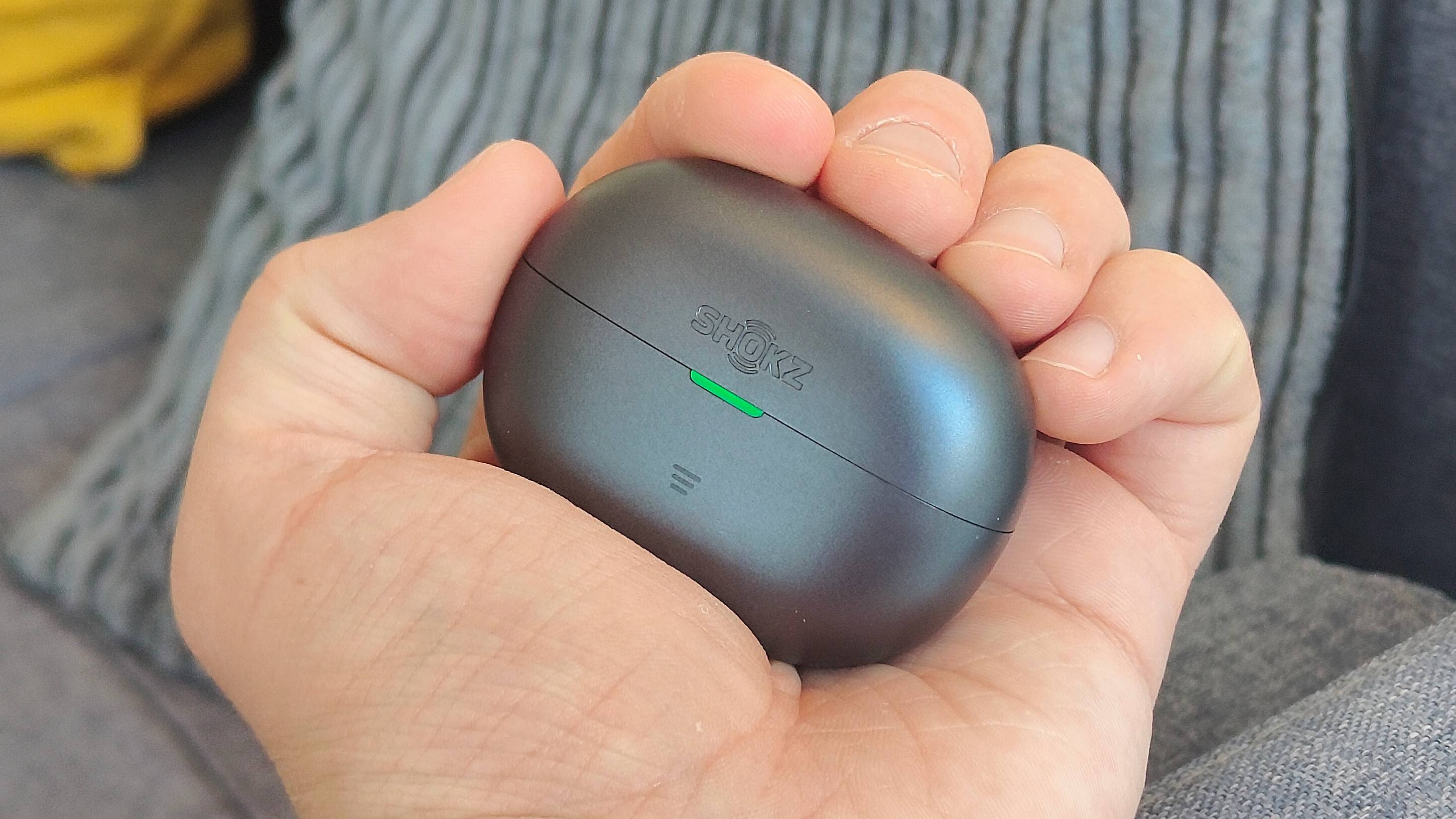
Portability is enhanced by the remarkably compact and lightweight charging case, weighing only 37.3g without the earbuds. The total package, including the earbuds, remains comfortably under 50g, allowing it to "disappear" effortlessly into pockets or small compartments within a gym bag. This emphasis on minimalist design extends to the charging mechanism, featuring a standard USB-C port. Intriguingly, Shokz opted to omit wireless charging capabilities and a dedicated Bluetooth pairing override button, features often found in more premium offerings. These omissions are likely strategic cost-saving measures, aligning with the Air’s budget-friendly positioning while still providing essential functionality. The available color options, black or purple, offer a subtle degree of personalization for users.
Audio Performance: Bass-Forward Sound for Open-Ear Listening
Shokz has consistently leveraged a specific audio architecture across its OpenDots line, and the OpenDots Air are no exception. They feature dual 11.8mm drivers, a configuration shared with both the OpenDots One and OpenDots 2. While Shokz remains somewhat enigmatic about the precise tuning and function of each driver, marketing materials frequently highlight "Bassphere," a term used to describe their two-driver system engineered to enhance low-end frequencies in an open-ear context. This proprietary approach aims to mitigate the inherent challenge of delivering robust bass in a design that doesn’t seal the ear canal.
In a move to differentiate the Air from its more expensive counterparts, Shokz has excluded certain premium audio enhancements. These include Dolby Atmos tuning for spatial audio, MirrorPitch technology (designed to direct sound more precisely into the ear), and Bassphere 2.0 (an upgraded version aimed at reducing distortion). Despite these omissions, the OpenDots Air deliver a surprisingly engaging audio experience for an open-ear product.
The sound profile is characterized by a clear distinction in the low-end, a notable achievement for earbuds that prioritize environmental awareness. Tracks like Brian Kelley’s Beach Cowboy and Kasabian’s Superpowers showcase a clean and well-defined bass that integrates harmoniously with higher-frequency sounds without overpowering them. This bass response is often a weak point for open-ear designs, and Shokz’s "Bassphere" technology appears to be effective in providing a more complete sound. The frequency response ranges from 100Hz to 40kHz, indicating a broad spectrum of audible sound reproduction, particularly strong in the upper registers.

However, it is important to manage expectations. The OpenDots