Google Expands Chrome Enterprise Healthcare Integrations to Secure Advanced Web-Based AI and Clinical Endpoints

The modern healthcare landscape is undergoing a profound digital transformation, characterized by the rapid integration of artificial intelligence (AI) and web-based clinical applications. Moving far beyond basic conversational interfaces, healthcare institutions are increasingly deploying autonomous AI agents capable of drafting clinical documentation, summarizing complex patient charts, navigating web applications, and executing multi-step administrative workflows on behalf of busy medical professionals. As electronic health records (EHRs) and mission-critical health systems migrate to the cloud and web-based environments, the browser has firmly established itself as the primary operational workspace. Within this digital ecosystem, clinicians, sensitive patient data, third-party applications, and advanced AI services intersect within a single session.
To address the intricate cybersecurity and data governance challenges introduced by this shift, Google has announced a significant expansion of its Chrome Enterprise healthcare integrations. Designed to support multi-vendor AI strategies—ranging from Google’s proprietary Gemini tools to a diverse array of web-based extensions and third-party models—these updates aim to fortify clinical endpoints, enforce strict Data Loss Prevention (DLP) policies, and streamline IT operations across healthcare systems globally. Building upon initial healthcare capabilities introduced earlier in the year, the latest wave of integrations brings robust enterprise-grade security to a wider array of clinical hardware, virtualized environments, and point-of-care workflows.
The Evolution of Clinical Workspaces and the Rise of Browser-Based AI Agents
For decades, healthcare IT infrastructure was dominated by siloed, on-premise client-server architectures. However, the operational pressures of modern medicine have driven a massive migration toward web-native platforms. Clinicians now spend the vast majority of their shifts inside web browsers, accessing disparate tools for diagnostic imaging, patient monitoring, laboratory reporting, and documentation.
This operational shift has been accelerated by the deployment of specialized AI agents. Unlike standard software programs, these agents actively assist clinical teams by automating routine yet time-consuming tasks. Whether an agent is synthesizing historical patient data into a concise summary or automatically completing multi-step form submissions, it operates directly within the browser session. Consequently, healthcare security teams face a complex challenge: they must grant these powerful tools sufficient access to function efficiently while maintaining absolute control over Protected Health Information (PHI) to comply with regulatory frameworks such as HIPAA.
Healthcare organizations rarely rely on a single technology vendor, frequently adopting a multi-vendor AI strategy to meet the diverse needs of different departments. Recognizing this flexibility, Google’s Chrome Enterprise Premium is engineered to secure data uniformly across various platforms and applications. By establishing a centralized governance and security layer, the browser acts as a protective perimeter, preventing unauthorized data exfiltration and ensuring that confidential medical records remain secure, regardless of the specific AI tool or browser extension being utilized by the clinician.
Strategic Partnerships and Endpoint Expansion
Securing the modern clinical environment requires seamless interoperability across diverse hardware configurations, ranging from shared workstations in bustling emergency departments to mobile nursing stations and specialized clinical carts. To meet these demands, Google has forged and expanded key technological partnerships with industry leaders in endpoint management and virtualization.
Integration with IGEL OS and the IGEL Marketplace
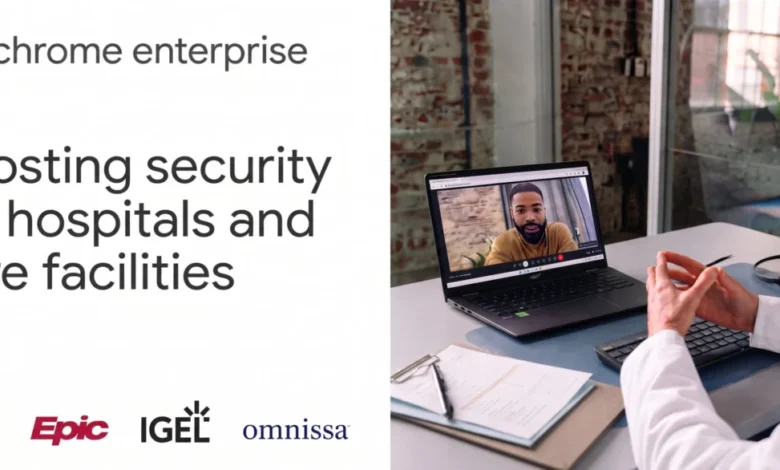
A primary milestone in the latest rollout is the compatibility of Chrome Enterprise with IGEL OS, alongside its upcoming availability in the IGEL Marketplace. This collaboration integrates Google’s enterprise-grade browser management and security frameworks with the IGEL Adaptive Secure Endpoint Platform.
IGEL OS provides an immutable, centrally managed endpoint foundation specifically designed to reduce the digital attack surface of healthcare facilities. By deploying Chrome Enterprise across IGEL OS endpoints—including high-turnover shared workstations and mobile clinical carts—healthcare IT departments can significantly simplify endpoint governance. Through the IGEL App Portal and the IGEL Universal Management Suite (UMS), organizations can streamline software deployment and enforce rigorous access controls. Simultaneously, the Google Admin console allows administrators to manage browser policies, extensions, and security protocols globally from a single dashboard.
Native Browsing for Flexible Clinical Endpoints via Citrix UniconOS
Expanding upon its long-standing collaboration with Citrix, Google has enabled healthcare systems to run Chrome Enterprise natively on Citrix UniconOS endpoints. This integration offers clinical staff a fast, familiar browsing experience across virtually any hardware device while providing IT administrators with an additional flexible deployment option. The result is an enhanced ability to deliver secure access and robust data protections across varied clinical environments without compromising user performance or system responsiveness.
Enhanced Device Trust Through Expanded Omnissa Collaboration
In the realm of virtual desktop infrastructure (VDI) and application delivery, many healthcare organizations rely on Omnissa Workspace ONE and Omnissa Horizon. Google’s expanded partnership with Omnissa brings zero-trust security architecture and device posture assessment directly to healthcare deployments. Building on foundational integrations established earlier in the year, healthcare IT systems can now verify the health and security compliance of endpoint devices before clinicians are granted access to critical applications and sensitive patient records. This proactive security measure ensures that compromised or unverified devices are automatically restricted from accessing internal networks.
Streamlining Point-of-Care Workflows Within Epic Environments
Beyond securing endpoints and managing browser-level security, administrative friction remains a significant contributor to clinician burnout. Recognizing this, Google has introduced specialized Chrome Enterprise capabilities tailored to optimize clinical workflows within major EHR platforms, most notably Epic Hyperspace for the web.
The latest updates include native support for silent printing and advanced PDF rendering tailored for Epic Hyperspace. In fast-paced clinical settings, the ability to securely and efficiently route essential patient orders, prescription labels, and identification wristbands directly to authorized, designated printers without unnecessary print-dialogue interruptions is critical.
Furthermore, the introduction of native PDF rendering ensures that sensitive documents remain strictly isolated within the active, managed browser session. This technical safeguard prevents documents from being inadvertently downloaded to unmanaged local file systems, thereby mitigating potential data leakage risks associated with local caching or unauthorized file sharing.
Chronology of Chrome Enterprise Healthcare Initiatives
To better understand the trajectory of Google’s healthcare strategy, a review of recent developments highlights a systematic effort to capture and secure the clinical market:
- May: Google introduces its initial set of healthcare-specific integrations for Chrome Enterprise, laying the groundwork for browser-based security and initial electronic health record compatibility.
- Interim Period: Continued software iteration focusing on AI agent governance, Data Loss Prevention (DLP) frameworks, and zero-trust verification models tailored to medical institutions.
- Current Rollout: Announcement of formal compatibility with IGEL OS, native integration with Citrix UniconOS, expansion of the Omnissa zero-trust partnership, and the introduction of advanced Epic Hyperspace workflow enhancements, including silent printing and isolated PDF rendering.
Background Context and Industry Implications
The healthcare sector has historically lagged behind finance and retail in adopting cloud-native technologies, largely due to stringent regulatory requirements and legitimate concerns regarding cybersecurity. Healthcare organizations remain prime targets for sophisticated ransomware attacks and data breaches, which can compromise patient safety and result in severe financial and legal penalties.
Simultaneously, healthcare providers face an unprecedented administrative burden. Studies consistently show that clinicians spend significant portions of their workdays managing electronic health records and completing documentation—time diverted away from direct patient care. The advent of generative AI and automated clinical assistants offers a promising solution to this crisis, but only if deployed within a secure, governed framework.
By positioning the browser as the central control plane, Google addresses the core tension between technological innovation and data security. Rather than attempting to secure every individual application or AI model separately, the browser-centric security model allows IT departments to enforce uniform policies regardless of whether a clinician is accessing an on-premise application, a cloud-hosted EHR, or an experimental AI drafting tool.
Industry analysts note that this approach significantly lowers the barrier to entry for healthcare systems wishing to adopt modern, cloud-based tools. By partnering with established enterprise infrastructure providers like IGEL, Citrix, and Omnissa, Google ensures that its security solutions integrate smoothly into existing IT management pipelines, minimizing the need for disruptive and costly infrastructure overhauls.
Official Responses and Strategic Outlook
While specific executive commentary from partner organizations underscores a shared commitment to seamless interoperability, the overarching strategic objective remains clear: empowering healthcare systems to embrace digital transformation with absolute confidence.
As healthcare institutions continue to scale their deployment of enterprise AI solutions—such as Gemini and other third-party web-based applications—the demand for unified security, robust data loss prevention, and centralized governance will only intensify. Chrome Enterprise provides the foundational infrastructure necessary to meet these demands, ensuring that patient data remains protected while care teams are equipped with the modern, efficient tools required to deliver high-quality medicine.
Healthcare IT and security leaders looking to modernize their clinical environments can explore the newly available Chrome Enterprise features directly through the IGEL Marketplace, review integration documentation for Epic workflows, or consult with Google’s enterprise health solutions specialists to design deployment strategies tailored to their specific operational requirements.
Related posts: