AWS Elastic Beanstalk Unveils Fully Managed Cluster Mode Powered by Amazon EKS to Streamline Microservices Management

Fifteen years after its initial debut transformed cloud architecture by allowing developers to focus strictly on business logic rather than infrastructure operations, Amazon Web Services (AWS) has announced the next major evolution of its flagship application management platform. AWS Elastic Beanstalk has officially launched a fully managed Cluster Mode, introducing a unified operational engine that leverages Amazon Elastic Kubernetes Service (Amazon EKS) to orchestrate modern microservices portfolios at scale. This milestone release addresses the growing complexity of distributed application management, offering organizations a way to run multiple applications across shared, highly secure, and efficiently utilized infrastructure.
The announcement marks a significant modernization chapter for a service that has maintained the trust of enterprise developers since 2011. While the original Elastic Beanstalk architecture simplified deployments for monolithic and single-stack applications running on languages such as Java, .NET, Python, Node.js, PHP, Ruby, and Go, the modern enterprise ecosystem has shifted dramatically toward containerization, microservices, and Kubernetes-based orchestration. The new Cluster Mode bridges the gap between the legendary simplicity of Beanstalk and the immense power of Kubernetes, enabling engineering teams to deploy, scale, patch, monitor, and upgrade complex workloads continuously for the life of the workload without requiring specialized expertise in native Kubernetes cluster administration.
A Decade and a Half of Operational Evolution
To understand the weight of this release, one must examine the trajectory of AWS Elastic Beanstalk. Launched in an era when cloud deployment often required exhaustive manual configuration of servers, load balancers, and scaling groups, Beanstalk acted as a pioneering Platform-as-a-Service (PaaS). It abstracted away the heavy lifting of infrastructure provisioning, allowing startups and enterprises alike to push code and let AWS manage the underlying plumbing.
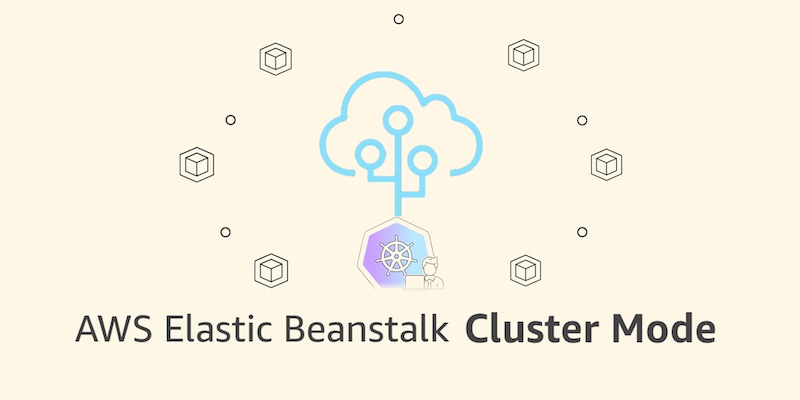
Over the past fifteen years, however, application architectures have evolved from monolithic deployments to distributed systems composed of dozens or hundreds of interacting microservices. While container technologies like Docker and orchestration platforms like Kubernetes solved the packaging and scaling problems of microservices, they introduced a steep learning curve and substantial operational overhead. Teams frequently found themselves spending significant engineering hours managing Kubernetes control planes, configuring ingress controllers, setting up observability pipelines, and managing security patches across disparate clusters.
Recognizing these friction points, AWS embarked on an ambitious journey to rebuild the operational engine beneath Elastic Beanstalk. Over the preceding months and years, the platform rolled out a succession of advanced capabilities designed to modernize the user experience. These included AI-powered environment analysis to diagnose runtime health issues and recommend automated fixes, official GitHub Action integrations for seamless CI/CD execution via simple YAML configurations, and robust infrastructure foundations built around OpenTelemetry-based observability. Furthermore, AWS integrated traffic-splitting deployments with automatic rollbacks, event-driven autoscaling, centralized secrets management via AWS Secrets Manager, and HTTPS by default through AWS Certificate Manager.
The introduction of Cluster Mode is the culmination of this multi-year engineering effort, fusing the platform’s signature ease-of-use with the enterprise-grade scalability of Amazon EKS.
Core Architecture and Mechanics of Cluster Mode
The newly released Cluster Mode is engineered specifically for organizations managing a portfolio of applications rather than isolated workloads. In traditional cloud environments, operating multiple applications often necessitates provisioning separate infrastructure stacks for each service, leading to resource fragmentation, underutilized compute capacity, and administrative bloat.

With Cluster Mode, multiple applications share a unified infrastructure baseline powered by Amazon EKS. Because workloads share underlying computational resources, per-application infrastructure costs decrease proportionally as the application portfolio expands, all without adding operational complexity. Whether an engineering organization manages ten distinct applications or a hundred microservices, administrators oversee them through a single, cohesive management experience, ensuring consistent operational guarantees across every deployed stack.
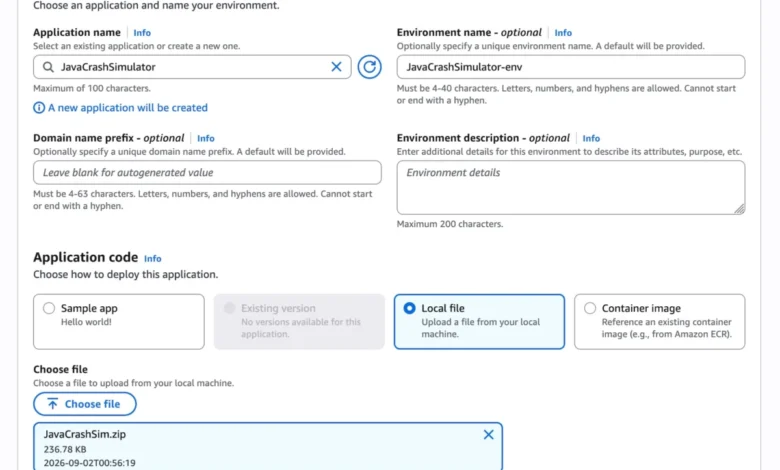
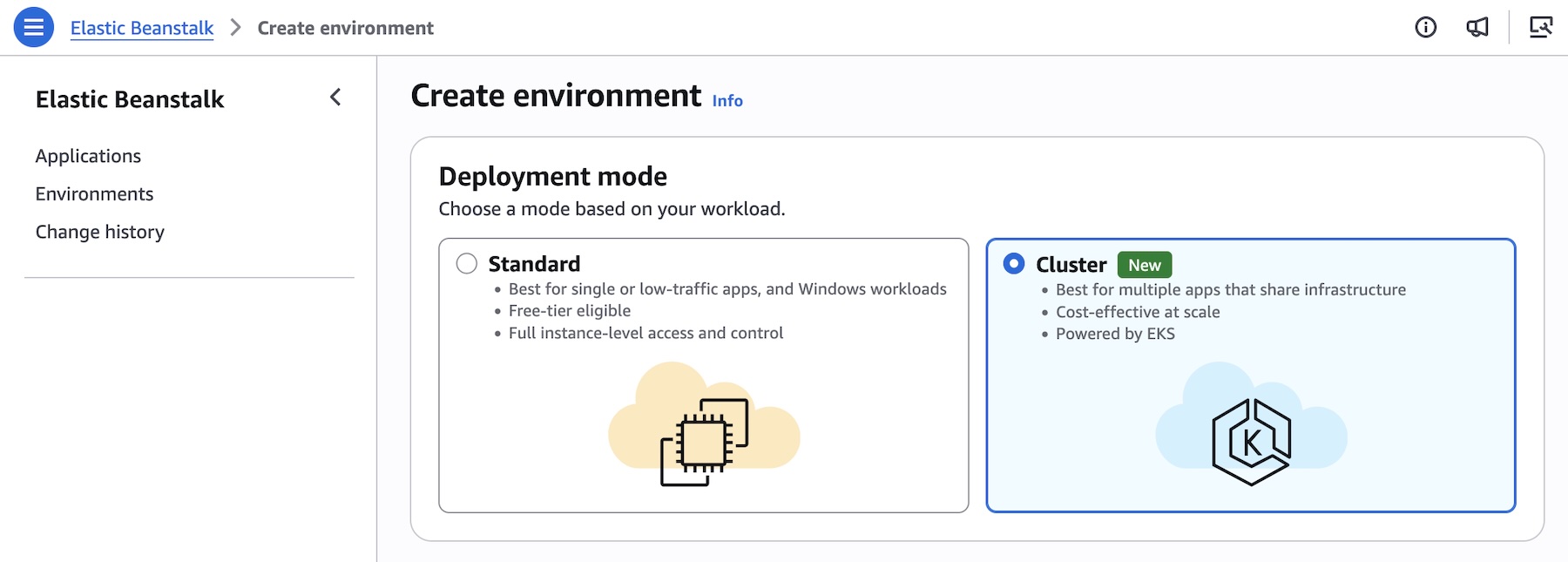
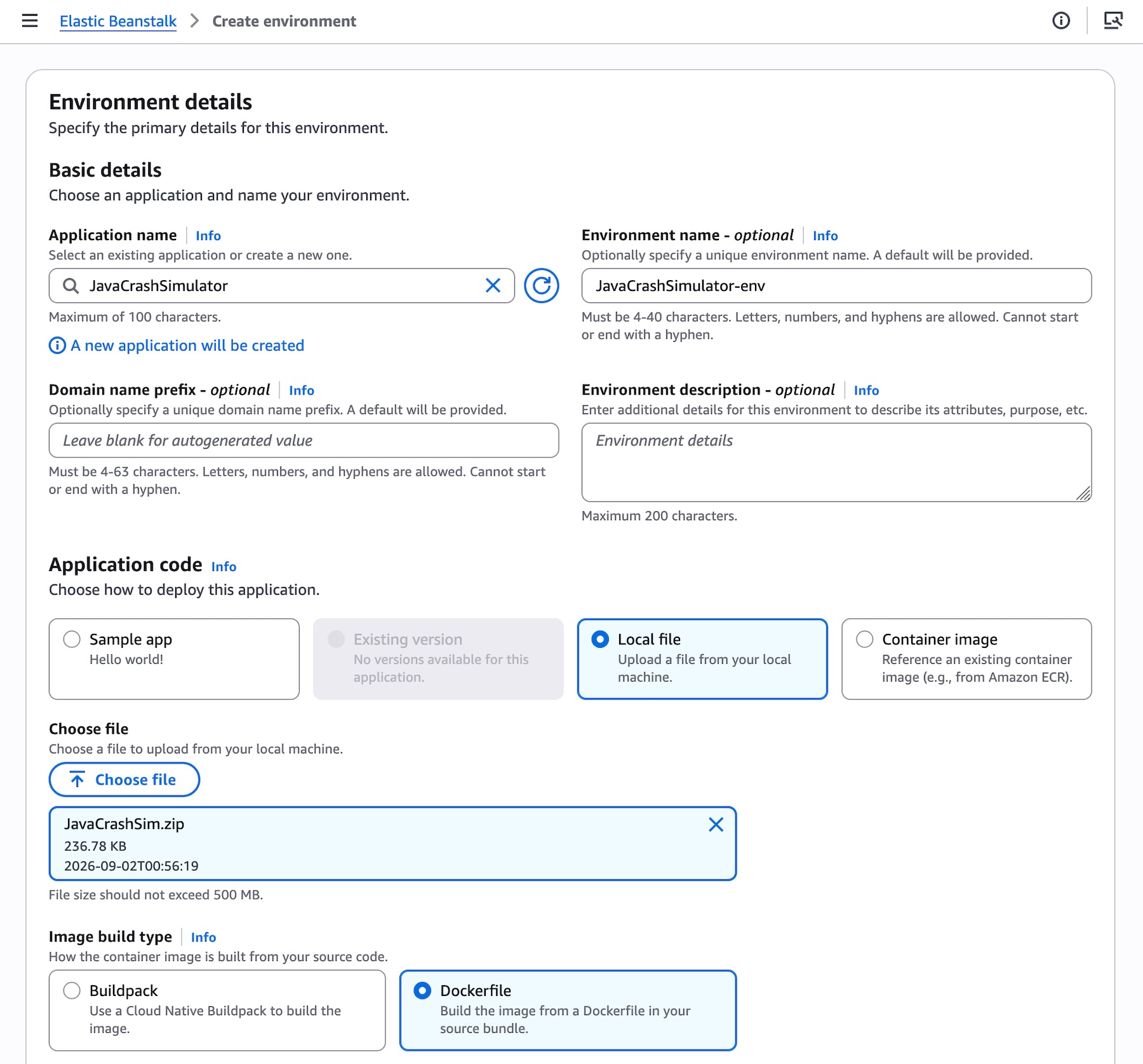
Getting started with Cluster Mode requires minimal configuration. Within the AWS Elastic Beanstalk console, developers create a new environment and select "Cluster" under the "Deployment type" parameter. Elastic Beanstalk accommodates raw source code, custom Dockerfiles, or pre-built container images. For instance, developers can supply local application source files while defining container image build parameters directly through the console interface.
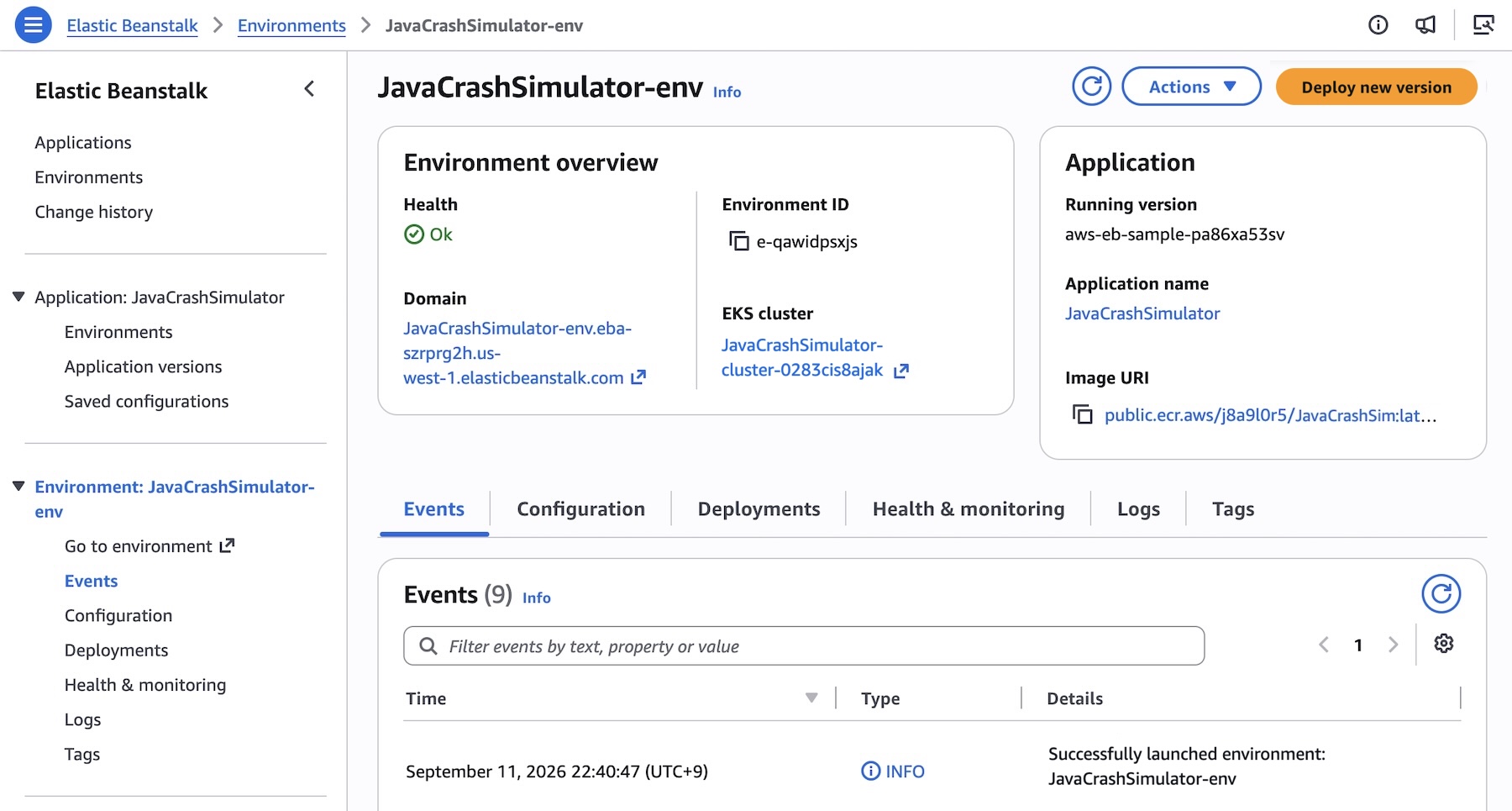
Upon clicking create, the underlying platform initiates the deployment sequence. For a fresh set of subnets, the initial deployment triggers the automated creation of an underlying EKS cluster—a provisioning process that typically requires approximately ten minutes. Subsequent deployments execute significantly faster because they intelligently reuse the established EKS cluster, streamlining continuous delivery pipelines.
Comprehensive CLI and SDK Support for Advanced Workflows
Beyond the graphical AWS Management Console, Elastic Beanstalk Cluster Mode offers comprehensive integration with the AWS Command Line Interface (AWS CLI), the specialized EB CLI, and native AWS Software Development Kits (SDKs). This programmatic flexibility allows platform engineering teams to codify infrastructure provisioning and embed deployments directly into automated CI/CD pipelines.
Consider a multi-service microservices architecture comprising a frontend interface, a shopping cart service, a payment processing module, and a shipping tracker. Engineering teams can instantiate the primary application via the AWS CLI:
aws elasticbeanstalk create-application
    --application-name "my-microservice"
    --description "Multi-services demo"
Pre-built container images residing in Amazon Elastic Container Registry (Amazon ECR) can then be registered as distinct application versions through an automated scripting workflow:
IMAGES=(
    "frontend-v1|public.ecr.aws/my-microservices/frontend:v1"
    "cartservice-v1|public.ecr.aws/my-microservices/cart:v1"
    "paymentservice-v1|public.ecr.aws/my-microservices/payment:v1"
    "shippingservice-v1|public.ecr.aws/my-microservices/shippings:v1"
)

for entry in "$IMAGES[@]"; do
    IFS='|' read -r label uri <<< "$entry"
    aws elasticbeanstalk create-application-version
        --application-name "my-microservice"
        --version-label "$label"
        --image-configuration Source="Uri=$uri"
        --region "us-west-2"
    echo "Registered: $label"
done
Configuration namespaces allow administrators to tailor individual service parameters precisely. For example, a public-facing frontend service requires an internet-facing Application Load Balancer (ALB) and an HTTP health check path, whereas internal microservices can remain isolated within the cluster network. A representative configuration file (frontend-options.json) defines these operational boundaries:
[
    "Namespace": "aws:elasticbeanstalk:eks", "OptionName": "cluster-role", "Value": "arn:aws:iam::0123456789012:role/EKSClusterRole",
    "Namespace": "aws:elasticbeanstalk:eks", "OptionName": "node-role", "Value": "arn:aws:iam::0123456789012:role/EKSNodeRole",
    "Namespace": "aws:elasticbeanstalk:eks:environment", "OptionName": "observability-role", "Value": "arn:aws:iam::0123456789012:role/ObservabilityRole",
    "Namespace": "aws:elasticbeanstalk:eks:environment", "OptionName": "subnets", "Value": "subnet-1,subnet-2,subnet-3",
    "Namespace": "aws:elasticbeanstalk:eks:environment:autoscaling", "OptionName": "min-replica", "Value": "1",
    "Namespace": "aws:elasticbeanstalk:eks:environment:autoscaling", "OptionName": "max-replica", "Value": "2",
    "Namespace": "aws:elasticbeanstalk:eks:environment", "OptionName": "cpu", "Value": "0.5",
    "Namespace": "aws:elasticbeanstalk:eks:environment", "OptionName": "memory", "Value": "256Mi",
    "Namespace": "aws:elasticbeanstalk:eks:environment", "OptionName": "memory-limit", "Value": "512Mi",
    "Namespace": "aws:elasticbeanstalk:eks:environment", "OptionName": "service-port", "Value": "8080",
    "Namespace": "aws:elasticbeanstalk:eks:alb", "OptionName": "scheme", "Value": "internet-facing",
    "Namespace": "aws:elasticbeanstalk:eks:alb", "OptionName": "healthcheck-path", "Value": "/_healthz"
]
Executing the environment creation command binds the registered version to the cluster tier:
aws elasticbeanstalk create-environment
    --application-name my-microservice
    --environment-name frontend
    --version-label frontend-v1
    --tier Name=Cluster,Type=EKS
    --option-settings file:///tmp/frontend-options.json
Coexistence with Standard Mode and Migration Pathways
Recognizing that enterprise architectures rarely transition overnight, AWS has structured Cluster Mode to operate in harmony with existing paradigms. Elastic Beanstalk Standard Mode, powered by Amazon Elastic Compute Cloud (EC2), remains fully supported and robustly maintained.
Importantly, Standard Mode and Cluster Mode environments can run side by side within the exact same Elastic Beanstalk application construct. This architecture empowers engineering organizations to execute gradual, risk-mitigated migrations, shifting one microservice or environment to Cluster Mode at their own operational pace. Built-in validation checks automatically verify compatibility before any modification is applied, ensuring that legacy workloads are never forcibly disrupted or prematurely deprecated.
Standard Mode continues to serve as an optimal deployment vehicle for traditional monolithic web applications, persistent filesystem-dependent workloads, and environments requiring direct, unabstracted host-level access to EC2 instances. Meanwhile, Cluster Mode addresses the demands of modern, stateless, containerized microservices requiring dynamic horizontal scaling and rapid deployment cycles.
Availability, Pricing Structure, and Industry Implications
AWS Elastic Beanstalk Cluster Mode is generally available starting today across all commercial AWS Regions where Elastic Beanstalk is currently supported. Developers seeking detailed Regional availability maps, API specifications, and troubleshooting playbooks can leverage the AWS MCP Server and associated plugins integrated with their preferred artificial intelligence development tools.
In alignment with AWS transparent cost principles, there is no additional platform surcharge levied for utilizing Elastic Beanstalk Cluster Mode. Customers incur charges exclusively for the underlying AWS resources consumed by their applications. These costs encompass the standard Amazon EKS control plane fee, EKS Auto Mode compute resources (which carry an approximate 12% premium on underlying EC2 instance costs), Amazon ECR storage and transfer fees, and Amazon CloudWatch monitoring telemetry. Platform architects should note that Elastic Beanstalk Cluster Mode is not eligible for the AWS Free Tier. Detailed pricing breakdowns are accessible via the official AWS Elastic Beanstalk Pricing portal.
Industry analysts view the release of Cluster Mode as a strategic move by AWS to capture organizations caught in the "Kubernetes complexity trap." While native Kubernetes offers unmatched orchestration power, the operational burden of maintaining raw manifests, Helm charts, and cluster security often overwhelms development teams whose primary value proposition lies in building application logic rather than infrastructure plumbing. By encapsulating Amazon EKS within the familiar, highly automated management wrapper of Elastic Beanstalk, AWS has effectively lowered the barrier to entry for enterprise-grade container orchestration.
As enterprises continue accelerating their cloud-native modernization journeys, innovations like Elastic Beanstalk Cluster Mode demonstrate how cloud providers are shifting the burden of operational toil away from developers. By combining the governance and security of Kubernetes with the hands-off lifecycle management of a fully managed service, AWS has established a new benchmark for application management in the modern enterprise landscape.
Related posts: