The Illusion of Pilot Success
In the current enterprise landscape, generative AI initiatives are often treated as isolated R&D projects rather than integrated components of business operations. Organizations frequently launch pilots with limited scope, tracking "vanity metrics" such as the total number of prompts submitted or the frequency of tool usage. While these metrics may look positive in a quarterly summary, they fail to account for the "production gap"—the discrepancy between a controlled environment and the messy, unpredictable reality of corporate workflows.
The common pattern of failure begins when initial enthusiasm wanes as leadership realizes that the "time saved" by an AI tool does not directly translate into cost reduction or revenue growth. Without a rigorous framework to track return on investment (ROI), these initiatives risk being relegated to the category of "innovation theater," where capital is spent without achieving sustainable productivity gains.
Defining the ROI Framework
To move past the pilot phase, organizations must shift their focus from the technology itself to the "workflow"—the repeatable, value-producing sequence of human and automated tasks. Dr. Adnan Masood, an expert in AI strategy and engineering, advocates for treating ROI as a strict accounting problem with well-defined boundaries.

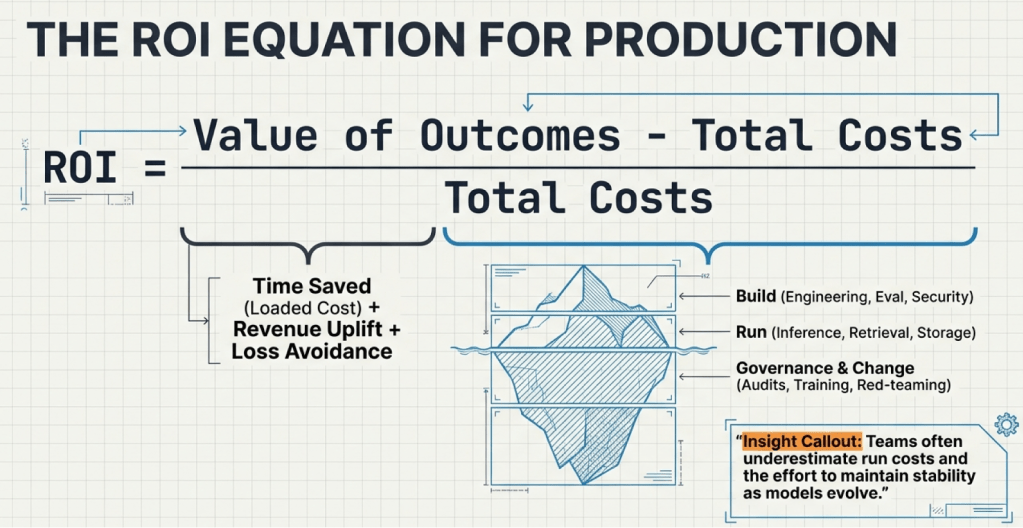
The proposed ROI equation is foundational:
ROI = (Value of Outcomes – Total Costs) / Total Costs
The "Value of Outcomes" is not merely anecdotal; it must be quantified through time savings multiplied by labor costs, revenue uplift, and the mitigation of financial loss (risk avoidance). Conversely, "Total Costs" is a comprehensive figure that must account for:
- Build Costs: Engineering labor, platform development, security hardening, and integration with legacy systems of record.
- Run Costs: Real-time inference fees, retrieval-augmented generation (RAG) storage, continuous monitoring, and incident response.
- Governance Costs: The often-overlooked expenses associated with audits, red-team security testing, and maintaining compliance with evolving AI policies.
- Change Management Costs: The human-centric expenses of retraining staff and redesigning workflows to accommodate AI-augmented roles.
Chronology of an AI Initiative
The lifecycle of a successful generative AI deployment typically follows a structured, three-phase chronology:
- Phase 1: Baseling (Weeks 1–4): Before any AI tool is introduced, teams must establish a baseline. This involves measuring current performance in specific workflows—such as ticket resolution time in support or cycle time in engineering—under normal conditions. This baseline provides the necessary contrast to determine if the AI is truly improving efficiency or merely shifting the workload.
- Phase 2: Controlled Integration (Weeks 5–8): The AI tool is deployed to a specific cohort, while a control group continues to work using traditional methods. This allows for direct comparison and prevents noise from external variables.
- Phase 3: Operationalization (Weeks 9–12): The system is moved into production, with constant monitoring of both model performance and financial burn rates.
Metrics Stack: Connecting Activity to Outcomes
A robust AI strategy requires a multi-layered metrics stack. Organizations should track data at four distinct levels:

- Activity Metrics: Basic usage stats (e.g., how many times the tool was accessed).
- Interaction Metrics: How users engage with the tool (e.g., acceptance vs. rejection rates of AI-generated suggestions).
- Workflow Metrics: The actual time or effort required to complete a business task.
- Outcome Metrics: The final business result, such as customer satisfaction scores or defect escape rates.
Failure to link these layers is a common error. For instance, high activity metrics coupled with stagnant outcome metrics suggest that the AI tool is being used, but it is not actually improving the quality or speed of work.
Strategic Selection of Use Cases
Not all business processes are suitable for generative AI. To maximize ROI, leaders should prioritize use cases that exhibit "operational leverage." These are processes that are high-volume, repetitive, and already governed by existing internal policies. Examples include IT security triage, where AI can assist in parsing logs, or legal document review, where the model can highlight discrepancies in contracts. By selecting use cases with existing documentation and clear success metrics, organizations can reduce the "governance friction" that often slows down production rollouts.
The Role of Human-in-the-Loop
A critical component of successful adoption is the design of the user interface. If an AI assistant requires a user to switch contexts, open a new browser tab, or navigate a separate dashboard, adoption will inevitably lag. The most successful implementations embed the AI directly into the existing workflow, such as inside a CRM for sales or a ticketing system for support.
Furthermore, training must be role-specific. Generic "how-to" manuals are rarely effective. Instead, providing playbooks that mirror the specific daily tasks of a role—with clear examples of when to trust the AI and when to override it—ensures that the human remains in control of the final decision.
Common Failure Modes and Mitigation
Industry data suggests that most AI initiatives stall due to a few predictable errors:
- Underestimating Run Costs: As models scale, inference costs can balloon, quickly outstripping the value generated by the tool.
- Ignoring Data Drift: Over time, as external data sources evolve, the accuracy of the model can degrade. Without automated evaluation, the quality of outputs may silently slip, leading to downstream errors.
- Lack of Feedback Loops: Failing to implement simple mechanisms for users to "thumbs up" or "thumbs down" results deprives the engineering team of the data needed to refine the model.
A 90-Day Path to Production
For teams looking to transition from pilot to production, a 90-day roadmap is essential. During the first 30 days, the focus should be on defining the workflow and establishing the baseline. Days 30–60 should be dedicated to a pilot with a small, controlled group and the implementation of instrumentation for outcome measurement. Days 60–90 should focus on calculating the full lifecycle costs, refining the model based on user feedback, and finalizing the governance documentation required for a full-scale rollout.
Implications for Enterprise Strategy
The shift toward "ROI-first" generative AI is indicative of a broader maturation in the technology sector. The initial "hype cycle" is giving way to a more disciplined approach where AI is treated as a piece of enterprise infrastructure rather than a novelty. For CIOs and CTOs, the implications are clear: the era of "experimentation for the sake of experimentation" is ending.
The future belongs to organizations that can bridge the gap between AI’s probabilistic nature and the deterministic requirements of business operations. By grounding AI strategy in financial reality, rigorous measurement, and a deep understanding of human-machine collaboration, enterprises can move beyond the pilot phase and capture sustainable value in an increasingly competitive, AI-enabled economy. The transition requires patience, precision, and a relentless focus on the outcomes that define business success.
Related posts: