The advent of robust version rollback functionality for Kubernetes control planes within Amazon Elastic Kubernetes Service (Amazon EKS) marks a significant milestone in simplifying cluster management and enhancing operational resilience for organizations worldwide. This new feature, now generally available, directly addresses a long-standing challenge in the Kubernetes ecosystem: the irreversible nature of control plane upgrades, which has historically necessitated complex, time-consuming, and often risk-averse operational strategies.
Historically, the open-source Kubernetes project has lacked native support for control plane rollbacks. Once an upgrade was performed, reverting to a previous version was not a straightforward operation. While community efforts, such as Kubernetes Enhancement Proposal (KEP) 4330 introducing emulated versions, have aimed to mitigate this, the practical implications for production environments have remained substantial. Organizations have had to implement elaborate compensating mechanisms, including extended bake periods, staggered rollout groups, automated sign-off processes, and multi-month upgrade cycles. These measures, while designed to ensure stability, often lead to delayed adoption of new Kubernetes versions, potentially leaving clusters vulnerable to security threats and missing out on performance enhancements and new features. The typical release cadence of three minor Kubernetes versions per year further exacerbates this challenge, particularly for entities managing hundreds or thousands of clusters, especially those operating under strict regulatory compliance mandates. The fear of an unrecoverable failed upgrade has frequently led to the decision to delay upgrades indefinitely, creating technical debt and increasing operational risk as clusters fall out of supported maintenance windows.
Amazon EKS Version Rollback, however, fundamentally alters this paradigm. This new capability provides EKS cluster administrators with a critical safety net, enabling them to reverse a Kubernetes version upgrade within a seven-day window. This allows for the restoration of a cluster to its previous, functional state, offering a crucial "undo" button for critical infrastructure operations. Unlike approaches that maintain a cluster in a transitional or emulated state, EKS version rollback returns the cluster to a fully validated previous version that was actively running in production. This means that if an upgrade from, for instance, Kubernetes 1.34 to 1.35 introduces unexpected compatibility issues or application failures, administrators can seamlessly roll back to 1.34 without the arduous task of rebuilding the cluster or engaging in high-pressure troubleshooting under duress.
A Detailed Look at the Rollback Process
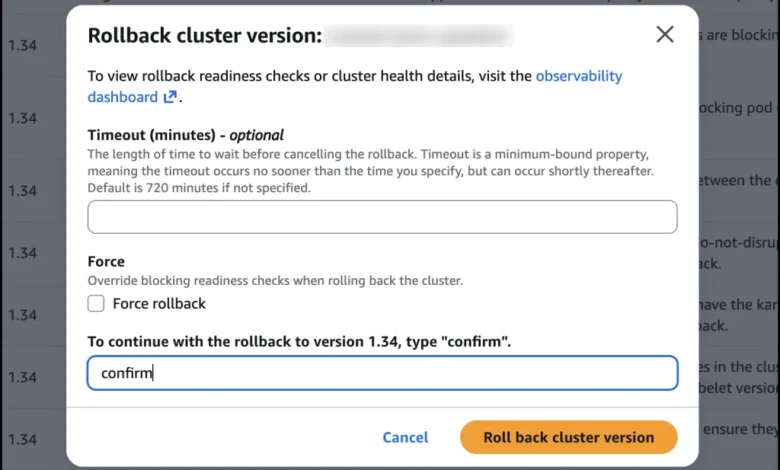
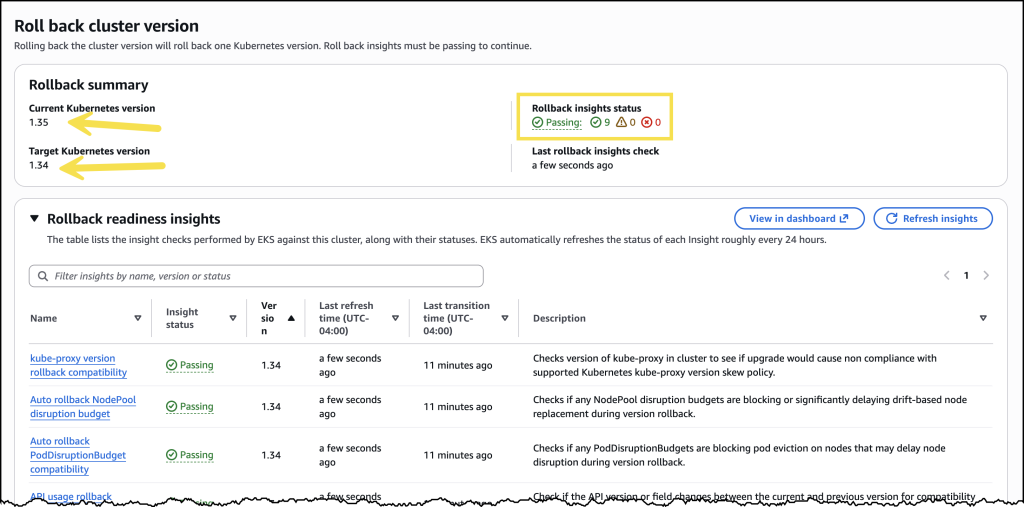
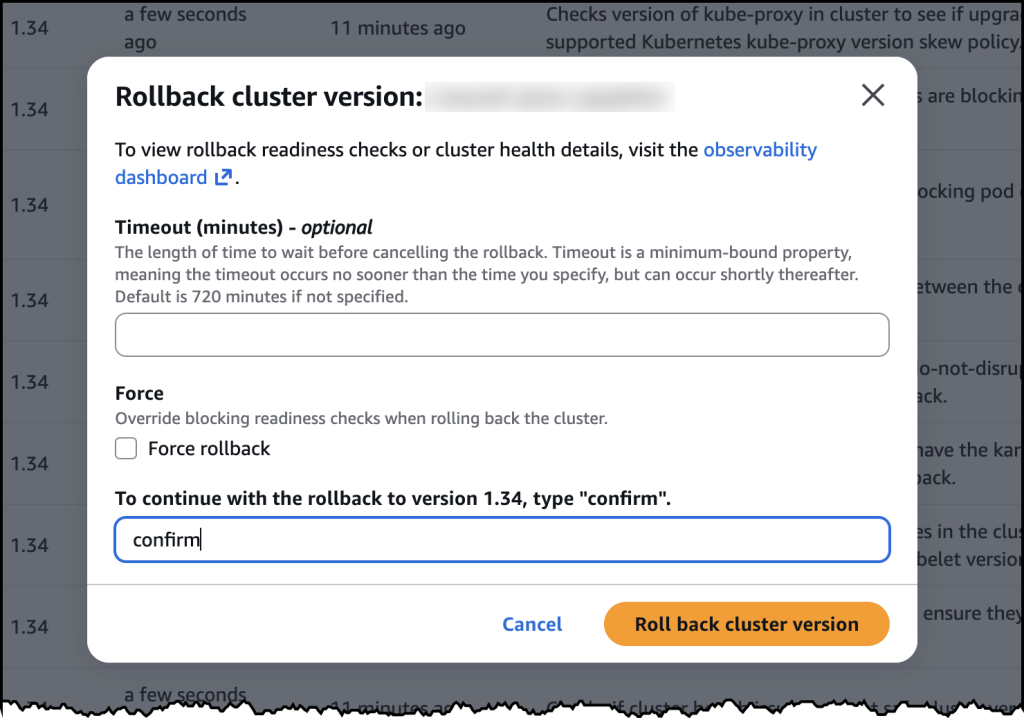
The EKS version rollback feature is designed with incremental and controlled operations in mind, mirroring the same phased approach EKS employs for upgrades. The feature supports rolling back one minor version at a time, ensuring a manageable and predictable transition. To facilitate safe rollbacks, Amazon EKS proactively assesses a cluster’s readiness for rollback. This is achieved through an integrated evaluation of cluster insights, which meticulously flag potential issues such as node version compatibility or add-on dependencies before an administrator proceeds with the rollback initiation. This pre-flight check is crucial for preventing unintended consequences and ensuring a smooth transition. For administrators who have already assessed the situation and require a swift resolution, a --force flag is available, allowing them to bypass these automated checks and expedite the rollback process. This comprehensive approach applies to all EKS clusters, irrespective of whether nodes are self-managed or managed by AWS.
Enhancements for EKS Auto Mode
For customers who have adopted EKS Auto Mode, a fully managed infrastructure solution that offers one-click deployment of production-ready Kubernetes clusters by automating compute, networking, and storage management, the rollback process incorporates additional considerations. In EKS Auto Mode, both the control plane and the managed nodes must be rolled back in tandem. Acknowledging that node rollbacks are inherently tied to pod disruption budgets (PDBs), the process can naturally take time, dependent on the specific configuration and PDB settings.

To provide administrators with granular control over this potentially time-consuming process, EKS has introduced a cancel API. This API allows users to halt a node rollback at any point during its execution. If an administrator determines that the rollback is taking longer than anticipated or decides to pivot their strategy, they can leverage the cancel API to stop the ongoing process. This enables them to adjust their disruption budgets to accelerate subsequent operations or to pursue an entirely different course of action.
Crucially, Amazon EKS prioritizes workload stability. By default, the service never bypasses customer-defined disruption budgets during a rollback. This ensures that application availability is maintained to the greatest extent possible. However, administrators retain the flexibility to modify or remove their disruption budgets if they deem it necessary to speed up the rollback process.
A Practical Demonstration
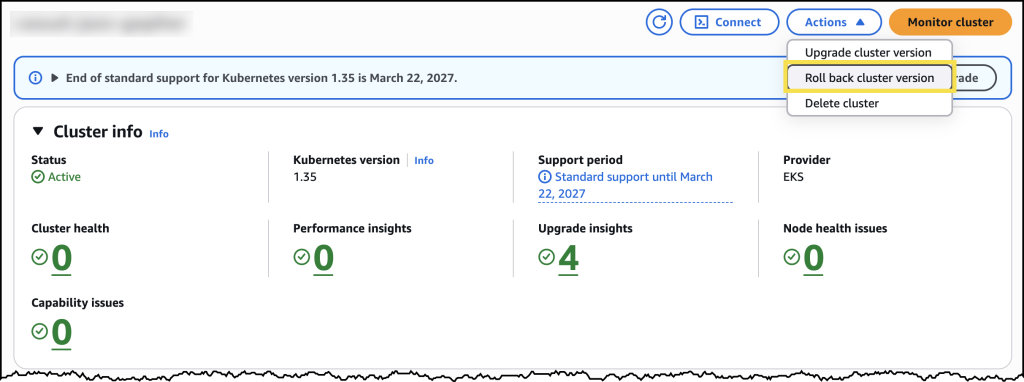
To illustrate the functionality, a walkthrough of the rollback process was performed within the Amazon EKS console. Upon navigating to a cluster that had recently undergone an upgrade, the option to initiate a version rollback was readily apparent. The console also provided essential information regarding the current rollback window, a critical parameter for understanding the timeframe within which a rollback is possible.
Before commencing the rollback, a review of the rollback insights was conducted. These insights offered a clear status of the cluster’s nodes and highlighted any potential issues that required attention prior to proceeding. This proactive feedback loop is instrumental in preventing unexpected complications.
Upon confirmation, the rollback process was initiated. Throughout the duration, the cluster remained fully operational, underscoring the non-disruptive nature of the control plane rollback. The control plane rollback itself took approximately 20 minutes, a duration comparable to that of a standard upgrade. For the EKS Auto Mode cluster, the node rollbacks were observed to proceed gracefully, adhering strictly to the configured pod disruption budgets.
Availability and Cost Implications
Kubernetes version rollbacks for Amazon EKS are available starting today at no additional cost. This capability is accessible in all commercial AWS Regions where Amazon EKS is offered. Customers will only incur standard EKS and compute costs, with no supplementary charges for utilizing the rollback feature.
Control plane rollbacks are universally available for all EKS clusters. Node rollbacks, specifically, are supported for clusters operating under EKS Auto Mode. The version rollback functionality is compatible with clusters running Kubernetes versions that are within Amazon EKS’s standard support and extended support timelines.
Organizations interested in leveraging this new capability can find comprehensive guidance in the Amazon EKS documentation or can directly access and experiment with the feature through the Amazon EKS console.
Broader Impact and Analysis
The introduction of Kubernetes version rollbacks in Amazon EKS represents a significant step forward in democratizing robust cluster management for a wider audience. By removing the fear of irreversible upgrade failures, this feature empowers organizations of all sizes, from startups to large enterprises, to adopt newer Kubernetes versions more readily. This, in turn, allows them to benefit from the latest security patches, performance optimizations, and innovative features, ultimately fostering a more secure and agile operational environment.
The implications for regulated industries are particularly profound. Environments with stringent compliance requirements often face significant hurdles in adopting new software versions due to the need for extensive validation and the high cost of potential failures. The rollback capability drastically reduces this friction, enabling these organizations to maintain compliance while staying current with critical security updates and platform enhancements.
Furthermore, the integration with EKS Auto Mode and the provision of a cancel API demonstrate AWS’s commitment to providing flexible and user-centric management tools. The ability to control the pace of node rollbacks and the option to override default settings offers a level of operational autonomy that is highly valued in complex production scenarios. This feature is not merely a convenience; it is a strategic enhancement that directly contributes to reduced operational overhead, minimized downtime, and improved overall system stability within the Kubernetes ecosystem. As the adoption of Kubernetes continues to surge across industries, the EKS version rollback feature is poised to become an indispensable tool for ensuring confident and efficient cluster lifecycle management.
Related posts: