The landscape of artificial intelligence is undergoing a significant architectural shift as the industry moves away from centralized, server-heavy processing toward decentralized, client-side execution. For years, deploying state-of-the-art transformer models required maintaining complex Python-based server environments, managing expensive GPU clusters, and navigating the latency issues inherent in routing every inference request through an external API. This traditional architecture, while necessary for the massive Large Language Models (LLMs) of the past, created significant barriers for developers regarding cost, privacy, and offline functionality. The emergence of Transformers.js, a library designed by Hugging Face, has effectively dismantled these barriers by allowing high-performance Natural Language Processing (NLP) models to run directly within the user’s web browser.
The Technical Evolution of Browser-Based AI
The transition of transformer models to the browser is not merely a change in programming language from Python to JavaScript; it represents a fundamental optimization of how neural networks interact with consumer hardware. At the core of Transformers.js is the ONNX Runtime (Open Neural Network Exchange), a cross-platform accelerator for machine learning models. By converting models trained in PyTorch or TensorFlow into the ONNX format via the Hugging Face Optimum library, developers can now execute these models using WebAssembly (WASM) or WebGPU.
Historically, the timeline of NLP has been defined by increasing model size. From the introduction of BERT in 2018 to the massive scale of GPT-4, the assumption was that "bigger is better" and "local is impossible." However, the 2023-2024 period marked a pivot toward "Small Language Models" (SLMs) and efficient quantization. Transformers.js leverages these trends, allowing models to be downloaded once, cached locally, and executed without a persistent internet connection. This "download once, run anywhere" model is facilitated by 4-bit and 8-bit quantization, which reduces model file sizes by up to 75% while maintaining nearly the same level of accuracy as their full-precision counterparts.
Performance Data and Hardware Acceleration
The efficiency of Transformers.js is heavily dependent on the underlying execution provider. According to industry benchmarks, running models via WebAssembly (WASM) provides a universal baseline that works on virtually any modern browser, including mobile devices. However, the introduction of the WebGPU API has revolutionized performance. WebGPU allows the browser to tap directly into the device’s graphics processing unit, offering a significant speedup for the parallel computations required by transformers.
In practical testing, an 8-bit quantized DistilBERT model—a common choice for sentiment analysis—can process a standard paragraph of text in under 100 milliseconds on a modern laptop using WASM. When WebGPU is enabled, this latency can drop even further, rivaling the performance of dedicated Python environments. This makes real-time applications, such as live translation or interactive document analysis, viable without the overhead of round-trip API calls.
Core Analytical Capabilities: The Pipeline API
The library mirrors the Hugging Face Python "pipeline" API, providing a high-level abstraction that handles tokenization, model execution, and post-processing in a single call. This design choice has been widely praised by the developer community for lowering the entry barrier to AI integration. Three primary tasks currently define the practical utility of the library:
1. Text Classification and Sentiment Analysis
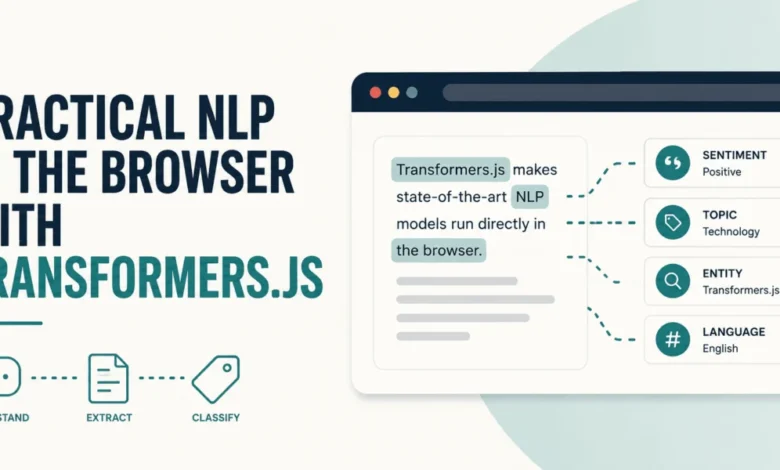
Text classification remains the "bread and butter" of NLP. By assigning labels and confidence scores to input text, businesses can automate the monitoring of customer feedback and social media mentions. The Transformers.js implementation allows for batch processing, where multiple strings are analyzed simultaneously. This is particularly useful for dashboards that need to categorize large volumes of local data without compromising user privacy.
2. Zero-Shot Classification
Perhaps the most versatile tool in the library, zero-shot classification, allows models to categorize text into labels that were not part of the original training set. Using Natural Language Inference (NLI), the model treats each candidate label as a hypothesis (e.g., "This text is about technical support") and determines the probability of that hypothesis being true. This removes the need for developers to collect and label massive datasets for specific niche categories, enabling rapid prototyping of routing systems and content filters.
3. Extractive Question Answering
Unlike generative AI, which creates new text and is prone to "hallucinations," extractive question-answering models locate the specific answer within a provided context. This is a critical distinction for enterprise applications in the legal, medical, or financial sectors, where accuracy is paramount. By providing a document as the "context" and a plain-English question, the model returns the exact character indices where the answer resides. This allows for sophisticated "search-and-highlight" features within PDF viewers and documentation sites.
Chronology of the Local-First AI Movement
The rise of Transformers.js is part of a broader industry trend toward "Local-First" or "Edge AI."
- 2017-2019: Transformers are introduced; execution is strictly limited to high-end Python servers.
- 2020-2021: On-device AI begins to gain traction in mobile apps via TensorFlow Lite and CoreML.
- 2022: Hugging Face begins exploring JavaScript implementations to support the growing web developer ecosystem.
- 2023: Transformers.js is officially released, coinciding with the debut of WebGPU in Chrome.
- 2024: Major enterprises begin adopting browser-based NLP to reduce cloud compute costs and satisfy GDPR/CCPA privacy requirements.
Industry Implications: Privacy and Cost Reduction
The shift to browser-side NLP has profound implications for the SaaS (Software as a Service) business model. Currently, many startups face "compute debt," where a significant portion of their revenue is consumed by API costs from providers like OpenAI. By offloading inference to the user’s device, companies can eliminate these per-request costs entirely.
Furthermore, the privacy benefits cannot be overstated. In traditional AI architectures, sensitive user data—such as private messages, medical records, or internal company documents—must be sent to a server for processing. With Transformers.js, the data never leaves the user’s machine. This "Privacy-by-Design" approach simplifies compliance with global data protection regulations and builds trust with end-users who are increasingly wary of how their data is used to train third-party models.
Case Study: The Intelligent Support Ticket Router
A practical application of these combined technologies is the creation of an automated support ticket analyzer. In a traditional setup, a customer service portal would send a submitted ticket to a cloud server to determine its sentiment, identify the relevant department, and extract an order number.
Using Transformers.js, this entire process can happen instantly as the user types.
- Sentiment Analysis flags the ticket’s urgency (e.g., a "highly negative" sentiment triggers immediate escalation).
- Zero-Shot Classification routes the ticket to "Billing," "Technical Support," or "Shipping" based on the content.
- Question Answering extracts key metadata, such as the order ID or the specific product mentioned.
This integrated approach reduces the load on human agents by ensuring tickets are correctly categorized and prioritized before they even hit the database.
Technical Limitations and Best Practices
Despite its advantages, Transformers.js is not a universal replacement for server-side AI. The library faces three primary constraints:
- Memory Limits: Web browsers impose strict memory limits on individual tabs. Loading a 1GB model might cause a tab to crash on devices with low RAM.
- First-Load Latency: While subsequent runs are instant due to browser caching, the initial download of a model (often 50MB to 200MB) can be a barrier for users on slow connections.
- Inference Only: The library is designed for execution, not training. Fine-tuning models still requires a Python environment and significant hardware resources.
To mitigate these issues, developers are encouraged to use "quantized" models (labeled with q4 or q8 tags) and implement progress callbacks to keep users informed during the initial download phase.
The Future of the Web AI Ecosystem
As the WebGPU API gains broader support across Safari and Firefox, and as the library of available ONNX models on the Hugging Face Hub continues to grow, the scope of what is possible in the browser will expand. We are already seeing the emergence of browser-based image generation (Stable Diffusion) and speech-to-text (Whisper) using similar technologies.
Transformers.js represents the democratization of machine learning. It moves AI out of the hands of those with the largest server budgets and places it into the hands of any developer with a text editor and a browser. By prioritizing privacy, reducing costs, and enabling offline functionality, the library is setting the standard for the next generation of web applications. The transition from "AI as a Service" to "AI as a Feature" is well underway, and the browser is the new frontline of this technological frontier.