AWS Unveils Enhanced Custom Event Bus for Amazon EventBridge to Streamline Enterprise Serverless Architectures

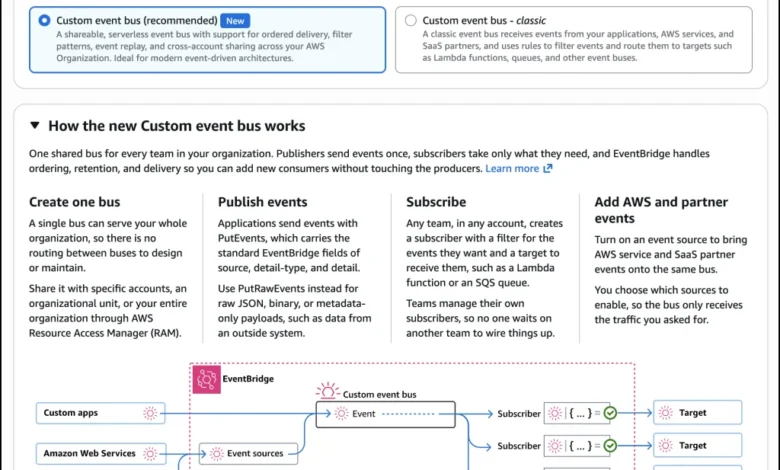
Amazon Web Services (AWS) has officially announced the launch of an enhanced custom event bus for Amazon EventBridge, marking a significant evolution in how enterprise organizations build, scale, and manage event-driven architectures across complex multi-account environments. Designed specifically to alleviate the operational friction associated with scaling serverless systems, the new feature introduces organization-wide resource sharing, native event ordering, simplified subscriber management, and a revamped economic model.
The release addresses a longstanding architectural challenge for modern engineering teams. While event-driven designs are celebrated for their loose coupling and scalability, growing organizations frequently find their infrastructure constrained as adoption spreads beyond a single team.
Main Facts and Operational Challenges
Historically, organizations building event-driven applications on Amazon EventBridge initiated their development with a single custom event bus housed within a solitary AWS account. For single-team operations, this model is straightforward and effective. However, as cloud adoption accelerates across entire enterprises, adherence to AWS security and operational best practices dictates a multi-account structure. In this recommended configuration, individual teams operate within isolated AWS accounts to maintain security boundaries, blast radiuses, and billing accountability.
To route events between these isolated accounts, system architects historically had to establish multiple event buses connected via intricate cross-account rules or complex bus-to-bus configurations. This workaround inadvertently reintroduced the precise operational complexity that serverless architectures were deployed to eliminate. Platform engineering teams rapidly lost centralized visibility into event subscriptions, while cross-account and bus-to-bus routing charges compounded expenditures. Furthermore, applications requiring strict event sequencing—such as financial ledgers or logistical tracking systems—were forced to construct elaborate workarounds or pivot entirely to alternative messaging technologies.

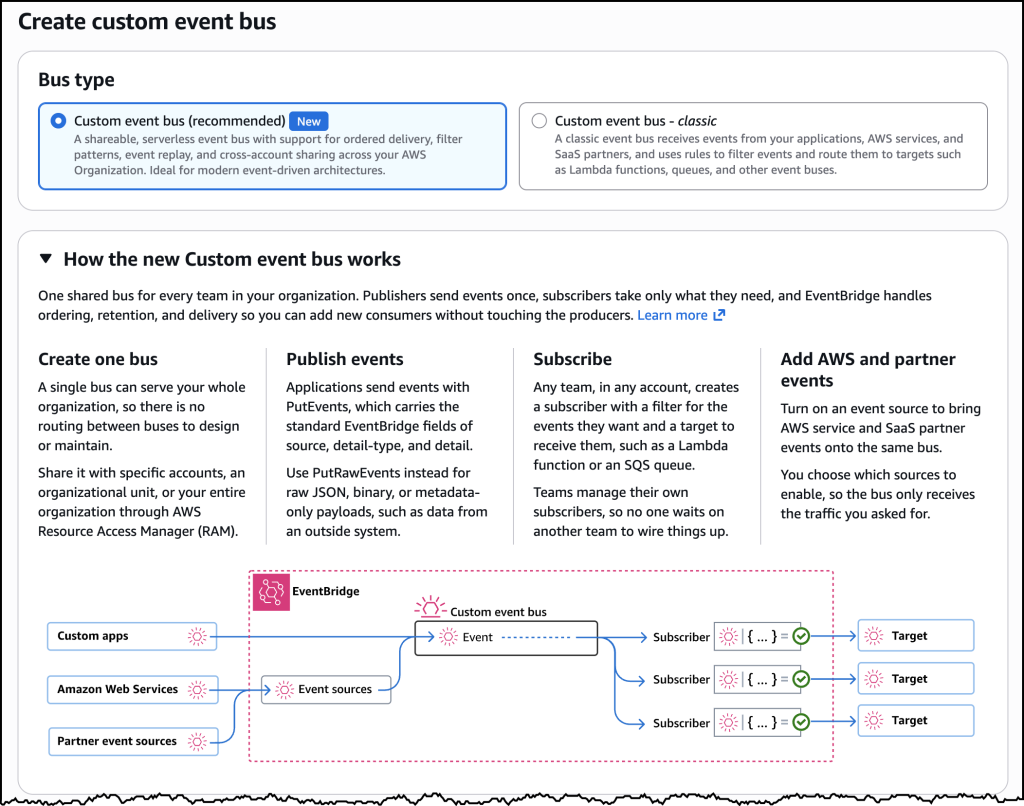
The newly introduced enhanced custom event bus directly targets these pain points. By deploying a single, centralized event bus shared across all AWS accounts within an enterprise organization, AWS enables teams to bypass the need for multi-bus configurations. The system introduces native ordering guarantees, a consolidated Subscriber resource, and a transparent pricing model that aligns financial attribution with actual usage.
Chronology and Transition Pathway
The introduction of the enhanced custom event bus represents the culmination of years of feedback from enterprise cloud architects dealing with hyper-scale serverless deployments.
In the initial phases of serverless adoption, Amazon EventBridge gained traction as a foundational serverless event router capable of ingesting data from AWS services, SaaS applications, and custom sources. As microservices proliferated, the demand for cross-account visibility grew exponentially. While features such as cross-account target invocation mitigated some friction, managing policies across dozens or hundreds of accounts remained cumbersome.
With today’s general availability, the transition path for existing workloads has been carefully structured to prevent disruption. Legacy custom event buses will remain fully operational and supported, automatically designated in the management console as "Custom event bus – classic." These classic buses will continue to ingest and route events using established rules and targets without requiring immediate code or configuration changes from development teams.
Conversely, the newly engineered resource—simply labeled "Custom event bus" in the management console—is available for adoption at an organization’s own pace. Administrators can provision the new infrastructure using the AWS Management Console, the AWS Command Line Interface (CLI), or programmatic EventBridge APIs across a broad initial footprint of global cloud regions, including US East, US West, multiple European hubs, and key Asia-Pacific markets.

Technical Architecture and Core Capabilities
The architecture of the enhanced custom event bus introduces several powerful capabilities designed to streamline publisher-subscriber workflows while preserving fine-grained governance.
Organization-Wide Sharing via AWS RAM
Platform teams can now instantiate a single event bus and seamlessly share it across every AWS account within an enterprise organization. Leveraging integration with AWS Resource Access Manager (AWS RAM), administrators can define sharing perimeters ranging from individual AWS accounts and organizational units to specific IAM roles and users. This eliminates the manual burden of orchestrating cross-account resource policies and bus-to-bus routing rules. Publishers can emit events into the central fabric without needing prior knowledge of downstream consumers, while subscribers independently establish their own data consumption parameters. To accommodate large-scale enterprises, the enhanced bus supports a default quota of 10,000 subscribers per bus, drastically reducing fragmentation.
Native Event Ordering and Synchronous Processing
While asynchronous processing remains the cornerstone of resilient event-driven design, specific business domains—such as real-time logistics, IoT tracking, and transactional state management—demand strict message sequencing. The enhanced custom event bus addresses this by supporting an EventGroupId parameter. EventBridge ensures that events carrying identical group identifiers are delivered sequentially to subscribers opting for ordered delivery, while concurrently allowing unordered consumers to process other streams asynchronously. To support this reliability, the architecture introduces synchronous invocation options for targets such as AWS Lambda, confirming successful execution before acknowledging the event and eliminating the intermediate requirement for Amazon SQS queues in ordered pipelines.
Consolidated Subscriber Resources and Advanced Evaluation
The architecture simplifies consumer onboarding through the introduction of the unified Subscriber resource. Rather than configuring disparate rules, retry policies, and dead-letter queues across multiple decoupled resources, engineers now manage a single entity that governs event filtering, target routing, and failure handling.
Additionally, the system features content-based deduplication. By automatically hashing payload contents to collapse identical events arriving within a five-minute window, EventBridge provides true exactly-once delivery semantics for upstream sources incapable of generating native idempotency tokens. Furthermore, native JSONata expression support enables real-time event transformation, allowing consumers to reshape payloads on the fly. EventBridge can also deserialize incoming Apache Avro or Protocol Buffers formats directly into JSON, granting subscribers the ability to execute fine-grained filtering across complex payloads without writing custom parsing boilerplate.
Economic Model and Pricing Analysis
Financial governance in multi-account cloud environments has historically been complicated by compounding routing fees. The enhanced custom event bus implements a modernized ingress and egress throughput pricing structure. Under this model, publishers incur costs based strictly on the volume of events ingested, while subscribers pay for events delivered. This decoupling eliminates the hidden cost multipliers previously associated with multi-hop cross-account routing topologies, providing financial analysts and cloud financial management (FinOps) teams with predictable cost allocation metrics.
Broader Impact and Industry Implications
Industry analysts observe that the release of the enhanced custom event bus signals a maturing enterprise serverless market. As enterprises transition from early-stage cloud migrations to deeply integrated, mission-critical distributed systems, infrastructure providers must offer native tools that reconcile operational decentralization with centralized governance.
By removing the architectural debt historically required to connect isolated AWS accounts, AWS has lowered the barrier to entry for large-scale event-driven designs. Platform engineering teams regain comprehensive visibility over data flows, security compliance officers secure strict boundary controls via AWS RAM, and application developers benefit from reduced latency, native event ordering, and simplified payload transformation. As organizations evaluate their long-term serverless strategies, these architectural refinements are expected to accelerate enterprise modernization initiatives across global industries.
Related posts: