Beelink ME Pro Creator Edition NAS Review: A Powerful, Modular Leap for Professionals

Beelink has officially entered the network-attached storage (NAS) market with a notably bold strategy, introducing its ME Pro series through a crowdfunding campaign on Kickstarter. Among the standout offerings in this new lineup is the four-bay Creator NAS, built around the Intel Core i5-13500H mobile processor. Designed primarily for content creators, video editors, and professionals managing heavy data workflows, this compact unit attempts to bridge the gap between high-performance mini-PCs and traditional enterprise storage solutions.
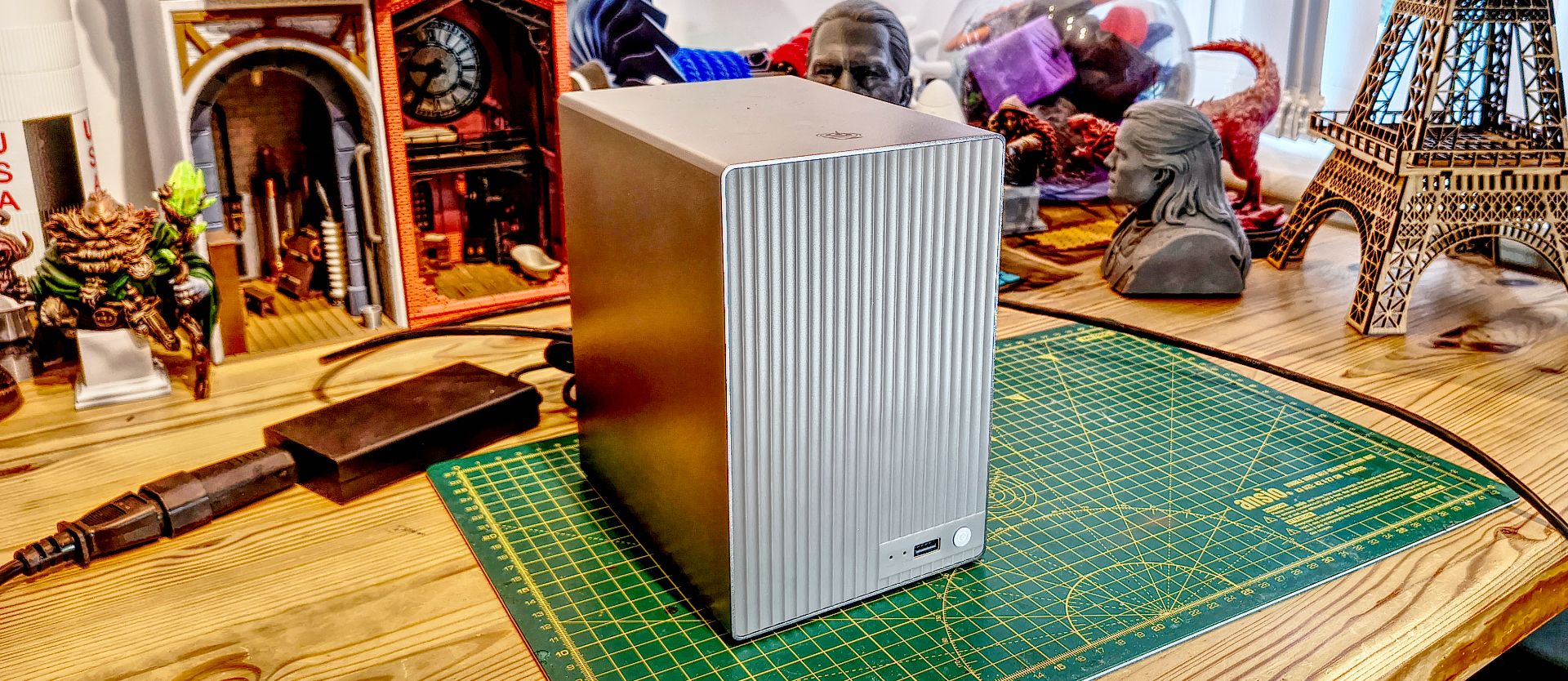
Measuring just 165 x 121 x 185mm and weighing 2.4 kilograms without drives, the all-metal unibody chassis occupies roughly 50 percent less volume than conventional four-bay storage enclosures produced by market mainstays like Synology and QNAP. Despite its diminutive footprint, the unit packs substantial hardware capabilities, including up to 32GB of DDR4 memory, extensive M.2 NVMe storage slot allocations, and a modular architecture that radically simplifies internal component maintenance and hardware upgrades.
Comprehensive Lineup and Flexible Configuration Options
The broader ME Pro ecosystem is expansive, catering to varying performance brackets and use cases. Beelink has structured the family into multiple tiers, ranging from entry-level home servers to high-end processing powerhouses. Below the flagship Creator NAS model, the company offers five "Home NAS" variants powered by energy-efficient or mid-tier processors, including the Intel J5005, N95, N150, and Core 3 304 chips. At the top end of the spectrum, two premium SKUs leverage advanced AMD Ryzen AI processors—specifically the Ryzen AI 7 H 350 and the Ryzen AI 9 HX 470—featuring dedicated neural processing units (NPUs) capable of delivering up to 86 TOPS (tera operations per second) for local artificial intelligence and machine learning workloads.
The review unit furnished with the Intel Core i5-13500H mobile processor utilizes a hybrid architecture featuring 12 cores and 16 threads, operating at a 45W TDP. Performance cores can boost up to 4.7 GHz, while efficient cores reach up to 3.5 GHz, all sharing an 18MB Intel Smart Cache. Outfitted with 32GB of DDR4-3200 memory (expandable up to 96GB using dual 48GB modules) and a 500GB system SSD, the configuration provides ample headroom for multitasking, virtual machine hosting, and high-speed data transmission.
Innovative Modular Design and Thermal Management
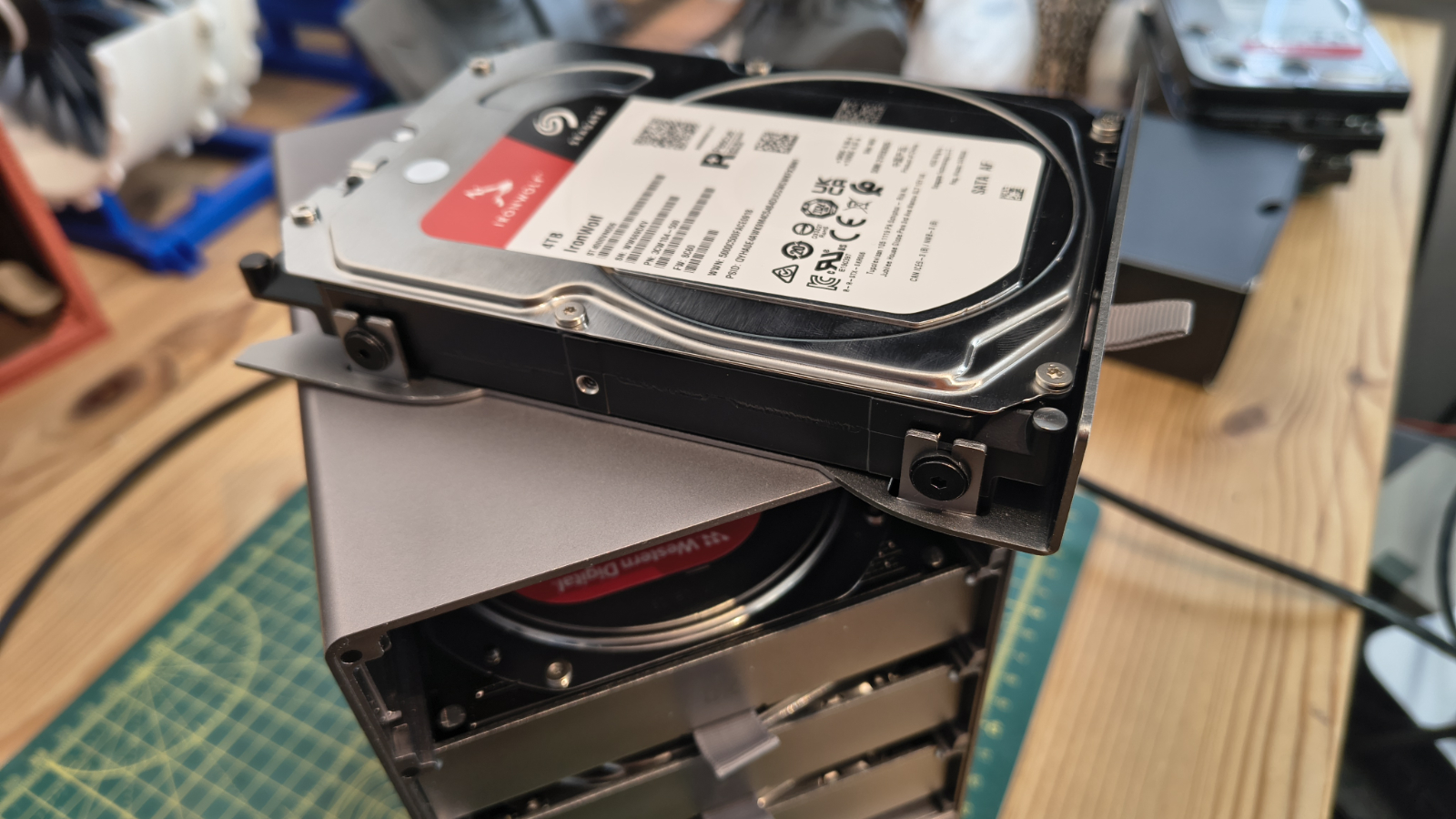
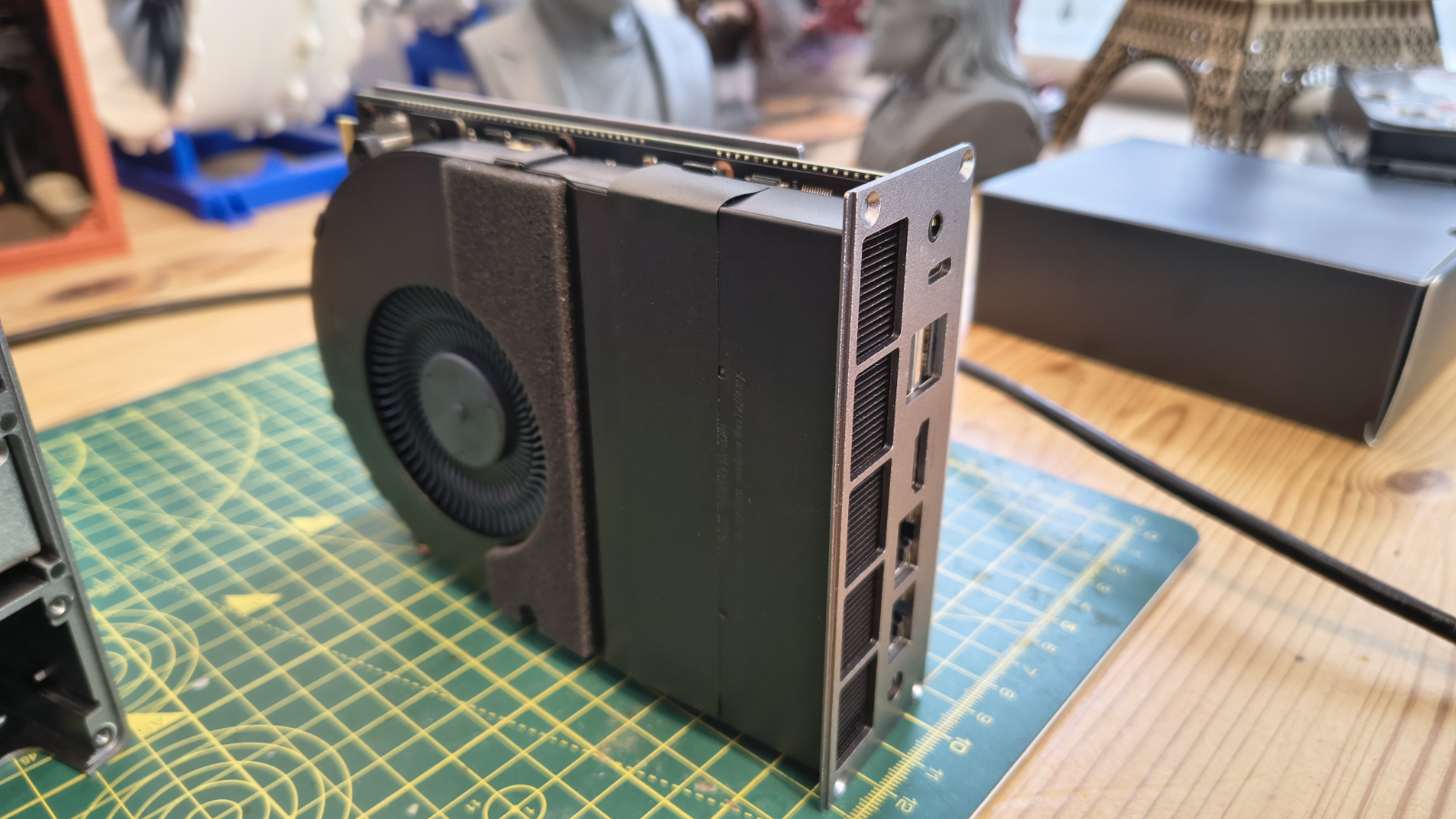
One of the defining architectural innovations of the ME Pro series is its drawer-style internal layout. Borrowing mechanical concepts from mini-PC designs, both the drive trays and the internal motherboard module utilize sliding interfaces. This allows the primary motherboard assembly to be extracted easily for routine maintenance or future platform upgrades without dismantling the entire chassis. Theoretically, users could swap out modular boards across different tiers within the same physical enclosure.
Thermal performance is managed via a precision-milled aluminum unibody that naturally radiates heat, supplemented by an internal blower on the motherboard module that draws in cool air and expels it efficiently. Acoustic management is further enhanced by silicone mounts placed on either side of each storage drive and between the case and the motherboard tray, successfully dampening mechanical vibration and operating noise to desktop-friendly levels.
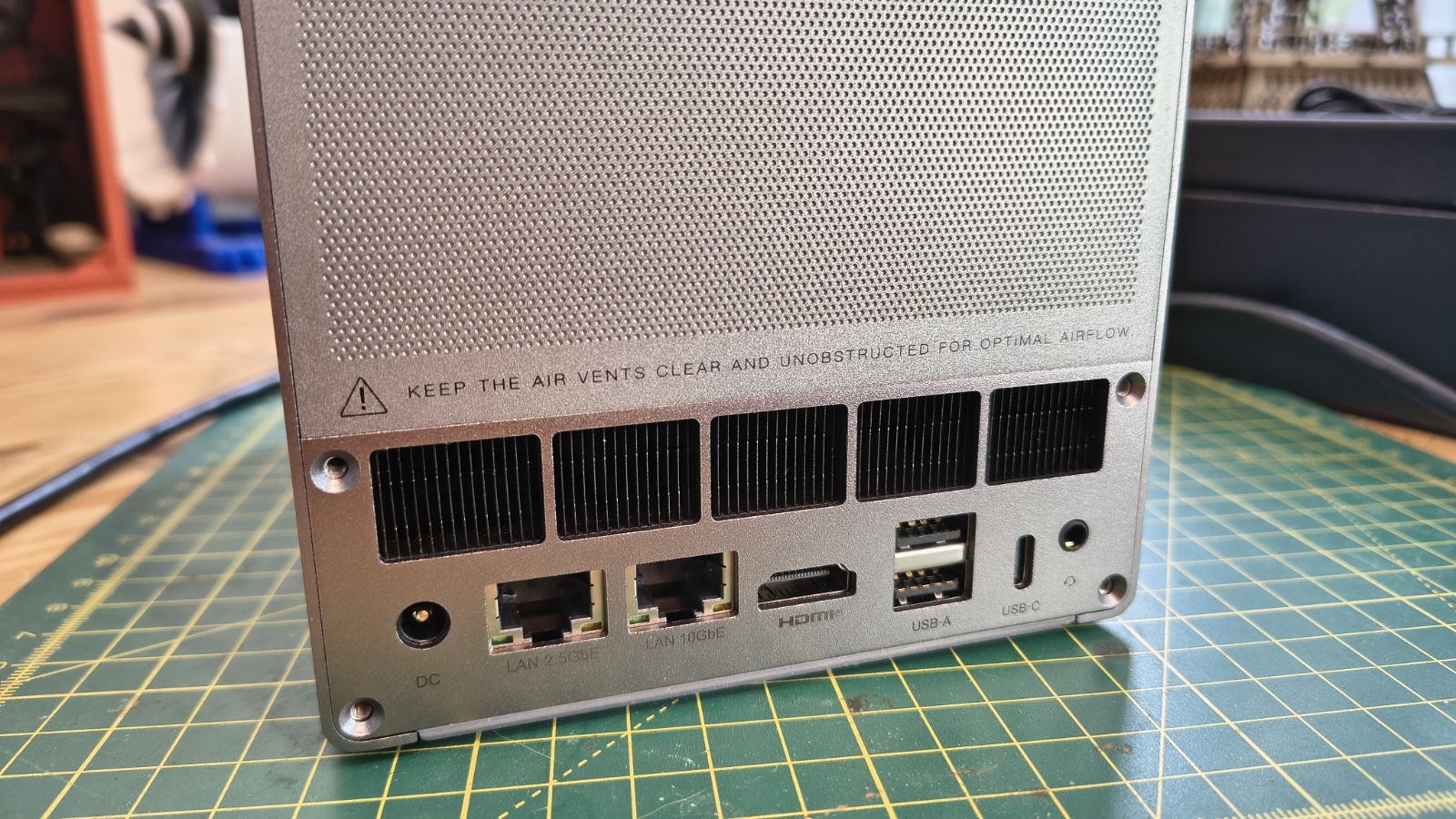
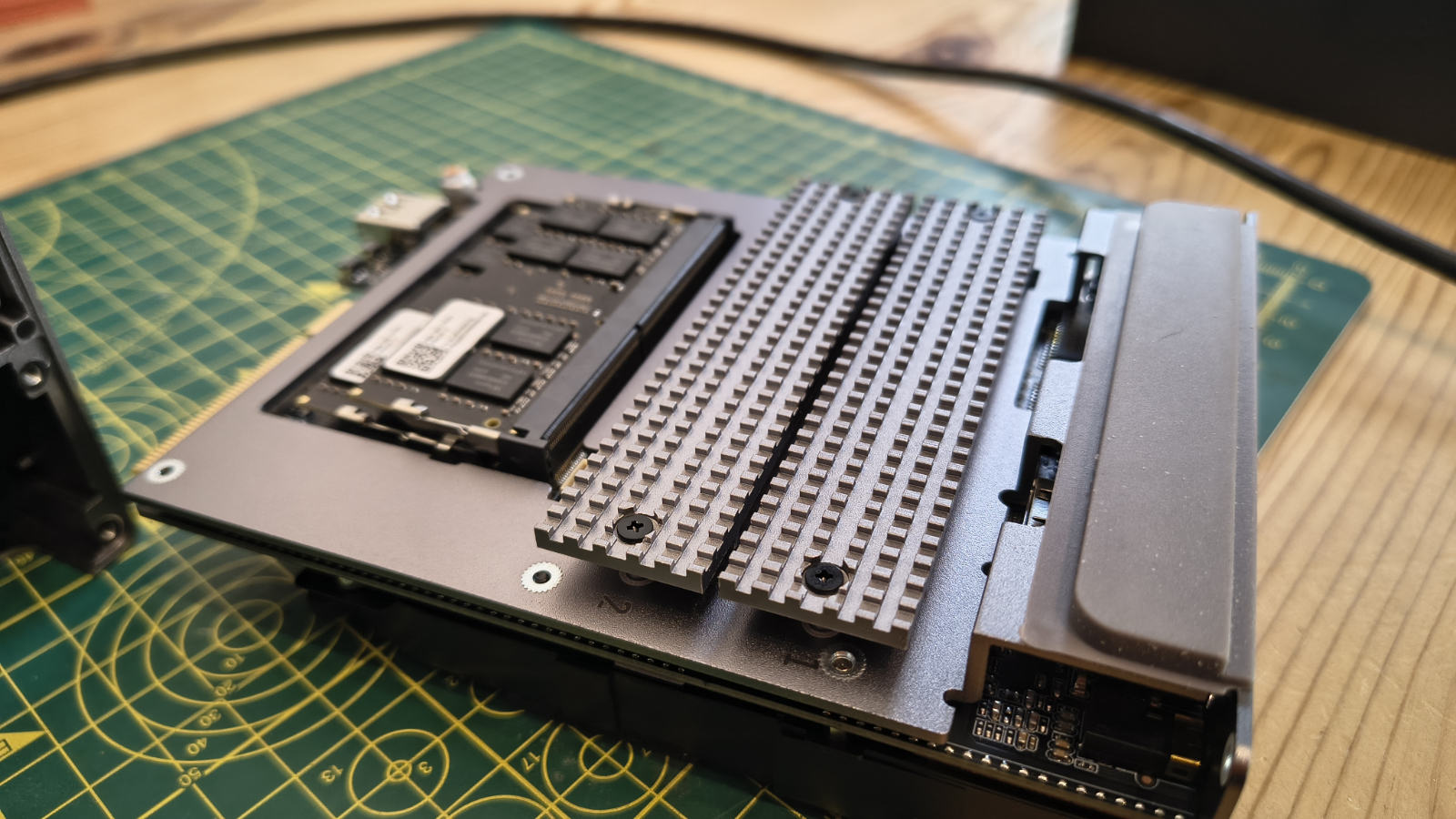
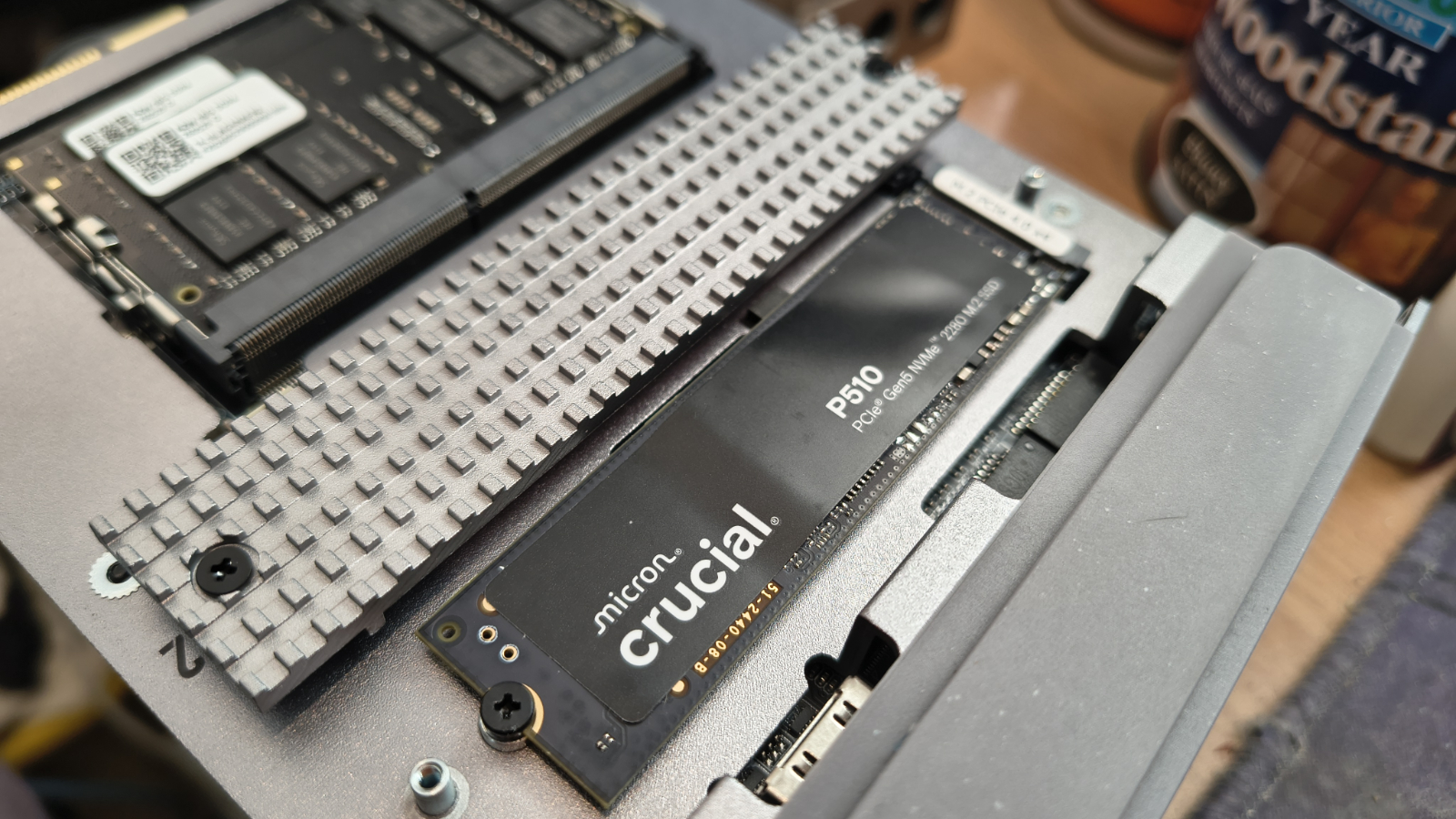
Connectivity options are robust, driven by the substantial PCIe lane allocation of the 13500H processor. The system features dual M.2 Gen 4 x4 slots with dedicated aluminum heatsinks for rapid internal caching or storage, alongside two M.2 Gen 3 x2 slots (one of which houses the operating system boot drive). Networking is anchored by a high-speed 10GbE LAN port paired with a 2.5GbE LAN port for failover or secondary routing. Additional peripherals are supported by a Thunderbolt 4 port capable of 40Gbps transfers, three USB 3.2 Gen 2 ports, and an HDMI output supporting up to 4K resolution.
Software Ecosystem: FygoOS and Collaborative Workspaces
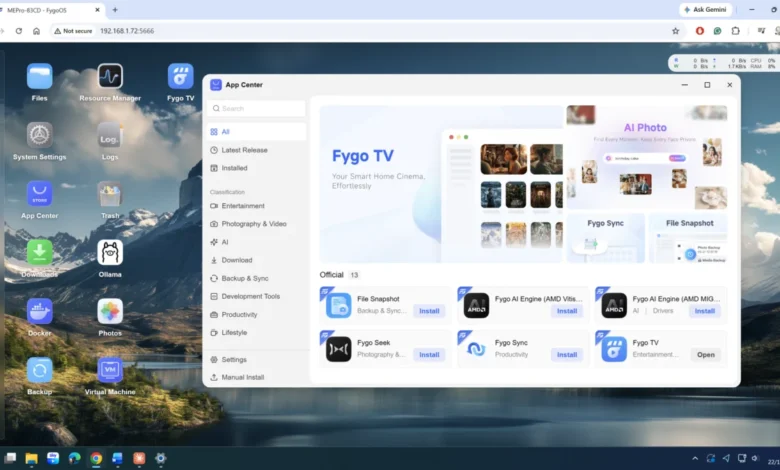
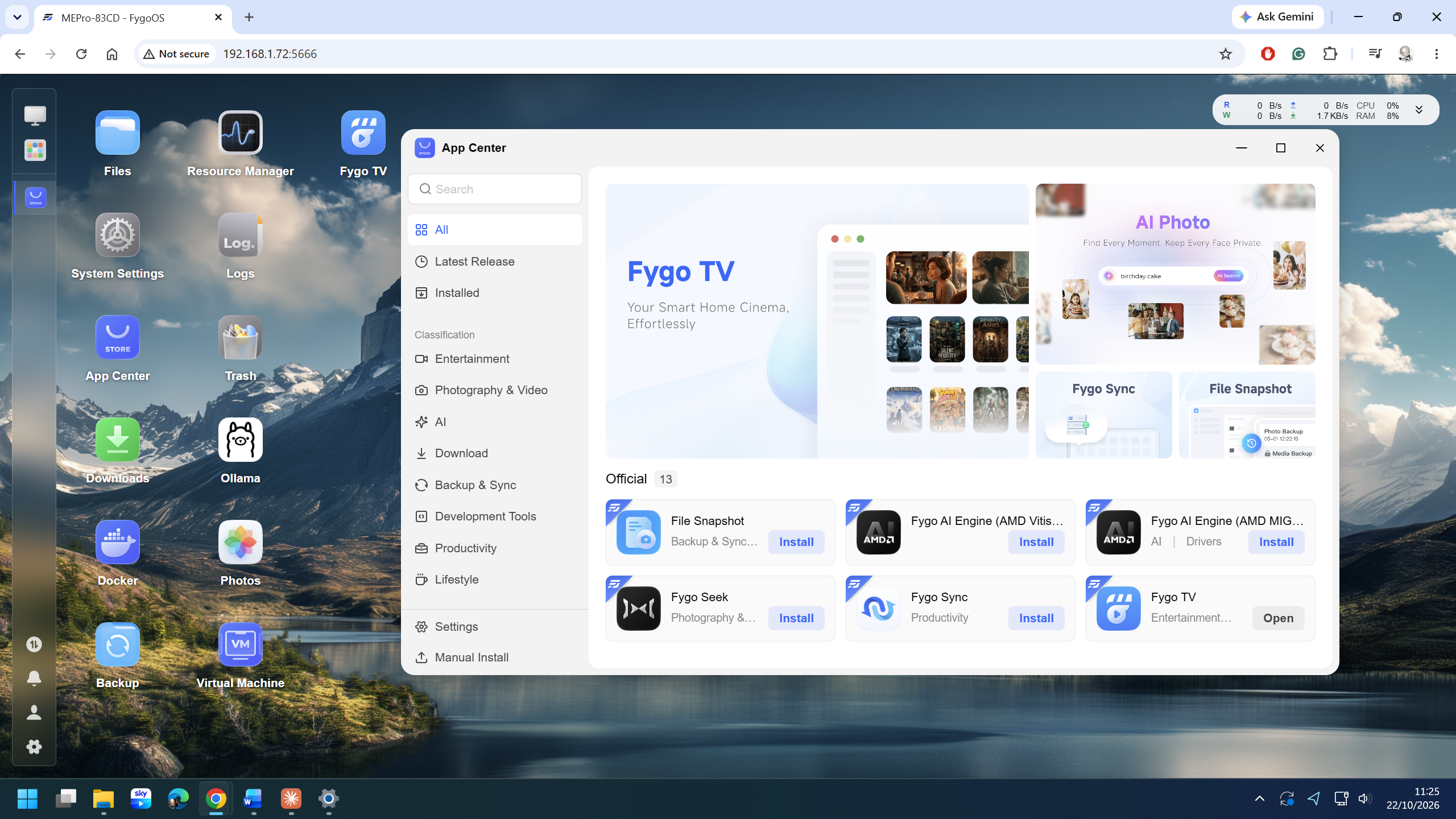
Operating system duties are handled by FygoOS, a proprietary NAS platform built upon a Debian Linux foundation. Emerging from the development efforts associated with fnOS and Feiniu Private Cloud, FygoOS aims to accommodate both novice users and advanced administrators by offering one-click application installation, comprehensive virtualization support via Docker, and robust file system compatibility including ZFS, Btrfs, and ext4.
For creative professionals, the software includes advanced media management and collaborative tools. The platform utilizes facial recognition and smart categorization for photo libraries, while its private cinema application automatically matches metadata with high accuracy for media streaming. Furthermore, a collaborative media workspace allows teams to preview complex assets—including high-resolution video, audio, documents, and 3D files—directly within the browser interface without requiring local downloads. Reviewers can leave timestamped annotations and comments, supported by granular access controls, watermarks, and custom branding options.
However, the software model introduces subscription considerations. While basic functionality is included with all hardware purchases, advanced business-tier features operate on a tiered subscription model. Although Beelink bundles extended free trial periods with higher-end models—such as six months free for the Core i5-13500H and Ryzen AI variants—the long-term subscription pricing structure beyond the promotional window remains unspecified, presenting a variable cost factor for long-term enterprise deployment.
Performance and Network Throughput
Real-world evaluation demonstrates that the hardware architecture is capable of handling demanding data pipelines. During large file transfers utilizing the 10GbE LAN port with a RAID 5 array comprising four 3.5-inch hard drives, sequential read and write operations approach saturation limits, though fully leveraging the 10GbE bandwidth generally requires integrating solid-state drive caching. CPU utilization during heavy file transfers remains remarkably low—hovering around 9 percent—leaving abundant processing capacity for background tasks, media transcoding, and concurrent virtual machine instances.
Despite these strong performance metrics, minor hardware and software limitations were observed during testing. The Thunderbolt 4 port currently lacks native host mode support—a feature listed as under development on the official FygoOS roadmap—meaning direct high-speed laptop-to-NAS tethering is not yet operational. Additionally, native link aggregation for combining network interfaces is absent from the graphical settings panel, requiring manual configuration via command-line Linux networking tools if network bonding is desired.
Market Positioning and Crowd-Funding Implications
Priced competitively through its Kickstarter launch phase—with Super Early Bird discounts offering the Core i5-13500H model at $819 compared to a standard list price of $1,169—the ME Pro series undercuts established competitors in terms of raw processing power and memory capacity per dollar. Lower-tier models start as low as $369 for the J5005 variant during early promotion, while top-tier AMD Ryzen AI configurations scale up to $1,379.
Nevertheless, backing a hardware product via crowdfunding inherently carries delivery and supply chain risks, alongside questions regarding long-term software support and community establishment. While established market alternatives such as the Ugreen NASync DXP4800 Pro, Synology DS925+, and UniFi UNAS Pro 4 offer proven brand ecosystems and mature operating software, they frequently compromise on CPU performance, memory expandability, or high-speed networking options.
Ultimately, the Beelink ME Pro Creator Edition establishes a compelling hardware blueprint for power users and creative professionals seeking high-end computing power, flexible modularity, and robust ZFS file system support in a compact desktop form factor. Whether the platform achieves mainstream commercial adoption will depend heavily on the successful fulfillment of Kickstarter commitments and the continued refinement of the FygoOS software environment.
Related posts: