Developer Mirocow Unveils PrismGit: An Open-Source Cross-Platform Git Client Powered by Autonomous AI Agent Loops

The landscape of software development toolchains is undergoing a subtle yet profound paradigm shift, moving beyond simple static automation toward deeply integrated autonomous agents. While terminal purists continue to rely on the command line interface (CLI) and traditionalists lean on graphical interfaces like GitKraken or SmartGit for complex workflows—such as interactive rebasing or three-way conflict resolution—a noticeable gap has persisted in modern developer tooling. Specifically, applications have lacked native, autonomous artificial intelligence integration capable of reasoning about repository state, analyzing complex diffs, and executing contextual operations rather than merely serving as a glorified interface for generating commit messages.
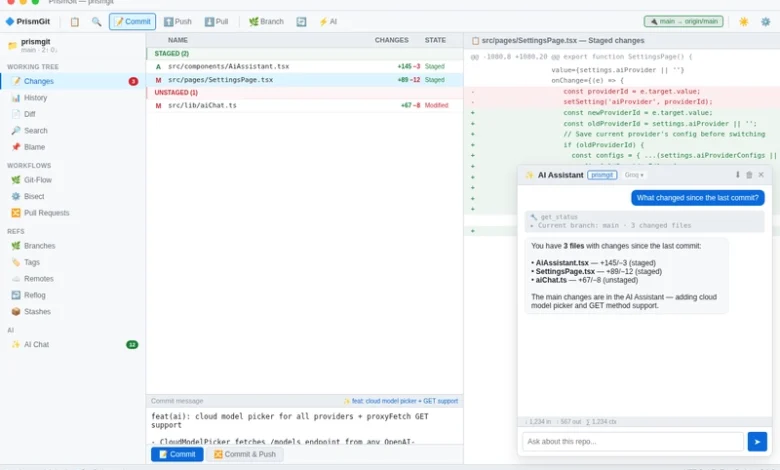
Addressing this architectural gap, independent developer Mirocow has introduced PrismGit, a modern, open-source, cross-platform Git client engineered from the ground up to feature an autonomous AI agent loop. Built using a robust stack comprising Electron 32, React 18, Vite 5, TypeScript 5.6, and Zustand, PrismGit aims to redefine how engineers interact with version control systems by merging high-performance graphical rendering with sophisticated large language model (LLM) orchestration.
The Architectural Foundation of PrismGit
Developing a desktop application that interacts simultaneously with heavy file systems, Git command-line utilities, and asynchronous AI networks presents significant performance and stability hurdles. Historically, desktop clients built on web technologies have suffered from sluggish user interfaces, high memory consumption, and thread blocking when executing intensive background operations like diff parsing or repository status checking.
To circumvent these engineering bottlenecks, PrismGit implements a strict process separation architecture. The core application divides responsibilities across isolated execution layers, ensuring that the user interface remains completely responsive even when the underlying engine is processing multi-megabyte diffs, handling massive commit histories, or waiting for network round-trips from remote LLM providers.
At the foundational layer, the application manages Git interactions through optimized wrappers and native bindings, communicating via asynchronous IPC (Inter-Process Communication) channels to the React-based frontend. State management is handled efficiently through Zustand, minimizing unnecessary re-renders across complex component trees and ensuring a fluid user experience during intensive merge conflicts or multi-branch analysis.

Furthermore, the engineering of cross-platform desktop clients frequently presents deployment nightmares due to native Node.js module compilation flags and platform-specific dependencies governed by tools like node-gyp. To enforce deterministic, reproducible builds without contaminating host development environments, the PrismGit ecosystem relies on decoupled Docker containers. Coordinated via a unified Makefile, this build pipeline utilizes tools such as Wine to seamlessly generate Windows binaries from Linux environments, ensuring consistent release artifacts across macOS, Windows, and Linux distributions.
Designing the Multi-Model AI Agent Tool-Use Loop
What distinguishes PrismGit from superficial integrations—such as IDE extensions that simply call an API to suggest a single-line commit summary—is its multi-model AI assistant architecture. Version 2.1 and later of the client support twelve distinct LLM providers. This flexibility accommodates both cloud-based APIs (including Anthropic, OpenAI, Google Gemini, and Groq) and fully local, air-gapped configurations via Ollama and LM Studio. For enterprises and privacy-conscious developers handling sensitive source code, the ability to run capable coding models locally ensures absolute data sovereignty.
Rather than relying on a traditional conversational chatbot interface where developers must manually copy and paste error logs or code snippets, PrismGit implements a sophisticated Function Calling and Tool-Use loop. The integrated LLM is provided with a rigorously defined schema consisting of over twenty-four specialized Git tools.
When a developer issues a natural language instruction—such as, "Analyze the recent styling modifications, stage the relevant files, and write a conventional commit message"—the AI enters a recursive execution loop:
- Context Gathering: The agent queries the repository state using its internal tool schema, executing commands to check modified files, read specific diffs, and understand the local branching context.
- Reasoning and Planning: The model evaluates the gathered data against the user’s intent, determining the sequence of operations required to fulfill the request.
- Execution: The agent invokes specific Git capabilities programmatically through the tool-use interface, executing staging, unstaging, or preliminary checks in a controlled environment.
- Verification and Refinement: The model reviews the outcome of the executed tools, confirming that the working directory is clean or that the expected changes have been staged correctly before presenting the final result to the user for approval.
This closed-loop execution transforms the Git client from a passive visualization dashboard into an active pair programmer capable of executing multi-step workflows autonomously.
Quality Assurance, Testing, and Localization
Maintaining a reliable Git client requires rigorous testing pipelines, particularly when dealing with edge cases in repository histories, detached HEAD states, and complex merge conflicts. PrismGit incorporates a comprehensive testing infrastructure leveraging Vitest for unit and integration logic alongside Playwright for end-to-end desktop automation testing.

In addition to its technical robustness, the application prioritizes global accessibility. PrismGit features 100% localization parity across four primary languages, ensuring that international development teams can leverage its advanced interface without language barriers. The entire project is distributed under the permissive MIT License, inviting contributions from the global open-source community to expand its tool schema and improve its performance benchmarks.
Industry Implications and Future Outlook
The release of PrismGit arrives at a critical juncture in the evolution of software engineering tooling. As generative artificial intelligence transitions from experimental web interfaces into core development environments, developers are increasingly demanding native integrations that respect local workflows rather than disrupting them.
Industry analysts note that tools bridging the gap between local deterministic systems (like Git) and probabilistic models (like LLMs) represent the next frontier in developer productivity. By embedding tool-use loops directly into version control clients, projects like PrismGit reduce the cognitive load associated with context switching between terminals, IDEs, and external chat interfaces.
However, widespread adoption of autonomous Git agents will also bring technical and philosophical debates to the forefront. Critics and security-conscious engineers often caution against granting automated agents the ability to modify repository states, execute rebases, or push code directly to remote servers without explicit, granular oversight. PrismGit’s design philosophy addresses these concerns by keeping the human developer firmly in the validation loop, utilizing agentic workflows primarily for preparatory analysis, staging assistance, and intelligent documentation generation.
As the open-source community begins to test and extend PrismGit via its GitHub repository, developers and maintainers alike are evaluating how these architectural patterns—particularly process separation, containerized cross-platform builds, and structured tool-use loops—will influence the next generation of desktop development software. The ongoing evolution of PrismGit promises to spark broader discussions regarding the optimization of heavy diff parsing, the limits of local AI execution, and the future of human-in-the-loop version control systems.
Related posts: