Google Cloud Unveils Managed Reinforcement Learning Fine-Tuning Service to Unlock Advanced Customization for Gemini Models

Google Cloud has officially introduced a fully managed Reinforcement Learning Fine-Tuning (RLFT) service designed to bridge a critical gap in enterprise artificial intelligence deployment. Traditionally, reinforcement learning—a cornerstone of modern large language model (LLM) post-training—has presented significant operational hurdles for enterprise customers. It typically requires massive, specialized training clusters and intimate access to model internals that external users cannot access when deploying proprietary architectures like Google’s Gemini.
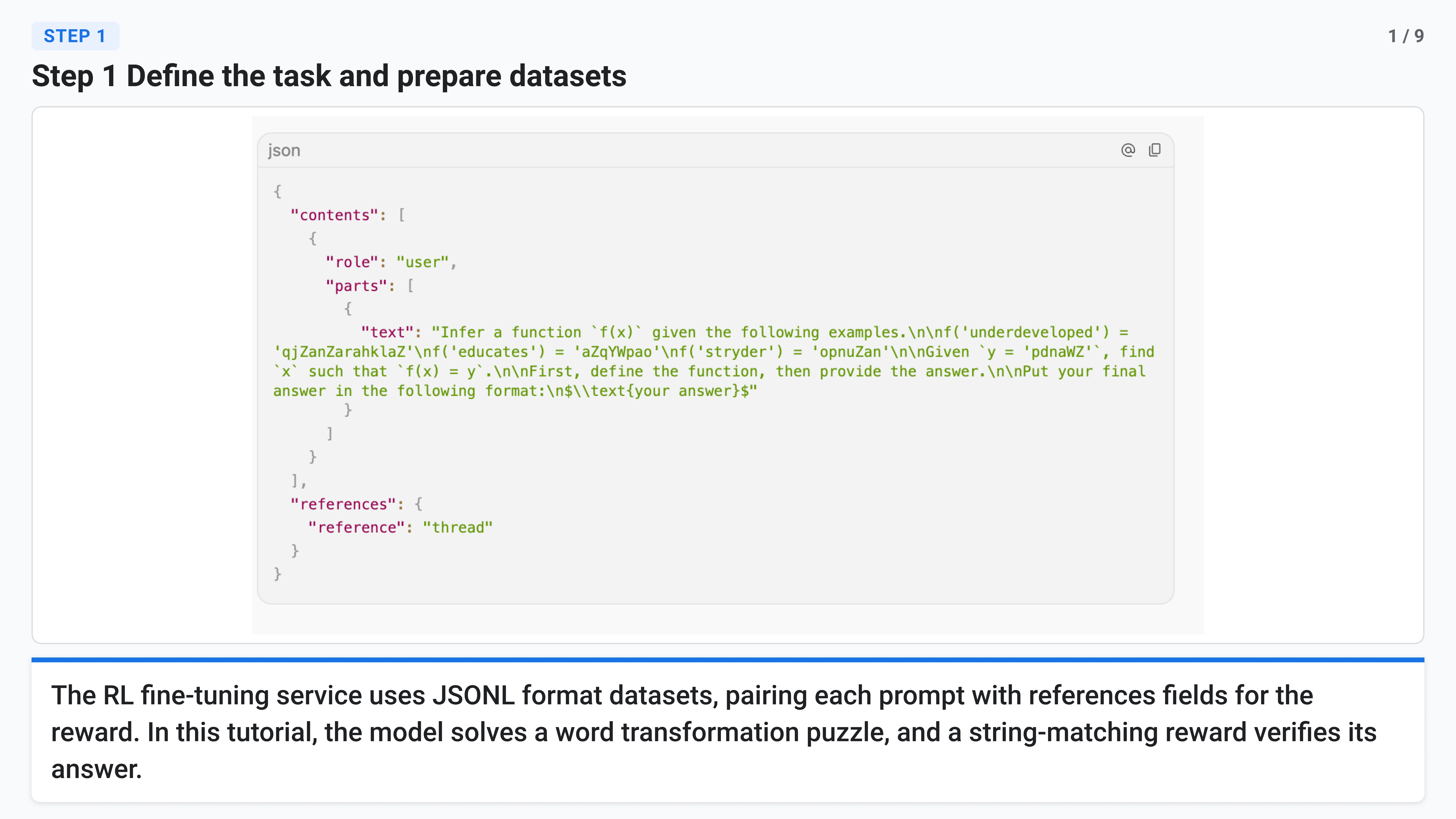
With this new service, Google Cloud aims to democratize access to advanced model alignment techniques. Organizations are no longer required to manage complex reinforcement learning infrastructures or possess deep machine learning engineering teams dedicated to pipeline orchestration. Instead, users are asked to provide only two components: a set of prompts and a programmatic reward function. Google Cloud manages the rest, handling the underlying compute infrastructure and proprietary model weights entirely behind the scenes.
This technical leap transforms how businesses can adapt foundational AI models to suit specific operational needs. Rather than relying solely on traditional supervised learning methodologies, enterprises can now train models using dynamic reward signals. As the enterprise AI landscape matures, this service arrives at a pivotal time when organizations are increasingly moving past generic out-of-the-box deployments and seeking highly specialized, domain-specific intelligence.
The Evolution of Model Customization: From Supervised Learning to Reinforcement Learning
To understand the significance of Google Cloud’s new RLFT service, it is helpful to examine the historical trajectory of LLM post-training. Historically, Supervised Fine-Tuning (SFT) has served as the primary mechanism for adapting pre-trained foundational models to specific downstream tasks. SFT relies on a static dataset of "gold standard" examples—pairs of prompts and ideal responses curated by human annotators. The model is then trained to mimic these expert demonstrations through gradient descent.
While SFT remains an indispensable tool for establishing baseline formatting, tone, and domain vocabulary, it suffers from inherent limitations. First, authoring comprehensive datasets for complex, highly nuanced enterprise tasks is exorbitantly expensive and time-consuming. Second, SFT struggles fundamentally with tasks that are difficult to demonstrate manually but exceptionally easy to evaluate programmatically. For instance, writing the exact SQL query for every possible database schema variation is virtually impossible for a human expert, yet executing the query against a database and verifying the correctness of the output is trivial and automated.
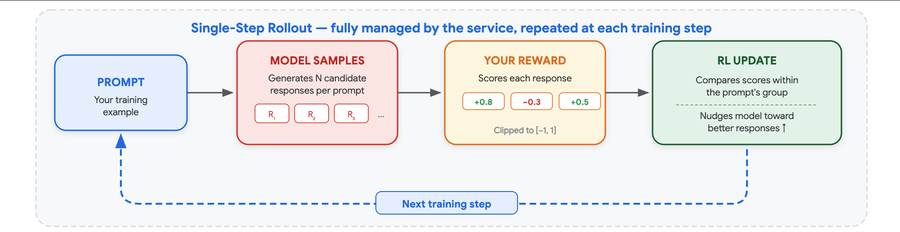
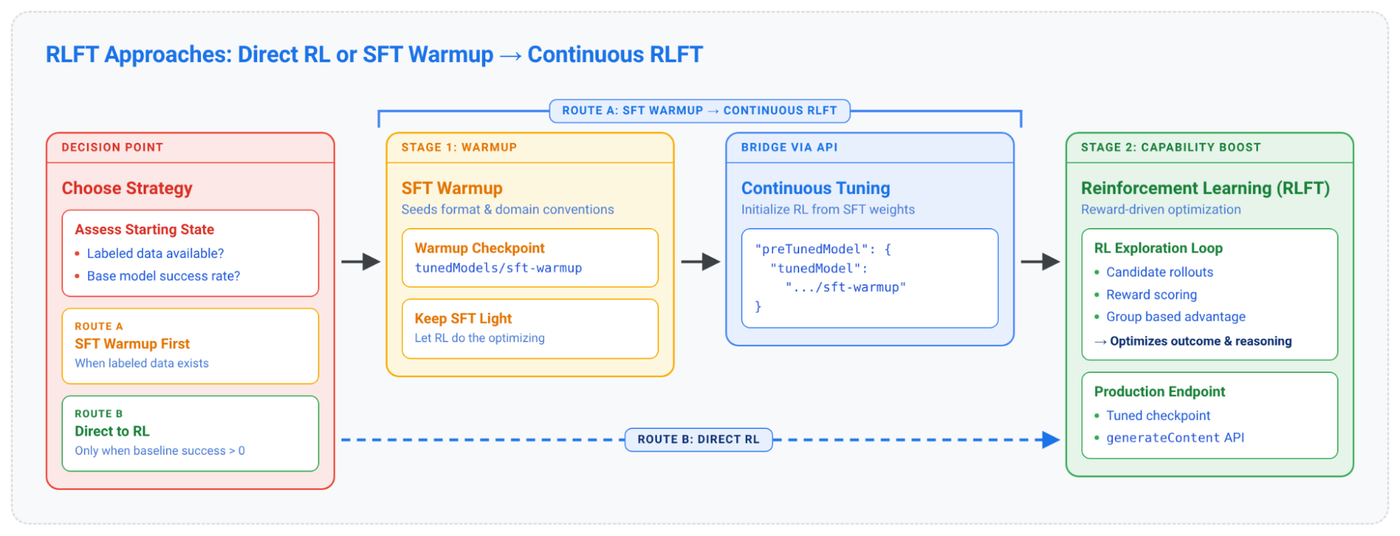
Reinforcement Learning Fine-Tuning bypasses the need for exhaustive example generation. Instead of learning by imitation, the model learns by exploration and optimization against a defined goal. During each training iteration, the RLFT service prompts the Gemini model to generate multiple candidate responses. These candidates are then evaluated by the user’s custom reward function, which assigns a numerical score based on predefined criteria. The service updates the model weights to favor higher-scoring responses while ensuring the model does not drift catastrophically away from its foundational Gemini behavior.
The Mechanics of the Managed RLFT Training Loop
The operational architecture of Google Cloud’s RLFT service is designed for seamless enterprise integration. At its core, the training loop operates on a continuous feedback cycle managed entirely within Google’s cloud infrastructure.
When an organization initiates an RLFT job, the service executes a structured, multi-step pipeline for every training batch:
- Generation: The model receives prompts from the user’s dataset and generates a diverse set of candidate completions.
- Scoring: The generated outputs are passed directly to the user-defined reward function—a piece of code or an external API endpoint specified during job setup.
- Optimization: Using advanced policy gradient methods, the service updates the model’s neural network weights, increasing the probability of generating outputs that yield higher reward scores while penalizing lower-performing paths.
- Regularization: To prevent reward hacking—where a model optimizes strictly for the reward metric at the expense of general language capabilities—the service enforces constraints that keep the newly tuned model close to the original Gemini baseline.
Throughout this process, developers monitor training progress via the Google Cloud console, observing real-time evaluation curves and reward metrics. Industry best practices recommend capturing model checkpoints dynamically based on validation reward saturation rather than simply relying on the final training step, thereby preventing overfitting.
When to Deploy RLFT Versus Traditional Supervised Fine-Tuning
Google Cloud emphasizes that RLFT and SFT are complementary methodologies rather than competing alternatives. Organizations are advised to exhaust standard prompt engineering and SFT methods before exploring reinforcement learning. However, enterprises typically find that RLFT becomes necessary under specific operational conditions:
- Scoring is Easier Than Authoring: When a task allows for automated verification (such as code compilation, mathematical equation solving, or data schema validation), writing a verifier is vastly more efficient than writing thousands of human-annotated training examples.
- SFT Performance Plateaus: When traditional supervised tuning reaches a ceiling on critical metrics—such as factual faithfulness, structural compliance, or domain-specific tone—RLFT can push performance past previous limits by directly optimizing for those exact outcomes.
- Handling Multiple Valid Answers: In many creative or analytical tasks, there are numerous equally valid ways to answer a prompt. A rigid SFT dataset penalizes any response that deviates from the single provided reference target, whereas a reward function can score any valid output favorably.
Real-World Enterprise Use Cases Across Industries
Early adopters of the RLFT service across various sectors have identified several high-impact use cases where traditional fine-tuning methods fall short. These applications share a common thread: they involve complex outcomes that businesses care deeply about but could never afford to demonstrate manually at scale.
AI-Powered Non-Player Characters (NPCs) in Gaming
Game development studios are utilizing RLFT to train conversational NPCs that adhere strictly to game lore, maintain character consistency, and adapt dynamically to player choices. Instead of writing exhaustive dialogue trees, developers use reward functions that score NPC responses based on personality constraints, lore accuracy, and narrative engagement.
Structured Entity Extraction
Financial institutions and legal firms process millions of unstructured documents containing critical data points. Using RLFT, models are trained to extract complex entities and output them into rigid JSON or XML schemas. The reward function evaluates structural validity and data completeness programmatically, ensuring near-perfect extraction reliability.
Content Moderation and Policy Enforcement
Trust and safety teams face evolving linguistic patterns when moderating digital platforms. RLFT allows organizations to train Gemini to detect subtle policy violations by scoring model decisions against established safety guidelines, reducing false positives and improving context-awareness over time.
Code Generation Measured by Execution
Software engineering organizations are leveraging RLFT to optimize code-generation models. Rather than evaluating syntax through static text matching, the reward function compiles and executes the generated code against a suite of unit tests. Models are explicitly rewarded for functional correctness, leading to significantly higher-quality software outputs.
Presentation Slide Generation via HTML
Marketing and corporate communications teams are automating slide deck creation. By defining reward functions that check for structural integrity, visual hierarchy, and HTML rendering correctness, enterprises can train Gemini to transform raw text reports into beautifully formatted presentation code seamlessly.
Industry Implications and the Future of Custom AI
The launch of Google Cloud’s managed RLFT service reflects a broader industry shift toward outcome-driven artificial intelligence. As foundational models become more ubiquitous, competitive advantage will no longer stem merely from accessing the largest base model, but from how effectively an organization can tailor that model to its unique operational workflows.
By abstracting away the computational complexity of distributed reinforcement learning clusters, Google Cloud lowers the barrier to entry for advanced AI customization. Enterprises that previously lacked the multi-million-dollar infrastructure investments historically required for RL post-training can now leverage these sophisticated techniques using standard cloud deployment tools.
As more organizations adopt reward-driven tuning paradigms, the software development lifecycle for AI applications is expected to evolve. Engineers will increasingly spend their time designing robust, domain-specific evaluation functions and reward metrics rather than curating static training datasets. This transition promises to accelerate the deployment of reliable, highly specialized AI agents across global enterprises, marking a significant milestone in the commercialization of generative artificial intelligence.
Related posts: