Google’s Updated Android Bench Places Gemini 4 Argon Behind Rival Claude and GPT Models in Specialized Coding Assistance

Google has released a significant update to its Android Bench evaluation framework, providing developers with a refined, metrics-driven overview of how leading artificial intelligence models perform when tasked with specialized Android application development. The latest rankings, published on October 26, introduce several high-profile frontier models to the benchmark suite, including offerings from OpenAI and Anthropic, alongside Google’s own newly introduced Gemini 4 Argon. The updated results reveal a shifting competitive landscape in AI-assisted software engineering, with Google’s flagship model trailing behind industry competitors in specific development pass rates, while highlighting critical trade-offs between computational performance and financial cost.
The Android Bench initiative was established earlier this year by Google as an authoritative response to the growing integration of generative artificial intelligence in mobile software engineering. As developers increasingly rely on large language models (LLMs) to accelerate application creation, debug legacy code, and implement modern architectural paradigms, standard benchmarks have often proven insufficient. Traditional coding evaluations frequently fail to capture the nuances of platform-specific development, such as adherence to the Android SDK, Jetpack Compose best practices, asynchronous programming patterns using Kotlin coroutines, and material design guidelines.
To bridge this gap, Google designed the Android Bench test to evaluate models against rigorous, real-world scenarios unique to the Android ecosystem. The evaluation framework rigorously measures not only whether a model can generate syntactically correct code, but whether the output aligns with optimal performance, security, and maintenance standards dictated by modern Android development. Recognizing that financial sustainability is a primary concern for individual developers and enterprise engineering teams alike, Google subsequently integrated average operational costs into the benchmark telemetry. This addition allows software architects to evaluate models through a holistic lens, weighing raw capability against the economic feasibility of deployment.
The October 26 benchmark update brings notable methodological improvements, most prominently the inclusion of detailed reasoning levels utilized by each model during testing. Furthermore, the expansion incorporates fresh evaluation data for several state-of-the-art architectures. Notable additions to the leaderboard include OpenAI’s GPT-6 Sol and GPT-6.1 Sol, Anthropic’s Claude Sonnet 5 and Claude Sonnet 5.5, and Google’s proprietary Gemini 4 Argon.
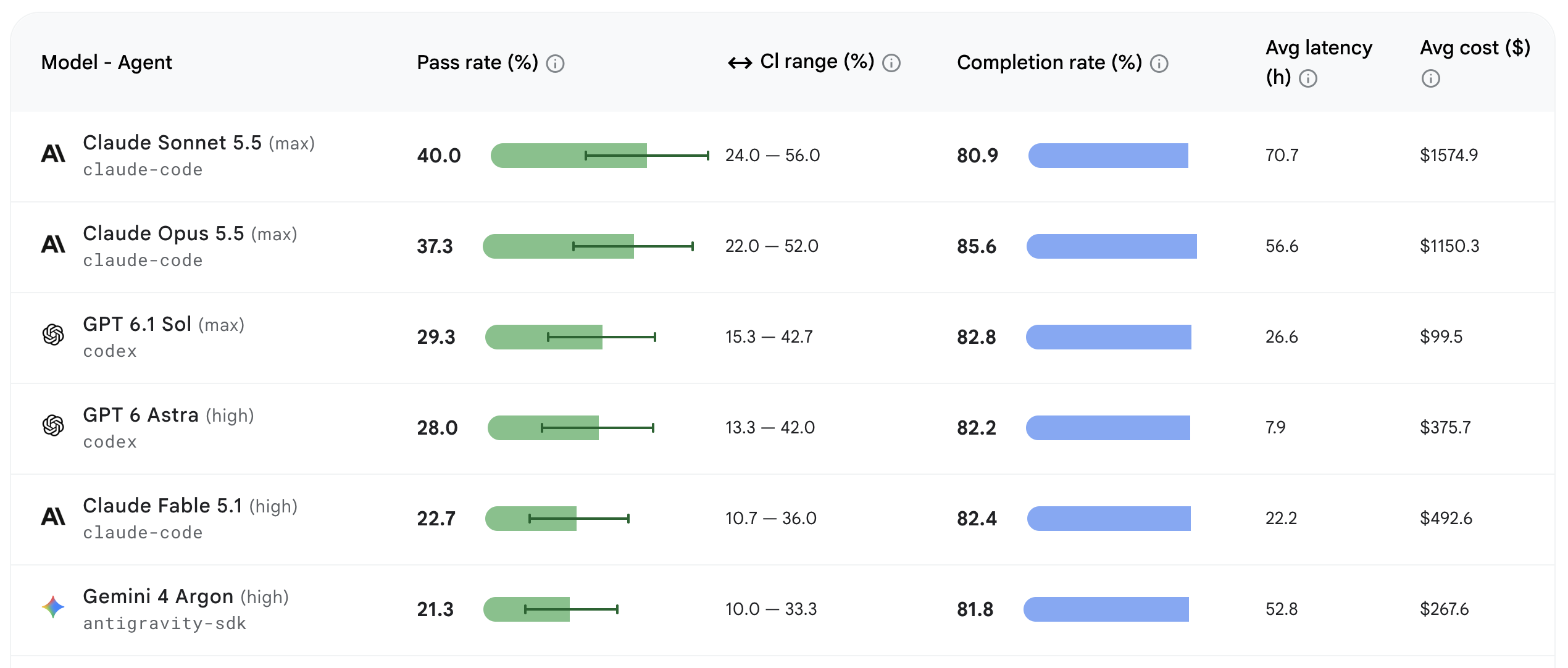
According to the updated leaderboard, Anthropic continues to dominate the upper echelons of Android coding assistance. Claude Sonnet 5.5 currently secures the top position, commanding an impressive pass rate of 40% and a high code completion rate of 80.9%. It is closely followed by its sibling architecture, Claude Opus 5.5, which was integrated into the benchmarking framework in early October and maintains a competitive runner-up status. These figures underscore Anthropic’s sustained strength in handling complex, multi-step logical reasoning tasks required in software architecture.
However, the most commercially intriguing addition to the October benchmark update is OpenAI’s GPT-6.1 Sol. While securing a lower pass rate of 29.3%, the model achieves a remarkably strong completion rate of 82.8%. More importantly, the economic telemetry associated with GPT-6.1 Sol highlights a dramatic divergence in cost efficiency. Running the benchmark suite utilizing OpenAI’s model incurs an average cost of just $99.50. In stark contrast, securing the top-tier performance delivered by Anthropic’s Claude models demands an expenditure of $1,574.90 for equivalent processing tasks. This vast economic disparity presents software engineering managers with a critical optimization puzzle: determining whether a marginal increase in pass rate justifies a cost multiplier exceeding fifteen times the baseline expense.
The most conspicuous storyline emerging from the updated Android Bench telemetry is the underwhelming debut of Google’s own Gemini 4 Argon. Positioned significantly behind competing frontier models, Gemini 4 Argon lands in a distant fifth place on the leaderboard. The model lags behind even mid-tier competitors such as Claude Fable 5.1, registering a modest pass rate of 21.3% and a completion rate of 81.8%. Furthermore, its operational efficiency places a moderate financial burden on developers, recording an average cost of $267.70 per evaluation cycle.
The subdued performance of Gemini 4 Argon aligns with prior industry reports and internal rumblings that surfaced shortly after the model’s initial announcement in late September. Following the public unveiling of Gemini 4 Argon, unverified leaks and internal assessments suggested that the model exhibited vulnerabilities when managing specific, intricate coding tasks. At the time, Google publicly defended the architectural integrity and overarching capabilities of its flagship model. Nevertheless, the empirical data published in the official Android Bench framework provides objective validation of these operational hurdles, demonstrating tangible gaps in specialized programming domains compared to competing systems from OpenAI and Anthropic.
The implications of these benchmark results extend far beyond academic curiosity, carrying direct consequences for the enterprise software market and individual developer workflows. As artificial intelligence transitions from a novelty tool to an indispensable co-pilot in integrated development environments (IDEs) such as Android Studio, the reliability of code generation becomes paramount. Flawed or sub-optimal code generated by inferior models can introduce severe security vulnerabilities, memory leaks, or performance bottlenecks that degrade the end-user experience on millions of mobile devices.
Furthermore, the cost metrics highlighted in the Android Bench framework emphasize the delicate economics of scaling AI-assisted development across large engineering organizations. While engineering leaders naturally gravitate toward models with the highest pass rates—such as Anthropic’s Claude Sonnet 5.5—the financial overhead of continuous integration and automated code refactoring can rapidly escalate operational budgets. Conversely, models that offer high completion rates at a fraction of the cost, exemplified by OpenAI’s GPT-6.1 Sol, present a compelling alternative for organizations prioritizing fiscal restraint without sacrificing baseline productivity.
For Google, the performance of Gemini 4 Argon on its native development benchmark represents both a technical challenge and a strategic imperative. As the primary steward of the Android operating system, maintaining leadership in developer tooling is vital to ensuring the long-term health and vibrancy of the platform ecosystem. The data generated by Android Bench provides Google’s engineering teams with clear diagnostic insights regarding where the underlying architecture of Gemini 4 Argon requires refinement.

As the artificial intelligence landscape continues its rapid evolution, benchmarks like Android Bench serve as vital barometers for the software engineering industry. They strip away marketing narratives and hyperbolic capability claims, offering empirical clarity on how frontier models perform under standardized, real-world constraints. Whether Google can leverage these insights to rapidly iterate on future iterations of the Gemini architecture—and whether competitors like OpenAI and Anthropic can close the cost-to-performance gap—will shape the trajectory of mobile software development in the years ahead.