Benchmarking Scikit-Ollama vs. Groq-Backed Scikit-LLM: Speed, Cost, and Accuracy


The rapid proliferation of Large Language Models (LLMs) has forced developers to confront a fundamental architectural dilemma: should intelligence be deployed on local infrastructure or offloaded to cloud-based inference providers? As the industry shifts from experimental prototyping to production-grade applications, the trade-offs between latency, data sovereignty, and operational expenditure have become central to software engineering strategy. By leveraging standardized interfaces such as Scikit-Ollama and Scikit-LLM, engineers can now execute rigorous, side-by-side performance benchmarks that quantify these variables with scientific precision.
The Evolution of Model Deployment Strategies
The landscape of LLM deployment has split into two primary camps over the last eighteen months. Local inference, facilitated by platforms like Ollama, allows developers to run sophisticated models such as Llama 3 on consumer-grade hardware. This approach is primarily driven by the need for data privacy, reduced reliance on third-party uptime, and the elimination of per-token API costs. Conversely, cloud-backed inference—specifically utilizing high-performance, low-latency platforms like Groq—offers the ability to run larger, more parameter-dense models without the overhead of maintaining specialized GPU clusters.
Historically, comparing these two environments required disparate codebases and inconsistent evaluation metrics. However, the maturation of wrapper libraries like Scikit-LLM and Scikit-Ollama has enabled developers to treat LLMs as traditional machine learning estimators. This interoperability allows for the application of standard scikit-learn conventions—specifically the .fit() and .predict() paradigm—to complex generative tasks, effectively lowering the barrier to entry for comparative performance analysis.
Establishing the Benchmarking Framework
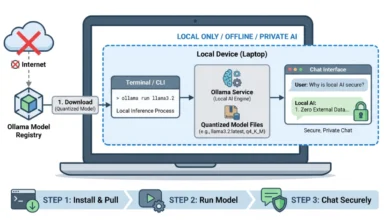
To evaluate these systems, engineers must establish a controlled environment that measures execution time, classification accuracy, and cost-efficiency. The setup begins by normalizing the development environment. For local deployments, Ollama acts as a background server, abstracting the complexities of model quantization and weight management. The installation process typically involves pulling the target model—such as Meta’s Llama 3—and configuring the local environment variables.
The benchmarking logic relies on a centralized "helper" function. This function serves as the arbiter of the experiment, ensuring that both the local and cloud estimators are subjected to identical input data, candidate labels, and evaluation metrics. By tracking the perf_counter at the start and end of the prediction cycle, developers can capture precise latency metrics that are critical for real-time application design.
Comparative Chronology and Performance Metrics
In a standardized test, the local deployment of a Llama 3 instance provides a baseline for performance. When processing a small, five-item sentiment analysis dataset, the local pipeline often exhibits higher latency. In controlled benchmarks, local inference cycles can span upwards of 80 seconds, largely due to the overhead of cold-starts and the compute-bound nature of running large models on localized hardware.
The primary advantage here is the cost profile: an effective investment of $0.00. This is an essential consideration for enterprises dealing with proprietary datasets where data egress to cloud providers is prohibited by compliance regulations. The accuracy of such models is competitive, often mirroring cloud performance on standardized tasks; however, the hardware requirements—specifically VRAM availability—remain a significant bottleneck for scaling to larger, concurrent request volumes.
The alternative, a cloud-backed pipeline using the Groq API via Scikit-LLM, presents a distinct set of operational metrics. By routing queries through a dedicated cloud endpoint, the latency profile shifts dramatically. In similar testing conditions, response times can drop from over 80 seconds to approximately two seconds. This performance leap is attributed to the specialized LPU (Language Processing Unit) architecture that powers Groq’s inference stack, which is optimized specifically for sub-second token generation.
Analyzing the Economic and Technical Implications
The economic argument for cloud-based inference is currently defined by aggressive pricing models and free-tier access provided by emerging API startups. While the current benchmark reveals a $0.00 cost for the cloud-tier test, developers must anticipate future shifts toward tiered pricing models as these platforms move toward commercial sustainability.
The technical implications for developers are twofold:
- Developer Experience: The integration of
SKLLMConfigallows for seamless switching between different model providers. By merely modifying the URL prefix—such as usingcustom_url::openai/gpt-oss-20b—a developer can pivot from a local model to a high-performance cloud model without refactoring the core business logic. - System Scalability: Local models are limited by the physical hardware of the host machine. While this ensures independence from network latency, it introduces a hard ceiling on concurrent users. Cloud models, while dependent on API reliability and network throughput, offer elastic scaling that is better suited for high-traffic, production-facing applications.
Industry Responses and Future Outlook
Industry observers and platform architects have noted that the "local vs. cloud" debate is moving toward a hybrid consensus. Many firms are now adopting a strategy where non-sensitive, high-throughput tasks are routed to efficient cloud endpoints, while sensitive, high-value data is processed through local, air-gapped instances of open-weights models.
The rise of tools like Scikit-Ollama and Scikit-LLM represents a significant milestone in this trajectory. By abstracting the inference layer into a standard library format, the AI community is effectively commoditizing the choice of backend. This shift forces model providers to compete not just on performance, but on transparency, security, and ease of integration.
Conclusion
The benchmarking of LLM classifiers is no longer an exercise reserved for infrastructure researchers. It has become a standard requirement for developers aiming to build robust, cost-effective, and performant AI applications. As demonstrated by the comparison of local Llama 3 deployments and cloud-based Groq inference, there is no universal "better" solution; rather, there is a design trade-off that depends entirely on the specific requirements of the project.
Local deployment remains the gold standard for data privacy and long-term cost stability, provided the developer has the hardware resources to sustain it. Cloud-backed deployment, conversely, provides unparalleled speed and ease of integration, making it the preferred choice for rapid iteration and high-scale production needs. By employing a rigorous, code-based benchmarking approach, engineering teams can navigate these trade-offs with data-driven confidence, ensuring that their chosen architecture aligns with their broader business and technical objectives. As the ecosystem continues to evolve, the ability to rapidly benchmark and switch between these inference engines will remain a critical skill for any developer operating within the generative AI space.