AWS Launches TorchNeuron to Run PyTorch Models on AWS Trainium Without Modifications

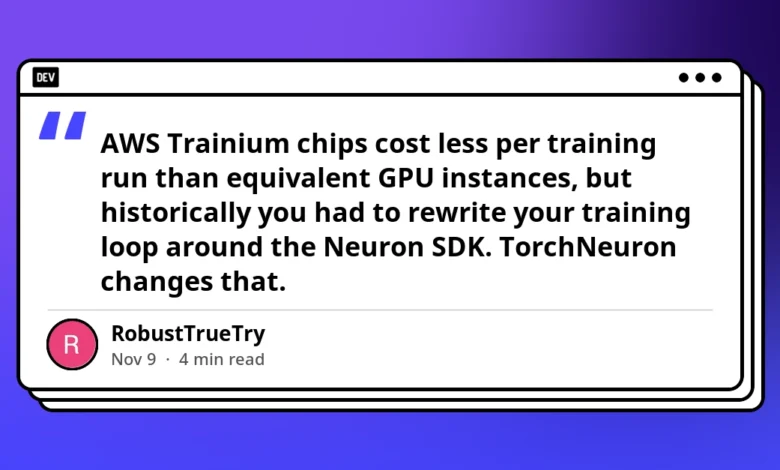
The landscape of machine learning infrastructure is undergoing a significant transformation as cloud providers race to offer cost-effective alternatives to traditional GPU clusters. Amazon Web Services has taken a major step forward in this competitive market by introducing advanced software integrations designed to harness the power of its custom-built AWS Trainium chips. Historically, deploying deep learning workloads to Trainium required developers to extensively refactor their training loops around the Neuron Software Development Kit, creating a steep learning curve and significant technical overhead. With the rollout of updated TorchNeuron tooling, AWS aims to lower this barrier to entry by registering a native PyTorch backend, allowing engineering teams to transition their models using minimal code adjustments centered primarily on the forward pass.
As enterprises face mounting pressure to optimize their cloud compute expenditures, specialized accelerators like Trainium have emerged as vital tools for managing the skyrocketing costs associated with large-scale model training. While Trainium instances—specifically the EC2 trn1 family—frequently demonstrate lower costs per training run compared to equivalent GPU-based instances, software friction has remained a persistent hurdle for adoption. The new TorchNeuron framework addresses this challenge by streamlining the porting process through standard PyTorch primitives. However, engineering leaders and machine learning practitioners must navigate specific architectural requirements, including XLA graph compilation nuances, hardware-specific optimization routines, and potential performance bottlenecks in data loading pipelines, to fully realize the economic and computational benefits of the platform.
Background Context and the Evolution of Custom Silicon
The genesis of AWS Trainium traces back to Amazon’s broader strategic initiative to reduce reliance on third-party hardware vendors and to tailor silicon directly to the workloads demanded by modern artificial intelligence. Following the successful deployment of AWS Inferencing chips, Trainium was engineered from the ground up to handle the intensive matrix multiplications and parallel processing tasks characteristic of deep learning training phases. Despite the hardware’s raw performance capabilities and attractive pricing structure, software maturity dictated early adoption patterns. Traditional deep learning frameworks were deeply entrenched in the CUDA ecosystem, meaning that hardware from alternative vendors often required proprietary compilation frameworks that disrupted standard developer workflows.
The introduction of native PyTorch integration via TorchNeuron represents a pivotal maturation phase for the Neuron SDK ecosystem. By abstracting away much of the low-level hardware communication and presenting a familiar interface to PyTorch developers, AWS is attempting to bridge the gap between custom silicon efficiency and software accessibility. This strategic shift mirrors broader industry trends where hardware differentiation is increasingly defined not just by raw transistors, but by the seamlessness of the software stack that orchestrates them. As organizations train increasingly massive transformer models and complex neural networks, the ability to transition existing codebases without radical architectural rewrites has become a decisive factor in infrastructure procurement decisions.
Technical Architecture and the Compilation Workflow
Transitioning a PyTorch model to run on AWS Trainium requires an understanding of how the underlying hardware processes computational graphs. Unlike standard GPUs that execute eager-mode operations dynamically, Trainium relies on Accelerated Linear Algebra (XLA) graph compilation. When utilizing TorchNeuron, the framework traces the model architecture ahead of execution to build a static computation graph. This foundational step requires developers to define clear example inputs, freezing tensor shapes and dimensions before the compilation phase begins.
The compilation process is initiated via standard tracing utilities within the PyTorch ecosystem, where a model set to evaluation mode is paired with dummy tensors reflecting expected runtime shapes. While this mechanism simplifies the initial porting phase, it introduces specific constraints regarding dynamic behavior. For instance, if a compiled model encounters inputs with varying sequence lengths or batch sizes during production training or inference runs, the runtime environment may trigger dynamic recompilation. Such events can introduce latency spikes and temporary throughput degradation. Consequently, machine learning engineers working with transformer architectures must carefully implement sequence padding and bucketing strategies to maintain computational efficiency.
Addressing Unsupported Operations and Device Fallbacks
While the core operator library supported by the Neuron compiler covers standard deep learning primitives—including convolutions, matrix multiplications, and attention mechanisms—developers frequently encounter a long tail of complex operations that present compilation challenges. Dynamic control flow, sparse tensor manipulations, and non-standard einsum patterns can occasionally fail to lower successfully onto the Trainium accelerator. When the compiler encounters an unsupported operation, the workload typically defaults to CPU execution or triggers a compilation error.
The implications of device fallback can be severe from a performance perspective. When tensors must constantly cross the boundary between the host CPU and the Trainium accelerator, the latency introduced by these memory transfers can quickly dominate step execution times, neutralizing the speed advantages of the hardware. To mitigate these issues, developers must analyze compiler diagnostic logs, isolate unsupported operators through systematic bisection of the model graph, and replace custom or non-optimized layers with hardware-friendly alternatives. Furthermore, utilizing specialized libraries provided within the ecosystem, such as XLA-fused versions of optimization algorithms like Adam and AdamW, helps keep complex parameter updates resident on the accelerator.
Optimizing the Entire Training Loop
A common pitfall encountered by engineering teams migrating workloads to alternative accelerators is focusing exclusively on model architecture while neglecting the surrounding training loop. While inference tasks can often be streamlined with straightforward model tracing, active training environments expose multiple operational bottlenecks that can stall accelerators if left unaddressed. Data loading pipelines, in particular, frequently fail to keep pace with high-performance silicon, transforming the CPU-side data ingestion process into the primary system bottleneck.
To maintain optimal hardware utilization, practitioners must implement aggressive data prefetching and ensure that input tensors match the exact data types and shapes defined during the initial tracing phase. Even minor discrepancies, such as an unintended precision mismatch from float64 tensors, can trigger costly memory copies and inadvertent recompilations. Additionally, standard logging practices—such as calling .item() on loss tensors during every iteration—force continuous synchronization between the device and the host, halting the training pipeline at every step. By accumulating metrics locally on the accelerator and synchronizing data only at designated logging intervals, engineering teams can eliminate unnecessary stalls and significantly improve overall training throughput.
Debugging Methodologies and Diagnostic Tools
Debugging compilation failures within an XLA-based environment requires a distinct set of diagnostic strategies compared to traditional CUDA debugging. Because error messages generated during graph lowering can occasionally obscure the root cause of a failure, AWS provides environment variables designed to increase diagnostic visibility. Setting specific environment flags allows developers to dump intermediate compilation graphs to disk, facilitating a granular examination of how far the compiler progressed before encountering an incompatible operation.
Moreover, leveraging specialized compiler flags optimized for transformer models can unlock targeted optimizations and enhance error reporting for attention-heavy neural network architectures. When encountering persistent, ambiguous compilation errors, engineers often resort to a methodical bisection approach—successively tracing and isolating halves of the model until the problematic operator is identified. Although iterative, this empirical debugging workflow provides a reliable pathway to uncovering subtle compatibility issues that can be resolved with minor code modifications.
Broader Industry Implications and Future Outlook
The maturation of tools like TorchNeuron signals a broader shift in the cloud computing market, where the democratization of specialized hardware is becoming a competitive necessity for hyperscale providers. As artificial intelligence models continue to grow in scale and operational complexity, the financial sustainability of training large language models and foundational architectures will increasingly depend on heterogeneous computing strategies. By reducing the friction associated with migrating PyTorch workloads to custom silicon, AWS is positioning Trainium as a viable, cost-effective counterweight to traditional GPU dominance.
Industry analysts suggest that the long-term success of alternative hardware platforms will be measured not merely by theoretical peak performance metrics, but by the developer experience and software ecosystem surrounding them. Initiatives that bridge the gap between standard, widely adopted frameworks like PyTorch and proprietary hardware architectures are crucial for driving enterprise adoption. As these software layers continue to evolve and compiler capabilities expand to handle increasingly complex dynamic workloads, the economic calculus of AI infrastructure deployment is poised to shift, offering engineering organizations greater flexibility and control over their computational budgets.