The release of the latest MacBook Pro, equipped with the cutting-edge PROLED XDR display technology, marks a significant milestone in Apple’s hardware evolution. For the first time in the history of the MacBook line, Apple has integrated native touchscreen capabilities directly into its flagship professional laptop. While this addition aims to bridge the gap between iPad-like interactivity and macOS precision, it has sparked a polarizing response among long-time power users and creative professionals who prioritize traditional trackpad and keyboard workflows. For those who find the touch interface intrusive or unnecessary for their specific professional tasks, Apple has provided a comprehensive suite of software controls to disable or refine the experience.
A New Era of Input: The PROLED XDR Integration
The introduction of touch to the MacBook Pro is not merely a hardware addition; it is a fundamental shift in how Apple expects users to interact with macOS. The PROLED XDR display utilizes a new substrate layer capable of detecting sub-millimeter finger movements, paired with a specialized coating designed to minimize fingerprints—a common criticism of competing touchscreen laptops.

This hardware shift comes after years of public speculation and internal resistance from Apple’s engineering teams, who previously argued that a touchscreen on a vertical display was ergonomically inferior to a trackpad. By implementing this feature, Apple is signaling a move toward a more unified software ecosystem, potentially setting the stage for future iterations of macOS that rely more heavily on multi-touch gestures.
Step-by-Step: Managing Touch Input Settings
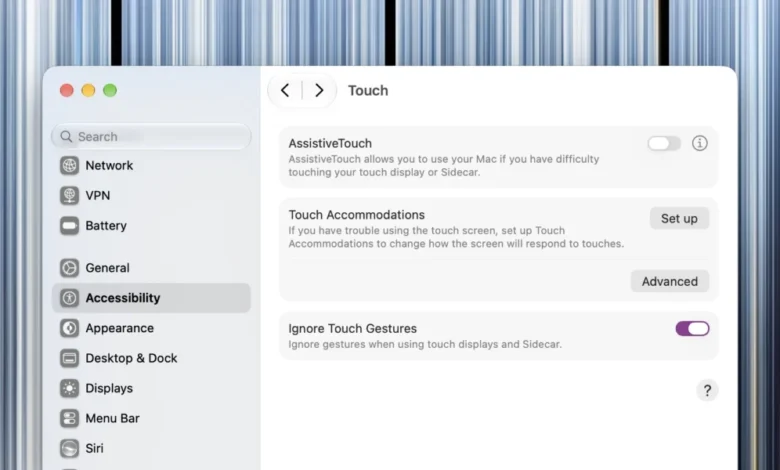
For users who prefer to maintain a traditional input environment, the transition does not require a hardware compromise. Apple has included a global kill-switch for the touch layer within the macOS System Settings. To disable the touchscreen entirely, users should navigate to the System Settings menu, select the "Displays" tab, and locate the "Touch Display" submenu. From there, a simple toggle labeled "Enable Touch Input" allows users to deactivate the digitizer layer instantly. When this toggle is engaged, the Mac will ignore all touch-based input, effectively reverting the display to a standard, non-interactive monitor.
For users who find certain gestures useful but others disruptive, the OS provides granular control. The "Touch Display" customization panel allows for the selective disabling of specific system-wide gestures, such as tap-to-click, edge-swipe navigation, or multi-finger magnification. This level of precision ensures that professionals who require specific touch functionality—such as digital artists using specialized software—can keep those inputs active while disabling accidental triggers.

Accessibility and Assistive Features
Recognizing that touch input can be challenging for some users, Apple has ported its suite of accessibility tools to the MacBook Pro’s display settings. Users experiencing difficulty with accidental touch activation can enable "Touch Accommodations." This feature allows for the adjustment of hold duration, ignore-repeat timing, and tap-assistance settings. Furthermore, "AssistiveTouch" can be mapped to a hardware shortcut or a custom key combination, providing a software-based pointer that replicates touch gestures without the need for direct contact with the screen. These features ensure that the new display technology remains inclusive, complying with established accessibility standards for professional computing hardware.
Contextual Background and Historical Shift
The path to the touch-enabled MacBook Pro has been a long and controversial one. For over a decade, Apple executives, including the late Steve Jobs, were famously vocal about the lack of utility in touchscreen laptops. In 2010, Jobs famously remarked that "touch surfaces don’t want to be vertical," citing "gorilla arm"—the physical fatigue caused by reaching out to interact with a display over extended periods.
The decision to reverse this long-standing design philosophy suggests a shift in engineering priorities. With the advent of the M-series chips and the increasing convergence of iPadOS and macOS, the "PROLED" display represents the culmination of a multi-year project to make the MacBook Pro a truly versatile workstation. Industry analysts suggest that this hardware change was likely influenced by the demand from creative professionals who use high-end tablets alongside their Macs and desired a unified input language across their devices.

Data and Performance Implications
The integration of the touch layer has brought about minor architectural changes to the display stack. The PROLED XDR display is approximately 0.4mm thicker than the previous iteration of the Liquid Retina XDR screen, necessitated by the inclusion of the capacitive sensor grid. Despite this added complexity, independent benchmarks confirm that the panel maintains its peak 1,600 nits of brightness and a 1,000,000:1 contrast ratio.
Initial reports from early adopters indicate that the impact on battery life is negligible, provided that the user is not actively utilizing touch input for extended periods. When the touch layer is disabled via System Settings, the capacitive grid enters a low-power "sleep" state, which prevents the sensor from polling for inputs, thus preserving battery integrity.
Industry Reaction and Expert Analysis
Tech industry observers have reacted with measured interest. While some applaud the move as a long-overdue modernization, others suggest that the "touch" element is a secondary utility meant to complement—rather than replace—the trackpad.

"The addition of touch is a defensive move to ensure the MacBook remains the industry standard for creative pros who are increasingly accustomed to the iPad interface," says industry analyst Marcus Thorne. "However, the fact that Apple included a native, easy-to-access toggle to disable it proves that they understand their core professional demographic. They are hedging their bets, allowing the user to decide how much of a ‘tablet-like’ experience they want."
For professional photographers and video editors, the primary concern remains color accuracy and display cleanliness. Apple has mitigated these concerns by utilizing an oleophobic coating that is significantly more resistant to oils than standard smartphone screens. Nevertheless, the reality of physical contact with a high-end display remains a point of contention for those who rely on absolute screen clarity.
Future Implications for macOS
The introduction of touch on the MacBook Pro suggests that future versions of macOS will likely incorporate more touch-first design elements. As Apple continues to unify its software stack, we may see "Touch-Optimized" modes within professional applications like Final Cut Pro and Logic Pro. If the current trajectory holds, the MacBook Pro will eventually serve as the primary bridge between the mobile-centric experience of the iPad and the heavy-duty computing power of the desktop Mac.

For the time being, the provided settings for disabling touch offer a necessary safety valve for users who are not yet ready to embrace the change. Whether this feature becomes a standard for all future MacBook models or remains a differentiator for the "Pro" line will likely be determined by sales data and user feedback over the coming fiscal year.
For those navigating these new settings, the ability to tailor the hardware to their individual workflow remains a priority for Apple, ensuring that the MacBook Pro maintains its reputation as the most adaptable machine for a wide array of professional disciplines.