DoorDash Slashes Conversational AI Grocery Reorder Latency from 16 Seconds to 2 Seconds Through Precomputation Architecture

Food delivery and local commerce giant DoorDash has achieved a dramatic performance breakthrough for its conversational shopping assistant, Ask DoorDash, successfully reducing the latency of its AI-powered grocery reorder flow from approximately 16 seconds down to just 2 seconds. The optimization, detailed in a series of engineering publications by the company, relies on a strategic architectural shift: moving heavy Large Language Model (LLM) reasoning and recurring purchase analysis out of the live request cycle and into an offline, precomputed batch process.
This reduction in waiting time has yielded immediate and substantial engagement gains across the platform. According to internal metrics released by DoorDash, the optimization doubled shopping list views and drove an approximately 34% increase in the overall order conversion rate for the grocery reordering flow. The implementation represents a significant milestone in the ongoing evolution of Ask DoorDash, highlighting how enterprise-grade agentic systems can balance advanced contextual personalization with the strict response-time demands of modern consumer applications.
Background and Architectural Evolution of Ask DoorDash
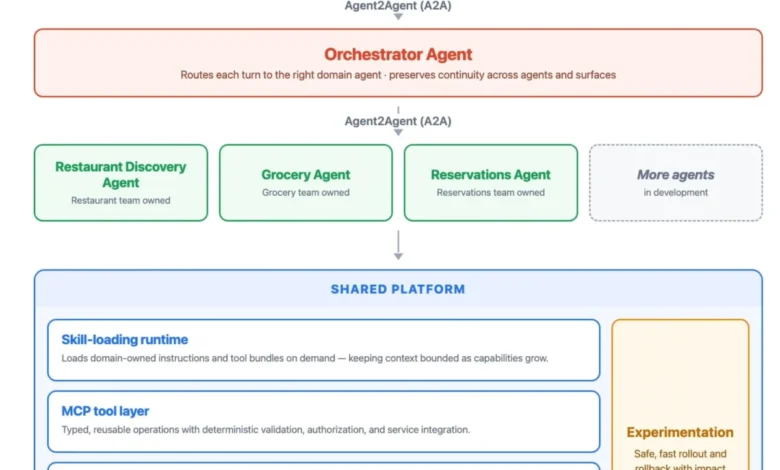
The path to sub-second grocery reordering began with the foundational rollout of Ask DoorDash, an AI-driven conversational assistant designed to help users navigate product discovery, recipe planning, and checkout through natural language. Previous architectural phases established a shared agent platform and a grounded shopping interface. These foundational layers provided reusable infrastructure—including memory management, orchestration tools, model access, tracing, and rigorous evaluation pipelines—allowing specialized domain teams to rapidly build, deploy, and scale intelligent agents.
Within this framework, domain engineering teams retain control over specific agent instructions, operational skills, specialized tools, and evaluation metrics. The efficacy of this shared platform approach was demonstrated during the subsequent integration of a dedicated Reservations agent, which engineering teams deployed in roughly one week—a development velocity reported to be approximately ten times faster than the timeline required to construct the platform’s initial domain-specific agents.
Despite the flexibility of the shared platform, the original grocery reordering workflow suffered from performance bottlenecks. Traditionally, when a customer initiated a reorder request, the system executed a live LLM inference loop on the fly. This loop required the model to simultaneously parse 90 days of consumer purchase history, evaluate profile signals, deduce recurring needs, resolve product availability against live store catalogs, and format the output. This heavy computational load resulted in a sluggish 16-second delay—an eternity in modern e-commerce UX where users expect instantaneous feedback.
The Mechanics of Precomputation: Batch Inference and Deterministic Validation
To solve the latency dilemma, DoorDash engineers re-evaluated the division of labor within the agent loop. As Twisha Jain, a software engineer at DoorDash, noted in a professional commentary on the design philosophy: "Better agentic systems aren’t always about more reasoning; they’re about deciding what belongs in the agent loop and what can happen ahead of time."
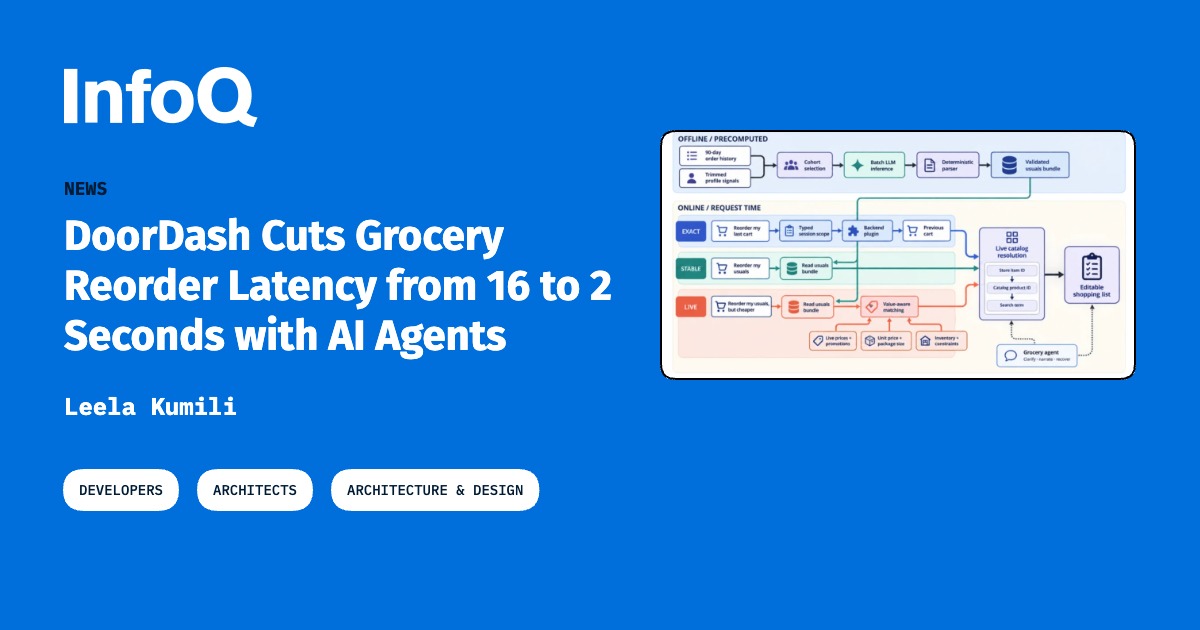
Adhering to this principle, DoorDash decoupled historical purchase analysis from real-time customer interactions. The updated architecture shifts heavy computation to an offline batch processing pipeline. Behind the scenes, the system continuously ingests and analyzes 90 days of consumer transaction history alongside comprehensive user profile signals. Batch LLM inference engines run asynchronously to identify patterns and predict likely recurring purchase needs.
Once the LLM generates these preliminary recommendations, the system routes them through a deterministic validation layer. This programmatic check verifies the integrity and plausibility of the generated results before writing the finalized structured data to a reusable shopping list repository. By performing this intensive reasoning offline, the system eliminates the need for generative AI calculations during the moment-of-intent user request.
Real-Time Catalog Resolution and Intelligent Fallbacks
While offline precomputation handles historical pattern recognition, live retail environments are inherently volatile. Inventory levels fluctuate, prices shift, items go out of stock, and product listings are frequently updated by merchants. To prevent stale data from breaking the user experience, DoorDash engineered a robust serving-path resolution mechanism.
When a customer triggers the grocery reorder flow, the serving path instantly retrieves the precomputed shopping list and initiates a multi-tiered resolution process against the current, live product catalog. The system follows a structured fallback hierarchy:
- Primary Match: It first attempts to match the exact original store item purchased in the historical transaction.
- Secondary Match: If the exact item is unavailable, it searches for an equivalent catalog product identifier.
- Tertiary Match: As a final resort, it evaluates standardized search terms to locate a suitable substitute.
This cascading resolution strategy ensures that customers are presented with accurate, immediately purchasable inventory without forcing the system to repeat historical reasoning loops for every individual request.
The Grounded Shopping Interface and Authoritative Direct Edits
The grocery reorder optimization is deeply integrated with Ask DoorDash’s grounded shopping interface. Rather than treating the conversation strictly as a linear text transcript, the architecture treats the shopping list as a structured, interactive artifact that both the user and the agent can modify.
To maintain system reliability and predictability, DoorDash implemented strict authority rules regarding user interactions. According to engineering documentation on the shopping interface: "A consumer’s direct edit is authoritative: the next agent turn starts from the edited list, not from what was said earlier."
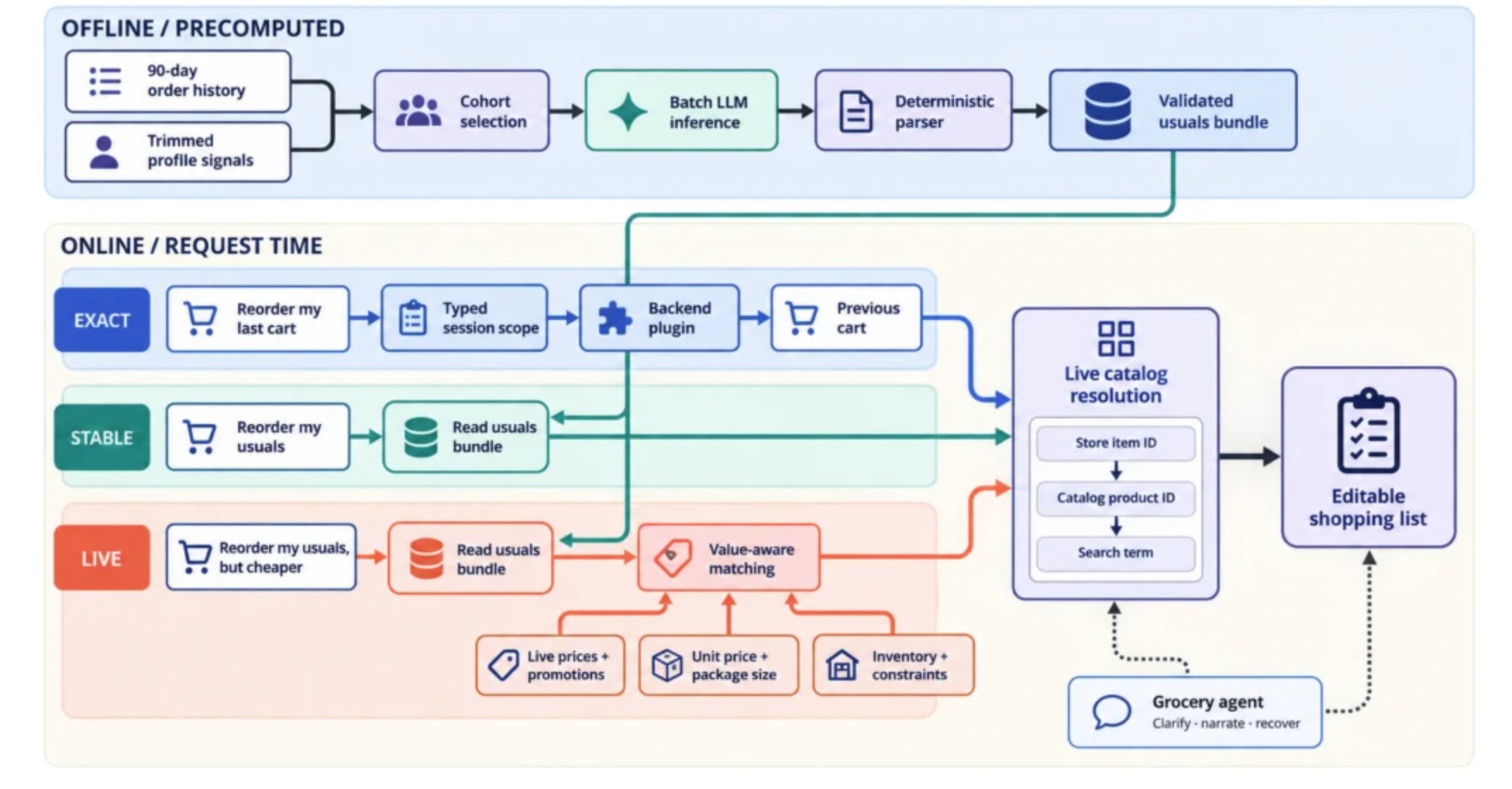
This design choice prevents state-sync drift between conversational memory and visible UI elements. When a user performs simple, mechanical operations—such as adjusting quantities, swapping package sizes, or removing unwanted items—the interface updates the structured list directly. These routine edits execute locally without triggering unnecessary LLM round trips, preserving low latency.
However, when a request demands complex contextual reasoning—such as finding cheaper product alternatives based on real-time pricing, active promotions, or shifting dietary preferences—the system seamlessly invokes the specialized Grocery agent to handle the deeper cognitive workload.
Broader Industry Context and Competitive Landscape
DoorDash’s architectural refinement reflects a broader industry-wide maturation in how consumer-facing artificial intelligence is engineered. Across the e-commerce and grocery delivery sectors, companies are shifting away from naive implementations where generative models attempt to handle every single application layer in real time, moving instead toward hybrid architectures that combine deterministic software engineering with targeted AI inference.
Competitors are likewise innovating in conversational commerce. Instacart, for instance, has heavily invested in its own AI-powered shopping assistant, leveraging over a decade of proprietary grocery data to support meal planning, cart creation, and item discovery based on localized inventory and user preferences. However, while many platforms focus primarily on expanding the feature sets of conversational assistants, DoorDash’s recent engineering focus underscores the critical importance of performance optimization, user-experience friction reduction, and infrastructural modularity.
Implications for the Future of Agentic AI Commerce
The success of the 2-second grocery reorder flow carries significant implications for the design of future agentic AI systems. By demonstrating that precomputation and deterministic validation can dramatically improve both system responsiveness and business metrics (such as the 34% boost in order conversion rates), DoorDash has established a blueprint for enterprise AI efficiency.
The reliance on a shared agent platform also signals a scalable organizational model for technology companies. By abstracting core agent infrastructure—such as memory, tracing, orchestration, and evaluation—into a centralized framework, product teams can iterate rapidly, deploying new domain-specific agents in days rather than months.
As consumers increasingly adopt conversational interfaces for routine, high-frequency tasks like grocery shopping, system latency and reliability will serve as key differentiators. DoorDash’s pivot from live generative reasoning to asynchronous precomputation illustrates that the future of agentic AI lies not just in smarter models, but in smarter system architecture that respects the user’s time and operational constraints.