Bitcoin Faces Major Resistance as Key Support Crumbles, Analyst Predicts Significant Downside Ahead


Bitcoin has encountered what a prominent market analyst has identified as a critical resistance level, following the breakdown of a long-standing support zone that had underpinned the cryptocurrency’s stability for several months. After a recent failed attempt to breach the $83,000 mark, the prevailing sentiment among some market observers is that purchasing Bitcoin at its current valuations presents a heightened risk-reward profile. Instead, attention is shifting towards a substantially lower price target, a level anticipated to draw significant buyer interest and potentially re-establish a floor for the digital asset.
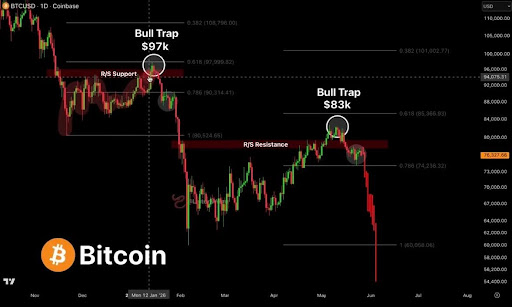
The analyst’s assessment hinges on the collapse of the approximately $80,500 price area. This region had served as a crucial bedrock for Bitcoin’s trading range over an extended period. Historically, during previous market pullbacks, this zone was consistently defended by eager buyers, facilitating price stabilization and enabling Bitcoin to rebound and pursue new all-time highs. However, this established dynamic appears to have undergone a significant reversal.
Following a brief surge towards the $83,000 level in May, Bitcoin failed to sustain its upward momentum, subsequently losing considerable strength. This rejection was characterized by the analyst as a "bull trap," a deceptive market scenario where traders enter positions expecting a breakout, only to witness a sharp reversal downwards. Since this event, the same price region that previously attracted robust demand has now transitioned into a formidable resistance barrier. This shift suggests a potential exhaustion of earlier buyers or a strategic withdrawal, while sellers have become more assertive on any price rebounds. The analyst posits that this change in market behavior explains the perceived lack of conviction and rapid fading of recent recovery attempts.
The breach of this critical support level also underscored the underlying fragility that had developed within the market structure. Once Bitcoin descended below its established range floor, selling pressure intensified rapidly. This phenomenon can be likened to an "air pocket" in trading terminology, a zone where there is a notable absence of strong buying interest, thereby offering little resistance to a downward price movement.
While Bitcoin continues to trade above the mid-$70,000s, the analyst does not view this area as a sustainable long-term support level. Instead, it is perceived as offering only temporary respite within a broader downward trend that has been in development for several months. This perspective aligns with a cyclical view of market movements, where previous support levels, once broken, often transform into areas of resistance, and vice versa.
Historical Context and the Shifting Market Landscape
The cryptocurrency market, particularly Bitcoin, has a history of pronounced volatility, characterized by rapid ascents and sharp corrections. The period leading up to May saw Bitcoin achieve significant gains, reaching near-record highs. This upward trajectory was fueled by a confluence of factors, including growing institutional adoption, favorable macroeconomic conditions, and ongoing development within the blockchain ecosystem. However, market cycles are inherent, and periods of consolidation and correction are often viewed as natural phenomena following extended rallies.
The breakdown of the $80,500 support level can be traced back to specific market events and sentiment shifts. Following the all-time highs, a period of profit-taking emerged, combined with an increasing number of traders positioning themselves for a potential downturn. The failed push towards $83,000 served as a catalyst, signaling to many that the upward momentum had stalled. This triggered a cascade of sell orders as stop-loss levels were hit and new short positions were initiated.
The analyst’s commentary suggests that the market may be entering a phase of deeper correction, a sentiment that has been building for some time among a segment of traders. The failure of Bitcoin to reclaim previous highs, coupled with the breach of key technical levels, has shifted the sentiment from bullish optimism to cautious pessimism for some market participants.
Technical Analysis and the $60,000 Target
The analyst’s projection of a more attractive entry zone for Bitcoin lies significantly lower, specifically within the $60,000 to $62,000 range. This forecast is closely linked to a Fibonacci extension level situated near the $60,000 mark. This level is considered a broader downside target stemming from the breakdown structure that began to form earlier in the year.

From this analytical perspective, the market is perceived as being in the midst of an incomplete correction. Previous failed rallies, including those that faltered near $97,000 and the more recent $83,000 level, are now being interpreted not as indicators of underlying strength, but rather as evidence of waning momentum. This implies that the buying pressure required to sustain higher prices is diminishing, while selling pressure is becoming more dominant.
The current expectation is that any short-term upward movements are likely to encounter renewed selling pressure below the broken $80,500 resistance level. Until Bitcoin can convincingly reclaim this former support, now acting as resistance, or descend into the projected lower demand zone, the analyst sees little fundamental justification for aggressive buying activity at current price points.
This outlook highlights a growing divergence in trading strategies and market sentiment. Instead of attempting to buy at what is perceived as a precarious price level, the advice offered is to await a more opportune entry point, potentially in the $60,000 to $62,000 region, where a resurgence of stronger, long-term demand is anticipated.
Broader Market Implications and Data Analysis
The implications of this bearish outlook extend beyond individual trading strategies. A sustained downward trend in Bitcoin could have ripple effects across the broader cryptocurrency market, often referred to as "altcoins," which tend to follow Bitcoin’s price movements with amplified volatility. If Bitcoin experiences a significant correction, many altcoins could see even steeper declines.
Supporting data from on-chain analytics firms can offer further context to these market dynamics. Metrics such as exchange inflows and outflows, holder sentiment, and network activity can provide insights into the conviction of market participants. For instance, sustained high inflows of Bitcoin onto exchanges could indicate an increased propensity for selling, while large outflows might suggest accumulation by long-term holders.
The analyst’s focus on specific price levels is rooted in established technical analysis principles. Fibonacci extensions are mathematical sequences used to identify potential support and resistance levels based on previous price movements. When multiple indicators align on a particular price zone, it can strengthen the conviction behind a trading thesis.
Expert Commentary and Market Reactions
While the specific analyst remains unnamed in the provided content, their perspective is representative of a growing chorus of voices within the financial commentary space that are adopting a more cautious stance on Bitcoin’s immediate future. This sentiment is not universal, as many other analysts and investors maintain a long-term bullish outlook, citing the fundamental adoption of Bitcoin as a store of value and a medium of exchange.
However, the current market environment, characterized by macroeconomic uncertainty, rising interest rates in some economies, and regulatory scrutiny, has prompted a more nuanced approach from many market participants. The narrative has shifted from pure speculative growth to a focus on fundamental value and risk management.
The reactions from related parties, such as institutional investors and cryptocurrency exchanges, are typically observed through their trading volumes, investment announcements, and public statements. While no direct quotes are available in the source material, the overall market sentiment influences the strategies adopted by these entities. A more bearish outlook might lead to reduced speculative trading and a greater emphasis on risk-hedging strategies.
Economic Factors and Bitcoin’s Trajectory
The trajectory of Bitcoin, like many other risk assets, is increasingly influenced by broader economic conditions. Inflationary pressures, central bank monetary policies, and geopolitical events all play a significant role in shaping investor sentiment and capital allocation. In periods of economic uncertainty, investors often move towards safer assets, which can lead to outflows from more speculative markets like cryptocurrencies.
Conversely, periods of quantitative easing and low-interest rates have historically been supportive of asset price inflation, including Bitcoin. The current economic landscape is more complex, with central banks grappling with inflation while also seeking to avoid a severe recession. This creates an environment where market movements can be highly sensitive to economic data releases and policy announcements.
The concept of Bitcoin as a "digital gold" or an inflation hedge remains a key part of its long-term investment thesis for many. However, its correlation with traditional risk assets, such as technology stocks, has also been observed, suggesting that its behavior is not solely dictated by its scarcity or inflation-hedging properties.
Looking Ahead: Potential Scenarios
The analyst’s projection of a potential decline to the $60,000-$62,000 range implies a significant retracement from recent highs. Should Bitcoin indeed fall to these levels, it would represent a substantial correction of approximately 25-30% from its peak values observed earlier in the year.
Two primary scenarios emerge from this analysis:
-
Continued Downside: If Bitcoin fails to find strong support at lower levels and the bearish sentiment prevails, the price could continue to drift downwards, potentially testing even lower support zones not explicitly detailed by the analyst. This scenario would be exacerbated by negative news, increased regulatory action, or a broader market downturn.
-
Reversal and Recovery: Alternatively, if Bitcoin reaches the projected demand zone and strong buying interest emerges, it could trigger a rebound. The strength and sustainability of this recovery would depend on the underlying market conditions and the conviction of the buyers. A successful defense of the $60,000-$62,000 level could pave the way for a renewed upward trend, but the immediate resistance at $80,500 would still need to be overcome.
The market’s response to the $80,500 level will be a critical indicator in the coming weeks. A decisive break above this level would invalidate the current bearish thesis, while a sustained inability to reclaim it would reinforce the analyst’s concerns about further downside.
In conclusion, the prevailing sentiment among certain market analysts suggests that Bitcoin is facing significant headwinds after the breakdown of a key support level. The shift of this former support into resistance, coupled with a failed attempt to reach new highs, has led to predictions of further price declines. While the long-term outlook for Bitcoin remains a subject of debate, the current technical indicators and market sentiment point towards a period of increased caution and potential downside risk, with a critical demand zone identified much lower in the $60,000 to $62,000 range. Investors and traders are advised to monitor these key price levels closely as the market navigates this evolving landscape.