Autonomous Data Products for the Autonomous Era: Rethinking Data Architecture for GenAI

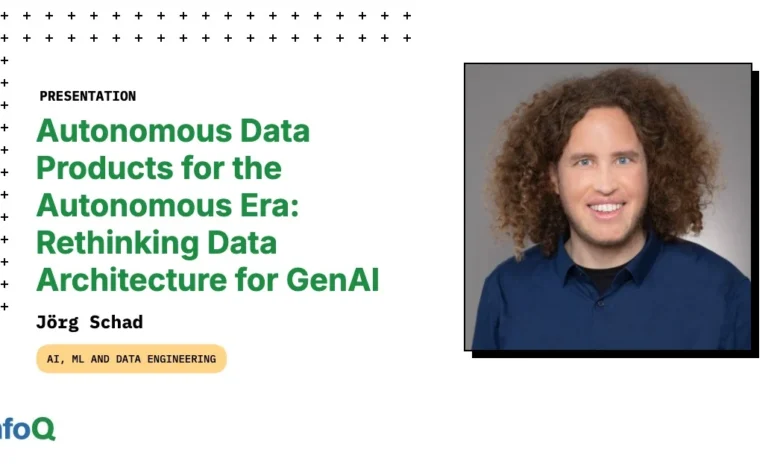
The rapid advancement of Generative AI (GenAI) and autonomous systems presents a critical challenge to existing data architectures. Traditional approaches, often characterized by fragmentation and complexity, are proving insufficient to meet the escalating demands for accessible, secure, and contextually relevant data. At a recent industry event, Jörg Schad, VP Engineering at Nextdata, outlined a compelling vision for "Autonomous Data Products" as a foundational element for "Data 3.0," an architecture designed to empower the autonomous era. Schad argued that the primary reasons for GenAI and deep learning project failures are not flawed models but rather an underestimation of the operational and economic complexities surrounding data accessibility.
Schad’s presentation, "Autonomous Data Products for the Autonomous Era: Rethinking Data Architecture for GenAI," highlighted the persistent gap between promising prototypes and production-ready systems. He emphasized that while initial demos may showcase impressive results using curated datasets, the transition to real-world data integration often reveals systemic weaknesses. This is particularly true as autonomous agents, rather than human analysts, become the primary consumers of data. The sheer speed and scale at which these agents operate necessitate a fundamental shift in how data is managed and exposed.
The Bumpy Road from Prototype to Production
The journey from a successful GenAI prototype to a fully integrated production system is frequently fraught with difficulties. Schad described a common scenario where consultants deliver impressive notebooks showcasing potential value, only for the project to falter when faced with the reality of integrating diverse data sources and complex systems. The rapid evolution of the AI and machine learning ecosystem, with its ever-expanding array of models, applications, and integration protocols (like MCP and A2A), exacerbates this challenge.
Beyond the technical hurdles of integration, two significant problems emerge: sheer volume and context rot. As more data is fed into large language models (LLMs) and GenAI systems, performance can degrade if the information is too general or excessive. There exists a critical threshold where adding more context, rather than enhancing, dilutes the model’s effectiveness and can lead to hallucinations.
Furthermore, the safety aspect is paramount. The risk of autonomous agents inadvertently wiping out databases or, more critically, exposing sensitive private data to unauthorized entities, demands robust security measures. Schad identified four core problem areas that need addressing: standardization of data and ML system access, speed of access and connection, specificity of information exposure, and overarching safety protocols. He drew a parallel to the microservices revolution, where Docker and Kubernetes brought standardization and orchestration, suggesting a similar paradigm shift is needed in the data world.
The Data 2.0 Problem: Organizational and Architectural Fragmentation
Schad characterized current data architectures as "Data 2.0," a state of fragmentation that hinders progress. From an organizational standpoint, numerous roles are involved in a typical ML or GenAI initiative—platform engineers, data product owners, ingestion teams, data architects, stewards, governance specialists, and consumers—each grappling with their own challenges within a disjointed system. This division of data and metadata across multiple personas significantly slows down the entire process.
Architecturally, this fragmentation results in a "data management hairball." Enterprises often employ a multitude of tools for cataloging, governance, quality, lineage, and pipeline management, creating a complex, interwoven system that teams must painstakingly stitch together. While foundational infrastructure like multi-cloud environments, storage, compute, and security are largely understood, the challenge lies in unifying these components and making data accessible to a growing number of applications.
Schad invoked the analogy of the LLVM compiler stack, which utilizes an intermediate representation to standardize compilation from various source languages to different targets. He envisions a similar "hourglass of standardization" for data, with a standardized middle layer enabling diverse applications to be built on top. This mirrors the impact of Kubernetes and Docker, which standardized container images, runtimes, and network/storage layers, allowing for greater interoperability and innovation.
The complexity in data arises from multiple dimensions: location (cloud regions, on-premises), formats and access modes (RAG, vector embeddings, SQL, notebooks), processing engines (Spark, Polars, Snowflake), application layers, and crucially, human skills and personas. This multifaceted complexity is not only a challenge for human developers but also for autonomous agents.
Context Rot and the Imperative of Specificity
The phenomenon of "context rot," where increasing input tokens to LLMs paradoxically decrease performance, was a key focus. Schad illustrated this with benchmarks showing performance degradation as more data or agents are exposed to LLMs. The goal, he explained, is to find a "sweet spot" where the LLM has access to precisely the information needed for a specific task, avoiding the ambiguity that leads to hallucinations. Breaking down this complexity is essential for feasible autonomous consumption.
Taming Complexity: Encapsulation, Abstraction, and Automation
Schad argued that the historical approach to taming complexity in computing has involved encapsulating it into manageable units, abstracting it through clean interfaces, and automating operations. This journey led to containerization, where data assets can be contained and specified in a scalable fashion, with well-defined interfaces.
For data, this means not only encapsulating raw business data but also relevant metadata (access times, classification rules). Abstraction through clean interfaces liberates users from worrying about underlying storage locations or team dependencies. Automation, in turn, becomes significantly easier once data is properly encapsulated and abstracted, allowing for the creation of runbooks for tasks like data classification, exposure control, and determining suitability for vector embeddings.
The Dawn of Autonomous Data Products
This leads to the core concept: "Autonomous Data Products." Drawing inspiration from Zhamak Dehghani’s "Data Mesh" concept, Schad defined data products as central units combining data and metadata, analogous to containers in the microservices world. They encapsulate data, metadata, and access paths, providing a crucial abstraction layer.
An "autonomous data product" is conceived as a running process with a "runtime controller" or "kernel" managing its lifecycle. This lifecycle begins with sensing inputs (upstream data changes, dependencies on other data products), followed by configuration of update triggers. The next stage involves running transformations, where the data product encapsulates underlying jobs (e.g., Spark, SQL transformations).
Crucially, outputs are not immediately accessible. They undergo rigorous data quality checks and validation before being "promoted" for downstream consumption. This proactive approach contrasts with current methods where data quality alerts often arrive post-fact, after potentially incorrect data has already influenced autonomous agents or chatbots. Autonomous data products offer standard APIs for observability and discovery, consolidating information about metadata, transformation code, and lineage, thus eliminating the need to navigate disparate systems.
Furthermore, autonomous data products cater to diverse consumer needs by exposing data in various formats—SQL for data scientists, file-based access for ML model training, embedding outputs or MCP for autonomous agents. This is facilitated by a logical abstraction centered on the semantic representation of data, allowing consumers to discover the asset first and then consider consumption methods. The entire system is API-driven, with each data product offering its own interface, simplifying sharing and access.
Data 3.0: A New Paradigm
Schad posited that this approach ushers in "Data 3.0," a paradigm shift that abstracts away the data management hairball. It provides a standardized, encapsulated way for autonomous data consumption, fostering domain-orientation. Multiple data products, managed by domain teams, can leverage their expertise without the bottleneck of a central data team. This "shifts left" responsibility to business teams who possess the deepest understanding of data semantics.
The Data 3.0 ecosystem comprises:
- Data Product Developers: Building and running data products.
- Data Product Owners: Responsible for business domains or the overall mesh, managing modeling, compliance, and usage analytics.
- Data Product Consumers (Agents/Humans): Discovering and using data products through a common interface, independent of underlying platforms.
- Infrastructure Team: Providing self-serve infrastructure for data product development, abstracting underlying services.
A Practical Example: Customer Feedback Data Product
To illustrate, Schad presented a customer feedback data product. This product ingests data from two disparate sources: structured feedback from online reviews (near real-time) and unstructured feedback from scanned PDFs from physical stores (weekly). The autonomous data product can intelligently configure update policies based on use cases, avoiding the inefficiency of consistently running large jobs when their outputs are infrequently accessed.
Before data is made accessible, robust data quality checks are performed, leveraging frameworks like Soda or Great Expectations. The output is then made available in multiple formats: vector embeddings for LLMs, SQL for data scientists, and document files for model fine-tuning. This ensures that regardless of the consumer’s needs, the data is consistent and reliable.
Ensuring Safe Autonomous Data Consumption
Bridging the gap between enabling rapid development by domain teams and ensuring data governance by CISO and compliance teams is critical. Schad proposed a policy-driven approach. Instead of manual reviews, policies (e.g., "no PII can be processed by LLMs") are defined centrally and enforced automatically when data products are deployed. This acts as an invariant, similar to Kubernetes’ Admission Controllers, but with runtime enforcement. This scalable and fast enforcement mechanism prevents governance teams from becoming bottlenecks.
Agent Lifecycle and Progressive Tool Discovery
The lifecycle of autonomous agents is enhanced through progressive tool discovery. Standardized MCP output ports within data products facilitate this. Agents interact with an MCP gateway that initially offers a "discover_tools" function. As the agent refines its task, it receives increasingly specific tools and resources, avoiding overwhelming the agent with an exhaustive list. This progressive discovery, coupled with a centralized authorization gateway, ensures that agents only access data and tools they are permitted to use, reinforcing standardization and security.
The Pillars of Data 3.0
The core building blocks of Data 3.0, as outlined by Schad, are:
- Encapsulating Data: Treating data as a product with defined boundaries.
- Standardizing Access: Providing consistent interfaces for data retrieval.
- Multimodal Access: Enabling various consumption methods (embeddings, SQL, APIs).
- Standardizing and Filtering Access: Implementing robust governance and authorization.
Business Outcomes and Implications
Data 3.0 shifts the focus from storage-centric decisions to semantic, domain-oriented models. The encapsulation within data products ensures that data and its metadata are always in sync, providing context-aware ground truths. This enables reuse across multimodal setups, where adding a new output modality (like vector embeddings) to an existing data product is straightforward, avoiding the pitfalls of out-of-sync data representations from separate pipelines.
The orchestration shift empowers data product owners to decide when data products should run, moving away from centralized, inefficient pipeline scheduling. The built-in lineage within the data product abstraction simplifies reasoning and justification for decisions made by models. Crucially, the proactive data quality and governance checks, performed within the data product lifecycle before consumption, safeguard against autonomous agents acting on erroneous data.
Demo and Key Takeaways
A demonstration of the Nextdata platform showcased how business domains are visualized, with lineage lines indicating data product dependencies. Individual data products display descriptions, owners, related services, code definitions, trust summaries (access frequency, quality checks), data models, API functions, and output ports (Snowflake, Iceberg, Pinecone embeddings, MCP). Data contracts and policy satisfaction are also visible, assuring governance compliance.
Interacting with an LLM connected to the system, Schad demonstrated how to query available data products, identify frequently accessed ones, and retrieve specific data through the MCP gateway. The system intelligently routes requests to relevant tools and data products, providing context-aware answers.
Schad’s key insight for attendees was to embrace "domain-centric GenAI and domain-centric use cases, not exposing too much information." This approach, he argued, is fundamental to building scalable and secure data architectures for the autonomous era. The underlying pattern of autonomous data products, he believes, holds the potential to revolutionize how organizations manage and leverage their data assets, moving beyond the limitations of Data 2.0 and fully embracing the opportunities of Data 3.0.