Cloudflare Unveils Cache Transcoding Prototype to Boost Storage Efficiency Using Zstandard and Pingora

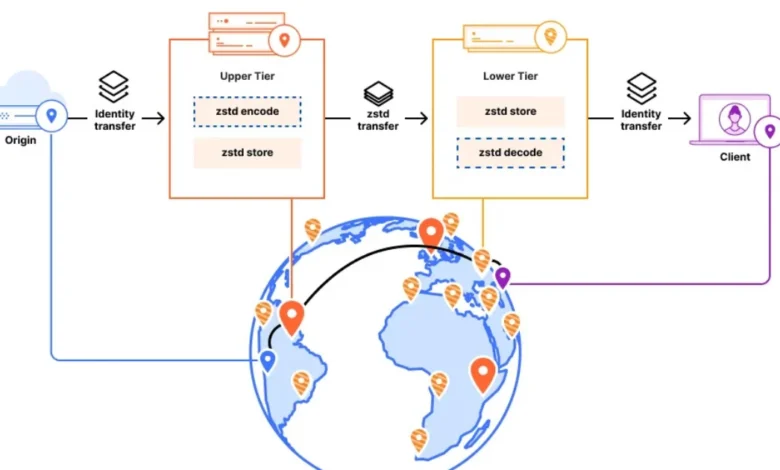
Cloudflare has recently introduced an innovative caching prototype designated as Cache Transcoding, designed to dramatically enhance the effective capacity of its global content delivery network (CDN) edge servers. By systematically compressing eligible uncompressed text assets—including HTML documents, JavaScript files, Cascading Style Sheets (CSS), and JSON data—utilizing Facebook’s high-performance Zstandard (zstd) algorithm before committing them to disk, the hyperscale web infrastructure provider anticipates unlocking petabytes of additional storage capacity. Although the architecture is currently in a prototype phase and undergoing rigorous empirical validation, early benchmarks suggest that this novel approach could redefine storage density economics across global edge networks while substantially mitigating inter-datacenter bandwidth congestion.
The architectural challenge of modern content delivery networks centers on balancing computational latency with physical storage constraints. As global web traffic continues its exponential climb, edge nodes are subjected to immense pressure to cache increasingly large volumes of dynamic and static web assets. Traditionally, web caching mechanisms store responses in the exact format they are received from origin servers or pass them through without secondary compression layers at the disk storage level. Consequently, uncompressed or poorly compressed text payloads consume disproportionate amounts of block storage on solid-state drives (SSDs) and hard disk drives (HDDs) deployed within globally distributed points of presence (PoPs).
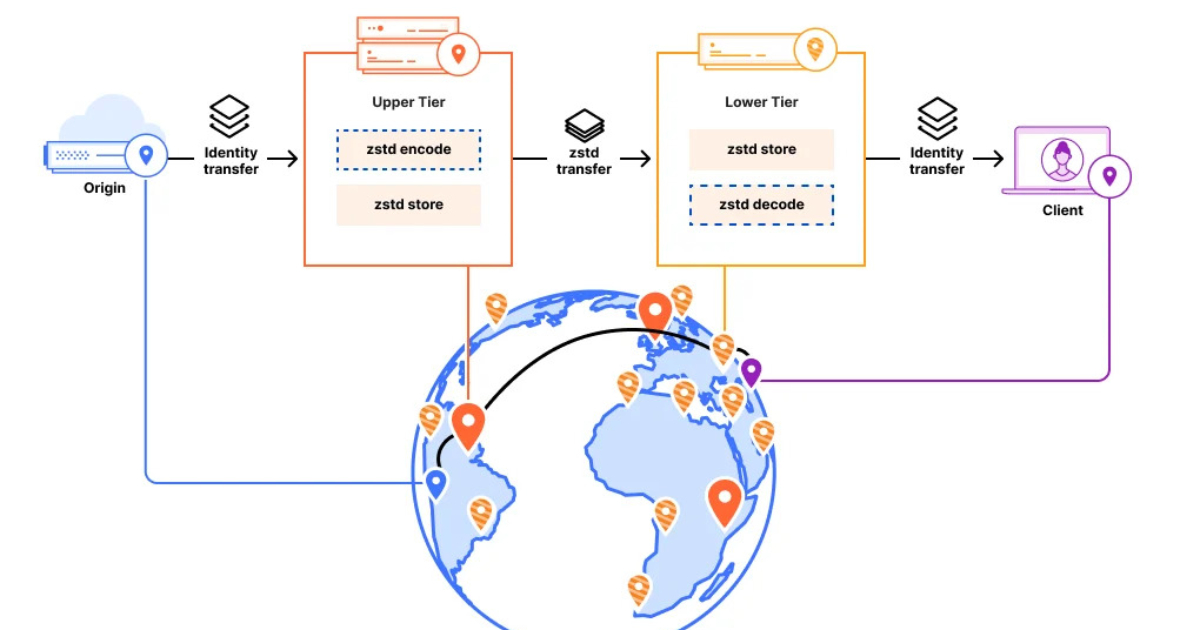
Cloudflare’s newly detailed methodology addresses this inefficiency by applying a deliberate compression pass upon ingestion into the cache tier. According to technical documentation published by Cloudflare engineer Aashi Patel, the process relies heavily on an optimized synergy between Zstandard, a lossless compression algorithm engineered specifically for real-time operation, and Pingora, Cloudflare’s proprietary, memory-safe proxy framework written in the Rust programming language.
The core operational mechanics of Cache Transcoding are remarkably streamlined. When an eligible HTTP response enters a Cloudflare edge node, it undergoes a single encoding pass via Zstandard prior to being written to the local disk cache. Conversely, when a client request triggers a cache hit, the stored asset is transparently decompressed before being transmitted back to the end user. Cloudflare’s engineering telemetry indicates that the additional CPU overhead incurred by this runtime encoding and decoding cycle is remarkably modest, yet the corresponding spatial dividends are profound. Across their test workloads, Zstandard compression achieved an average reduction factor of approximately 2.8 times for eligible content.
This compression ratio fundamentally alters the capacity planning metrics for edge infrastructure. By shrinking the physical footprint of cached text assets, Cloudflare enables existing hardware deployments to absorb significantly larger volumes of popular web content without necessitating immediate, capital-intensive hardware upgrades. Furthermore, because more content remains locally resident within regional edge caches, the volume of data that must be repetitively fetched across expensive long-haul backbones and inter-datacenter links drops correspondingly. As Patel summarized in her technical analysis, the encoding penalty is paid precisely once during the asset’s initial ingestion, whereas the resulting dividends in storage capacity and network bandwidth compound continuously with every subsequent cache reuse.
Despite the compelling macro-level advantages of universal text compression, Cloudflare’s engineering team deliberately engineered Cache Transcoding with precise operational guardrails to prevent computational bottlenecks. Transcoding is not applied indiscriminately to all incoming web traffic. To maximize efficiency, the caching pipeline enforces strict eligibility criteria before routing an asset through the Zstandard encoder.
Specifically, Cache Transcoding targets uncompressed responses that successfully return HTTP success codes, contain compressible textual payloads (such as HTML, JSON, CSS, and JavaScript), and possess a payload size of at least 4 KiB. Conversely, the system explicitly bypasses range requests, precompressed data streams (such as Gzip, Brotli, or Zstd compressed assets arriving directly from origin servers), binary files, and responses lacking a definitively calculable content length.
This 4 KiB size threshold is a calculated trade-off. It successfully shields edge CPUs from wasting precious cycles processing countless tiny objects—where the processing overhead would vastly outweigh any marginal storage savings—while sacrificing only about 1% of the total eligible data volume. Moreover, both the size threshold and the underlying Zstandard compression level are fully tunable parameters, allowing network administrators to dynamically calibrate the balance between CPU utilization, latency, and storage density depending on prevailing workloads and hardware profiles.
To contextualize the rationale behind these exclusions, one must examine the macro-level composition of modern web traffic traversing Cloudflare’s global network. Empirical traffic sampling reveals a stark dichotomy between media assets and textual payloads. Media-heavy formats—encompassing high-resolution images, video streams, and downloadable font files—traditionally account for roughly 21.4% of total HTTP requests. However, due to their sheer physical size, these same media assets consume an overwhelming 63.3% of total transferred bytes. Crucially, these formats are almost universally distributed in pre-compressed or inherently optimized binary states. Attempting to pass images, videos, or fonts through a secondary real-time Zstandard transcoding pipeline would yield negligible compression gains while unnecessarily scorching CPU resources.
In sharp contrast, compressible text formats—namely HTML, JavaScript, CSS, and JSON—represent the conversational backbone of the interactive web. These text assets account for a substantial 67.3% of total incoming requests, though they translate to a more modest 22.3% of total transferred bytes. Crucially, Cloudflare’s internal traffic analysis indicates that approximately 71% of this textual volume routinely arrives from origin servers completely uncompressed, presenting a massive, largely untapped reservoir for high-ratio lossless compression at the edge.
The architectural integration of Cache Transcoding builds upon Cloudflare’s ongoing transition toward high-performance, memory-safe systems software. The deployment of Pingora—the Rust-based asynchronous proxy framework that replaced portions of Cloudflare’s legacy C-based infrastructure—provides the foundational concurrency and safety required to execute intensive cryptographic and compression operations at wire speed. By coupling Pingora’s low-latency event loop with Zstandard’s exceptionally fast compression and decompression throughput, Cloudflare has constructed a resilient pipeline capable of sustaining millions of requests per second without introducing noticeable Time-to-First-Byte (TTFB) degradation for end users.
As technical details of the prototype circulated across engineering communities, the announcement sparked vibrant discussions and critical technical inquiries on platforms such as Hacker News and specialized systems architecture forums. While the broader industry generally lauded the resourcefulness of the approach, nomenclature choices and architectural edge cases drew immediate scrutiny from seasoned systems engineers.
A minor semantic debate emerged regarding Cloudflare’s use of the term "transcoding," a descriptor historically reserved for converting multimedia streams from one digital format or codec to another (such as transcoding H.264 video to AV1). Critics argued that the phrase "Cache Encoding" or "Cache Compression" might more accurately describe a process of lossless byte-stream transformation. However, defenders of the terminology noted that transforming data representations between network transmission formats and local disk storage states aligns conceptually with transcoding pipelines in broader software engineering lexicons.
More substantive technical questions focused on the lifecycle management of cached assets and the handling of complex HTTP operations. For instance, several infrastructure engineers questioned the logic of compressing newly ingested content versus targeting cold, infrequently accessed storage tiers. Commenter MayeulC observed that prioritizing cold content might yield superior CPU efficiency gains during decompression cycles, given that rarely accessed assets could tolerate heavier initial compression levels without impacting hot-path latency.
Another prominent engineering concern involved the execution of HTTP range requests—partial content fetches commonly utilized by media players, PDF viewers, and large file download managers to retrieve specific byte ranges of a resource. Without compression, range requests are trivially satisfied by performing a direct seek operation to the exact byte offset within a flat, uncompressed cached file. However, when a file is compressed via Zstandard and stored as a variable-length byte stream on disk, locating a precise internal byte offset becomes significantly more complex, as the compressed blocks do not map linearly to the uncompressed source file’s byte addresses. While Cloudflare has not yet published an exhaustive architectural blueprint detailing how its prototype resolves range requests over Zstandard-compressed blocks, engineers speculate that localized block-indexing or chunked dictionary mapping must be employed to prevent full-file decompression bottlenecks during partial content reads.
To quantify the systemic impact of the prototype under real-world topologies, Cloudflare’s engineering teams conducted comprehensive benchmarking suites both with and without Tiered Cache enabled. These tests were explicitly designed to measure how edge-level compression influences local disk caching efficiency, read/write IOPS (Input/Output Operations Per Second), and inter-tier transfer volumes as data propagates across regional and core data centers.
The implications of successful cache transcoding extend far beyond individual server cost reductions. For a hyperscale cloud provider managing tens of millions of domains and serving a significant fraction of global web traffic, reducing storage footprint by a factor of nearly three translates into massive capital expenditure savings on enterprise-grade solid-state storage hardware. Furthermore, by shrinking data payloads moving across regional backbones, Cloudflare enhances the overall resilience and throughput capacity of its private global network, mitigating congestion during peak traffic surges or distributed denial-of-service (DDoS) attacks.
As development continues, Cloudflare’s engineering roadmap for Cache Transcoding remains dynamic. The prototype is undergoing iterative refinement, with upcoming testing phases scheduled to evaluate varying Zstandard compression levels, alternative object size heuristics, diverse content type distributions, and complex multi-tiered caching scenarios. While broad production rollout timelines have not yet been formally established, the initiative underscores the relentless pursuit of efficiency at the absolute margins of modern distributed systems engineering—turning microscopic computational investments into macroscopic infrastructural gains.