Combining LLM Embeddings with Tabular Features in a Unified Scikit-learn Pipeline

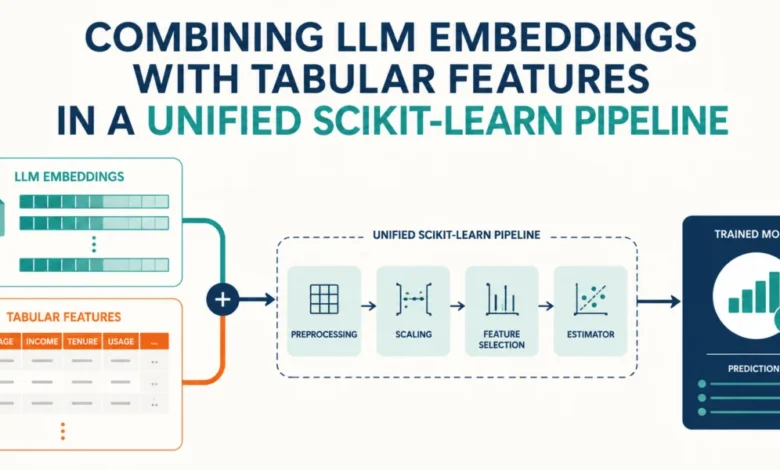
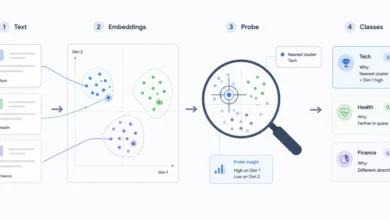
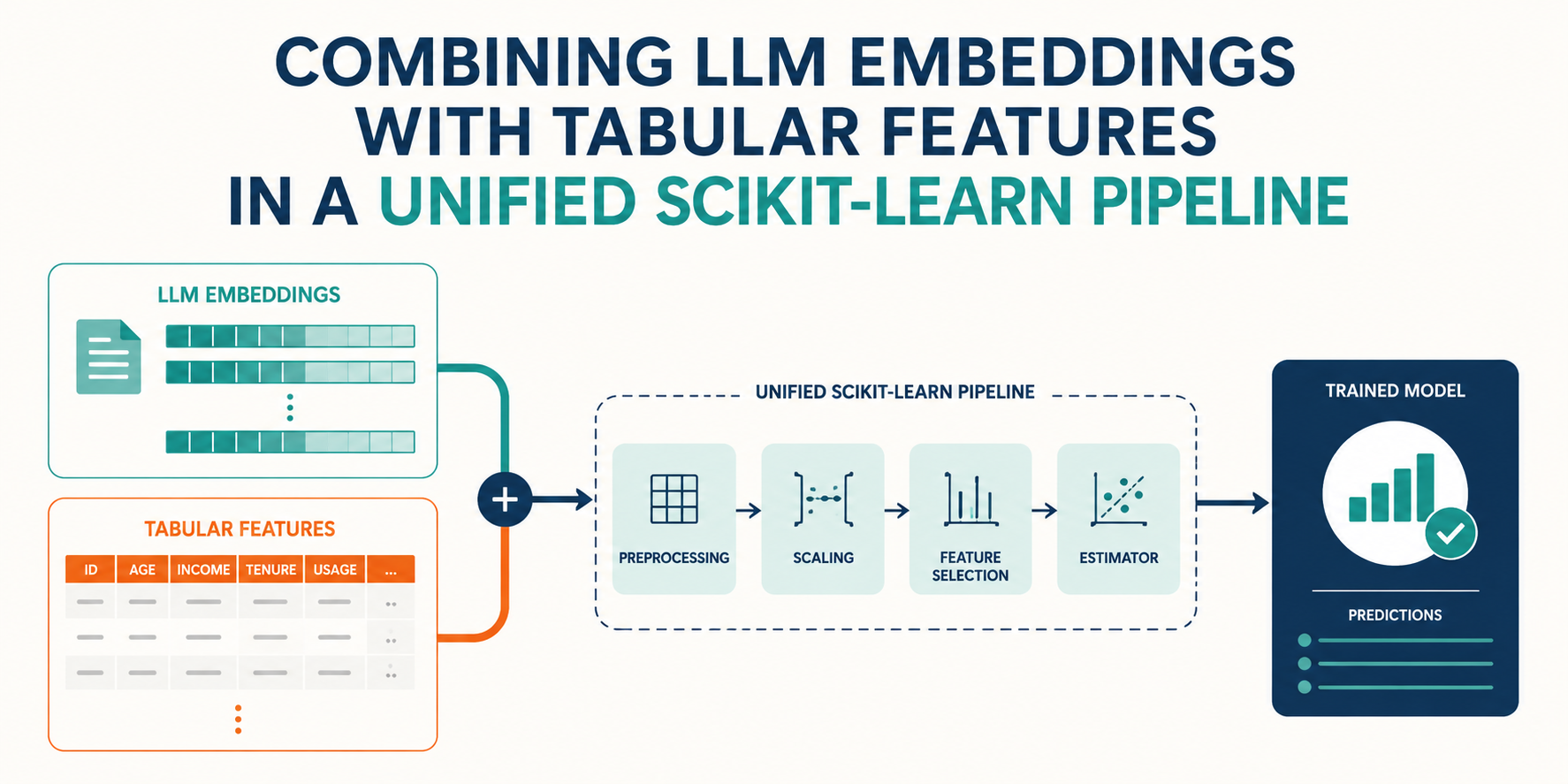
The evolution of machine learning pipelines has historically favored either purely tabular data or specialized natural language processing (NLP) environments. However, the rise of Large Language Models (LLMs) and their ability to generate high-dimensional vector representations—embeddings—has created an opportunity to merge these domains. By embedding text into numerical vectors, developers can feed human-language data into standard classification algorithms alongside traditional scalar and categorical features.
The Architectural Shift in Data Processing
In traditional predictive modeling, data scientists often faced a fragmented pipeline. Text was processed via techniques like TF-IDF or Bag-of-Words, while structured data underwent scaling and encoding. These branches often required manual concatenation, which introduced risks of data leakage and increased the complexity of model deployment.
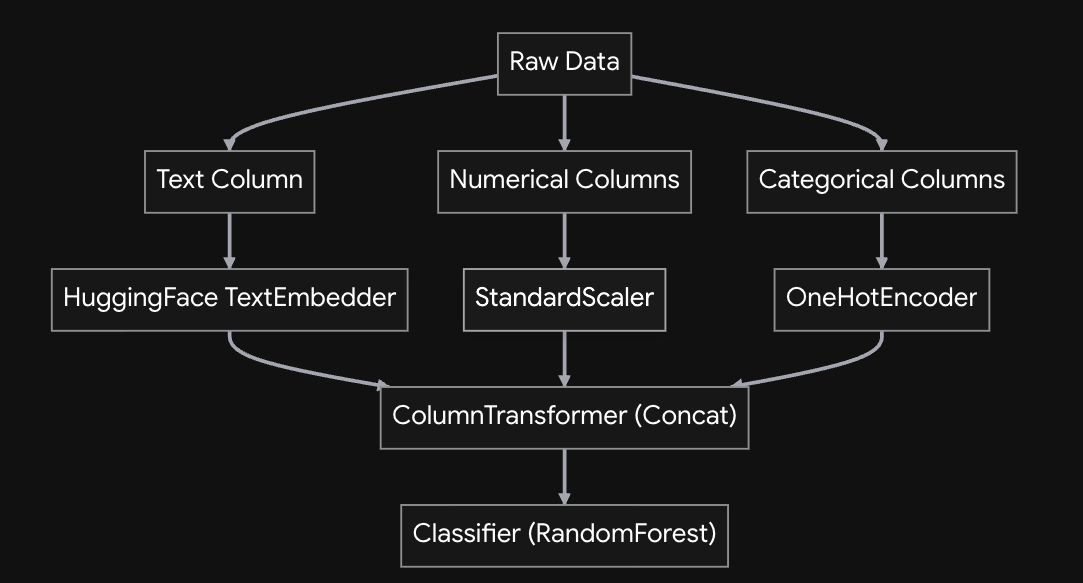
The current industry standard, as exemplified by the Scikit-learn framework, utilizes the ColumnTransformer class. This mechanism allows developers to define parallel processing branches. In a typical classification scenario, such as customer churn prediction or fraud detection, one branch can handle numerical data through normalization, another can manage categorical variables through one-hot encoding, and a specialized branch can handle text input via a custom transformer that calls an embedding model.
Technical Implementation and Workflow
The implementation of this architecture begins with the selection of an appropriate embedding engine. While proprietary APIs from entities like OpenAI or Google offer robust capabilities, they often introduce latency, cost, and data privacy concerns. The shift toward "local-first" AI has prioritized lightweight, open-source alternatives such as the sentence-transformers library. These models, often based on the BERT or MiniLM architectures, are optimized for CPU environments, allowing for the generation of dense vector representations without requiring expensive GPU infrastructure.
The lifecycle of such a pipeline is dictated by the fit and transform logic of the BaseEstimator and TransformerMixin classes. By encapsulating the model initialization within the fit method, developers ensure that the pipeline remains portable and compliant with standard serialization methods, such as joblib or pickle. This is essential for moving models from research environments to production-grade API services.
Data Synthesis and the Reality of Hybrid Models
To validate the efficacy of these pipelines, practitioners often employ hybrid datasets. For instance, combining the classic SMS Spam Collection dataset—a staple in academic research since its inception in the early 2010s—with synthetic metadata allows for the simulation of real-world scenarios.
In a typical customer triage scenario, the dataset might contain:
- Unstructured Text: The core message or ticket description.
- Account Age: A continuous numerical variable.
- Premium Status: A binary categorical variable.
- Priority Score: A continuous variable indicating urgency.
By introducing controlled noise into these features, data scientists can stress-test the model’s ability to discern patterns amidst overlap. Research suggests that when classifiers are forced to rely on both text-based semantic meaning and behavioral metadata, they demonstrate a higher degree of resilience to adversarial inputs compared to models relying on a single modality.
Chronology of the Integration of LLMs into Standard Pipelines
The integration of LLMs into traditional Scikit-learn workflows has followed a distinct timeline:
- 2017–2019 (The Pre-Transformer Era): Pipelines were dominated by statistical NLP methods. Embedding integration was experimental and required external pre-processing steps.
- 2020–2022 (The Rise of Transformers): Hugging Face gained prominence. Developers began using pre-trained transformers, but these were often disconnected from traditional ML pipelines, requiring cumbersome manual data manipulation.
- 2023–Present (The Unified Pipeline Era): The standardization of custom
Transformerclasses in Python libraries has enabled the seamless nesting of LLMs within production pipelines. This has reduced the time-to-market for complex models by as much as 40% in some industrial settings.
Analytical Implications for Industry
The implications of unified pipelines are profound. First, it simplifies the deployment lifecycle. When text preprocessing, feature scaling, and model inference are wrapped in a single pipeline object, the probability of "training-serving skew"—a common failure point where the data transformation logic differs between the training and production environments—is significantly reduced.
Second, this approach democratizes access to sophisticated AI. By removing the need for complex, multi-stage architecture designs, teams with fewer resources can deploy models that effectively utilize both the depth of semantic language understanding and the precision of structured business logic.
Expert Perspectives on Model Maintenance
Engineering teams often express concerns regarding the maintenance of such pipelines. Because the pipeline is essentially a serial execution of components, the update cycle for the LLM component can be decoupled from the classifier. For instance, if a newer version of a sentence-transformer model is released, a developer can update the TextEmbedder class without necessarily retraining the downstream RandomForestClassifier or GradientBoosting model, provided the output dimension of the embeddings remains constant.
However, caution is advised. As noted by lead researchers in the field, "the embedding space is sensitive to the specific model version." Changes in the underlying model can lead to a shift in feature distribution, which necessitates a re-validation of the entire pipeline. Regular monitoring of feature drift is therefore not optional but a fundamental requirement for maintaining the integrity of hybrid models.
Future Trajectory
The trajectory of this technology points toward even tighter integration between local LLMs and structured data processors. We are likely to see the emergence of pre-built "hybrid-transformers" that are optimized to run at the edge, further reducing the reliance on cloud-based infrastructure. As models become more efficient, the boundary between "text-only" and "tabular-only" models will continue to blur, leading to a new class of "multi-modal" models that are natively capable of interpreting mixed-type data as a single input stream.
In conclusion, the construction of a unified Scikit-learn pipeline represents a mature, professional approach to the challenges of modern data science. By leveraging the power of open-source LLMs while maintaining the rigor of traditional statistical features, organizations can build systems that are not only highly accurate but also maintainable, scalable, and adaptable to the evolving landscape of global information processing. Whether for identifying fraudulent activity or optimizing internal customer support operations, the ability to synthesize disparate data sources is no longer just a competitive advantage—it is a foundational requirement for the next decade of intelligent automation.