Enterprise adoption of artificial intelligence agents has evolved past a singular, one-size-fits-all model. While commercial off-the-shelf offerings like the Gemini Enterprise Agent Platform provide organizations with turnkey deployment, rapid scalability, and built-in governance, a substantial segment of developers continues to chart a different course. Engineering teams operating with bespoke workflows, proprietary data pipelines, and custom execution engines frequently require lightweight agent hubs tailored specifically to their architectural constraints.
For developers building centralized agent infrastructures from the ground up, the core requirement is predictability. Systems must execute reliably, log every transactional event comprehensively, and operate safely within strict security sandboxes. To address these complex infrastructural demands, development frameworks are increasingly incorporating advanced developer tools designed to bridge the gap between high-level language models and rigid enterprise backends.
The Antigravity SDK has emerged as a foundational runtime engine for these custom environments, providing the exact underpinnings utilized in Antigravity 2.0 and the Antigravity CLI. By embedding declarative safety policies, real-time telemetry, and stateful multi-turn persistence directly into applications, the SDK ensures that updates to the core runtime automatically propagate optimizations down to individual agents. This technological convergence enables organizations to construct robust, highly observable multi-agent control planes capable of managing complex, distributed artificial intelligence workloads.
The Architecture of a Modern Multi-Agent Control Plane
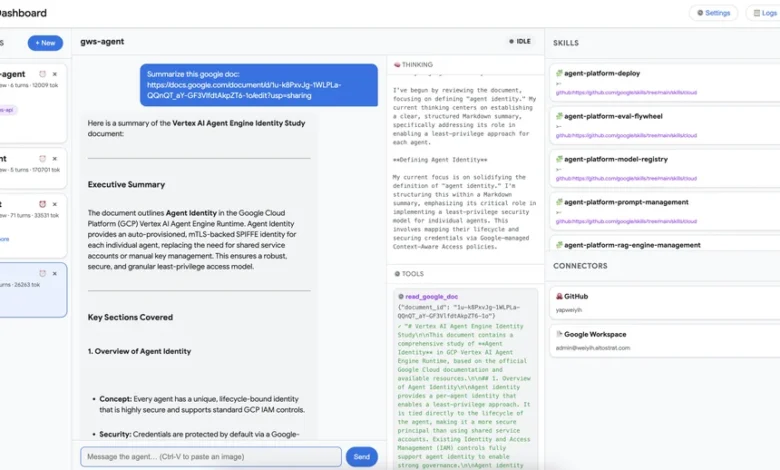
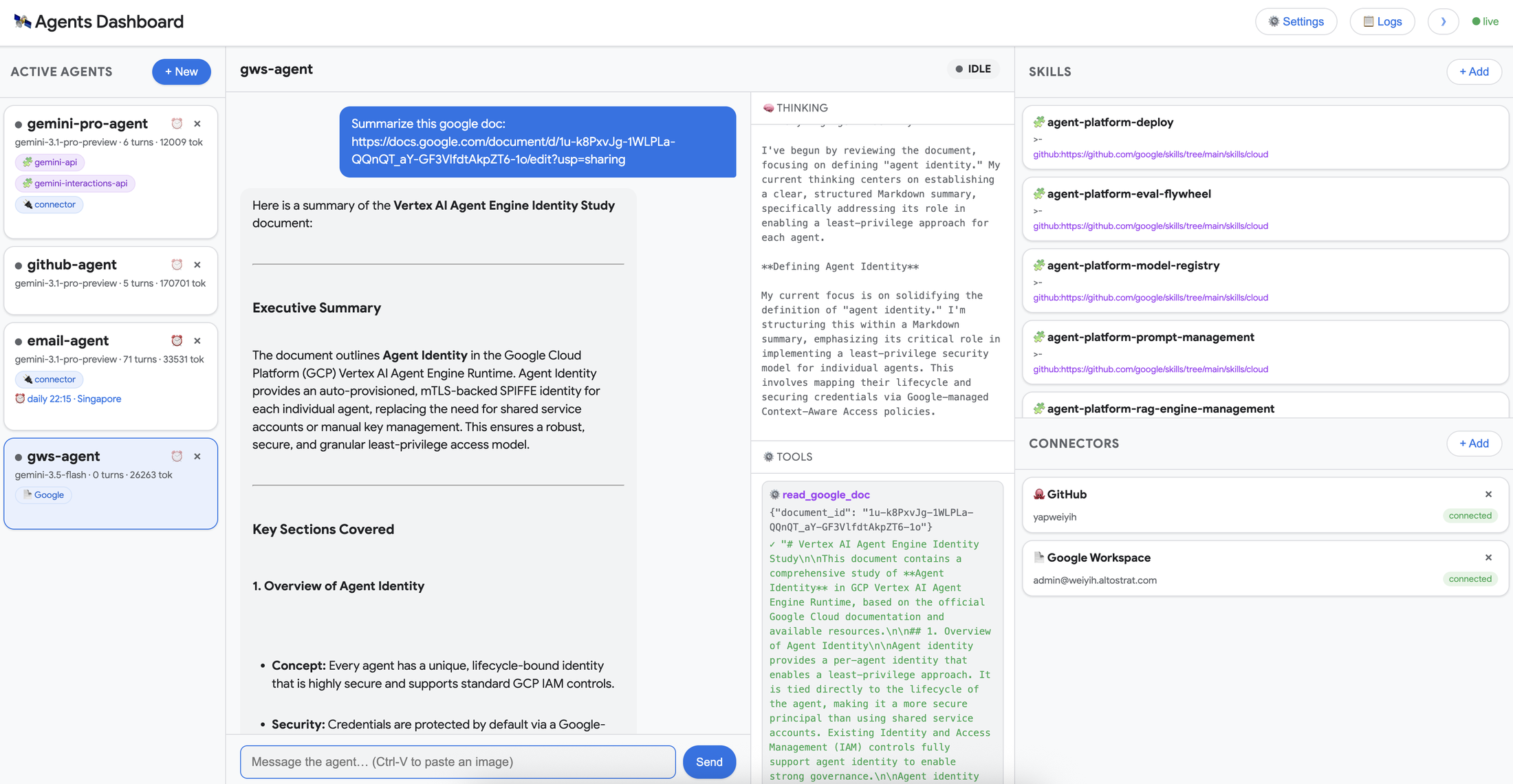
A multi-agent control plane serves as the operational nerve center for large language model workloads. In enterprise environments running dozens of autonomous and semi-autonomous agents simultaneously, visibility is paramount. Administrators and operations engineers require deep insights into cognitive processes—specifically, what an agent is thinking, which tools it invokes during execution, and how operational state is stored across multi-turn interactions.
The modern control plane architecture relies on a synergistic relationship between two critical components: the agent core and the observability middleware.
The Antigravity SDK agent core functions as the operational engine, managing intricate model interactions across advanced foundation models such as Gemini 3.1 Pro and Gemini 3.8 Flash. This core handles real-time tool execution, generates granular thinking traces that outline the agent’s logic, and executes modular domain-specific skills.
Complementing the agent core is an event-driven observability and telemetry middleware layer. Powered by native Antigravity SDK Lifecycle Hooks, this middleware intercepts critical agent actions—including step initiations, real-time thinking updates, and external tool calls—and streams telemetry data seamlessly over WebSockets to centralized enterprise dashboards.
Operational Challenges in Distributed Agent Ecosystems
The necessity for specialized control planes stems from the distinct operational challenges associated with managing multiple autonomous background agents. In a typical enterprise deployment, an organization might deploy diverse specialized instances, such as a code-repository assistant (github-agent), an operational researcher (gemini-pro-agent), and an automated task scheduler (email-agent).
Historically, observing the granular progress and internal state of these distributed agents has presented significant hurdles. Without a unified control interface, engineering teams face fragmented logging, opaque decision-making paths, and severe vulnerabilities regarding unauthorized filesystem access or untracked API calls. When an agent running background research or document summarization encounters an unexpected runtime anomaly, diagnosing the root cause often requires sifting through disparate log files scattered across virtual instances.

To resolve these friction points, modern control plane designs integrate five foundational mechanics: streaming application programming interfaces for real-time observation, lifecycle hooks for telemetry interception, declarative policy engines for behavioral steering, modular skills for dynamic capability management, and session state persistence for trajectory tracking.
Core Building Blocks of SDK-Powered Architectures
The Antigravity SDK organizes these complex responsibilities into four distinct, modular building blocks designed to streamline custom agent hub development.
1. Modular Capabilities with Dynamic Skills
Rather than relying on static, monolithic prompts or cumbersome in-memory registries, modern agent hubs utilize dynamic skills. Skills provide reusable, domain-specific instruction bundles and reference assets that agents load dynamically during execution. Within the Antigravity SDK ecosystem, these skills are resolved directly from filesystem directories containing a standardized SKILL.md file. This architecture allows developers to update an agent’s operational capabilities simply by modifying repository files, eliminating the need to recompile or restart core application services.
2. Sandboxed Built-In Tools and Workspace Scoping
Security and isolation remain primary concerns when deploying autonomous agents with access to local filesystems and enterprise networks. The Antigravity SDK addresses this by providing production-ready file and workspace tools out of the box, sparing developers the burden of writing custom, error-prone filesystem wrappers. When these tools are combined with explicit workspace definitions and declarative safety policies, agent operations are strictly confined to authorized directories, preventing unauthorized data exfiltration or unintended system modifications.
3. Session Isolation and Trajectory Persistence
Maintaining conversational context and operational history is essential for long-running enterprise tasks. The Antigravity SDK manages state persistence through declarative configuration rather than external, tightly coupled databases. By specifying a designated save directory (save_dir), developers establish a root location where full turn trajectories, tool execution receipts, and generated artifacts are preserved systematically under structured identifiers (traj-<conversation_id>). This native persistence model simplifies auditing, debugging, and session restoration.
4. Real-time Telemetry via Lifecycle Hooks
Deep system visibility requires the ability to intercept execution flows without altering core application logic. Lifecycle hooks in the Antigravity SDK enable dashboards and monitoring engines to observe and steer every stage of an agent’s lifecycle. Utilizing decorated asynchronous functions, developers can stream status updates over WebSockets, inspect tool parameters in real time, and enforce human-in-the-loop approval workflows before critical tool executions are authorized.
Broader Implications and Industry Impact
The maturation of lightweight, SDK-driven agent hubs marks a significant maturation phase in enterprise artificial intelligence deployment. As organizations move beyond experimental proof-of-concept projects and into production-grade deployments, the demand for transparent, governable, and secure agent infrastructure will only accelerate.
By combining the advanced natural language understanding and reasoning capabilities of models like Gemini with rigorous control plane frameworks, developers no longer have to choose between the ease of turnkey commercial platforms and the flexibility of custom code. Instead, tools like the Antigravity SDK empower engineering teams to construct bespoke, highly secure agent ecosystems that meet exacting enterprise standards for observability, predictability, and compliance.
Related posts: