Unlocking the Power of Next-Generation Hybrid Search: Native BM25 Integration Arrives in AlloyDB and Cloud SQL for PostgreSQL 17+

The architectural blueprint of modern enterprise applications, particularly those driven by generative artificial intelligence, retrieval-augmented generation (RAG), and sophisticated data agent ecosystems, has long relied on vector search as a foundational pillar. Vector embeddings have fundamentally transformed how machines comprehend conceptual meaning, nuances, and semantic relationships within unstructured datasets. However, despite their extraordinary capacity for interpreting abstract user intents, pure vector search models frequently encounter operational limitations when tasked with pinpointing specific alphanumeric identifiers, exact serial codes, and precise product SKU numbers. To construct truly resilient, high-performance search infrastructures and AI applications, engineers increasingly require a harmonious fusion of semantic vector search capabilities and traditional exact-keyword full-text search—a methodology universally defined as hybrid search.
Historically, implementing a dual-engine architecture capable of executing both semantic vector similarity algorithms and full-text keyword indexing required organizations to provision, manage, and synchronize disparate data backends. Within environments utilizing Google Cloud’s AlloyDB and Cloud SQL, incorporating a robust Best Matching 25 (BM25) ranking algorithm necessitated the integration of an external full-text search engine. This traditional dependency inevitably introduced architectural friction, including persistent data silos, synchronization lags, operational complexity, and escalated infrastructure expenditures. Addressing these long-standing enterprise pain points, Google Cloud has announced the preview of native BM25 indexing in AlloyDB and Cloud SQL for PostgreSQL 17+. Enabled through the open-source pg_textsearch extension originally created by Tiger Data, this development effectively eliminates the necessity of maintaining separate, dedicated full-text search infrastructure.
The Evolution of Information Retrieval and the Limitations of Legacy PostgreSQL
To contextualize the significance of native BM25 integration, database administrators and software architects must examine the historical constraints of relational text retrieval. For years, developers relying on PostgreSQL’s built-in ts_rank function for full-text search at scale encountered notable performance and accuracy degradations. As data corpora expanded into millions of records, ranking quality diminished due to fundamental mathematical limitations within the native engine. Most notably, PostgreSQL’s legacy text search lacked support for inverse document frequency (IDF). Consequently, ubiquitous terms carried the exact same statistical weight as rare, highly specific keywords. Furthermore, the absence of term-frequency saturation meant that a document repeating a common word fifty times would effortlessly outrank a concise, highly relevant document mentioning the term only once.

In contrast, the BM25 algorithm has remained the definitive gold standard within the information retrieval domain for decades. BM25 rectifies the deficiencies of legacy rankers by introducing three core probabilistic scoring principles: inverse document frequency, ensuring that rare terms carry significantly more weight than common ones; term frequency saturation, preventing excessive repetition from artificially dominating search results; and document length normalization, which prevents longer documents from receiving an unfair advantage simply due to a higher word count. The integration of the pg_textsearch extension brings this enterprise-grade scoring mechanism directly into PostgreSQL database pages, allowing transactional and analytical workloads to benefit from sophisticated keyword relevance without external middleware.
Bridging the Gap: How Hybrid Search Transforms Enterprise Data Architecture
By establishing a unified hybrid search backend natively within the operational database, enterprises are liberated from the overhead of maintaining specialized search clusters. Operational data, semantic vector embeddings, and full-text keyword indices now reside within a single, cohesive storage and execution layer. This unified approach delivers substantial reductions in total cost of ownership, eliminates network latency introduced by cross-system queries, and drastically simplifies disaster recovery and data governance protocols.
The synergy between semantic vectors and keyword indexes solves a classic enterprise dilemma: reconciling conceptual intent with literal exactness. For instance, in a retail e-commerce inventory database containing horticultural products, a user query such as "trees that grow taller than houses" demands a high degree of semantic interpretation—a task where vector embeddings excel. Conversely, a query specifying a regional attribute or exact classification, such as "California," requires absolute, uncompromising keyword precision.
Through the implementation of Reciprocal Rank Fusion (RRF) algorithms, modern database functions can seamlessly merge the disparate output streams of vector similarity searches and BM25 keyword searches into a single, flawlessly ordered result set. In practice, this means an e-commerce application can simultaneously evaluate abstract conceptual queries and stringent geographic parameters, elevating hyper-specific items like the "California Sycamore" to the absolute top of the search results page.
Technical Implementation: Deploying BM25 and Hybrid Search in AlloyDB
Implementing advanced full-text search and hybrid capabilities within AlloyDB has been streamlined to leverage standard PostgreSQL syntax supplemented by specialized user-defined functions (UDFs). To examine this architecture in a practical context, consider a representative retail schema named cymbal_products. This table contains a unique identifier (uniq_id), a product name, a comprehensive textual product_description, and a generated vector embedding column (product_embedding) designed to process comprehensive retail inventory data.
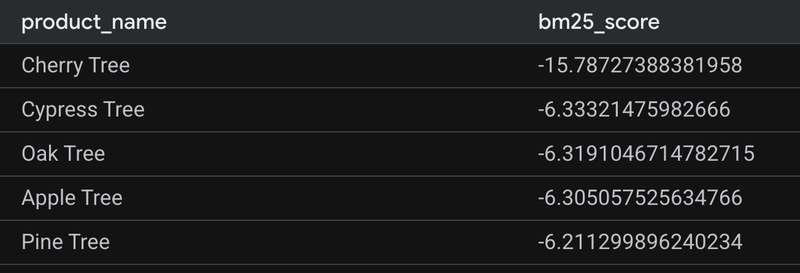
To initiate BM25 functionality, database administrators must first enable the pg_textsearch extension within the target instance. Once activated, creating a specialized BM25 index on the product_description column allows the database to construct the necessary inverted index structures optimized for probabilistic relevance scoring. Executing a standalone full-text search query is subsequently achieved using the dedicated <@> special operator provided by the extension. When querying terms such as "cherry tree," the search engine evaluates document frequency and term saturation, returning relevance scores where increasingly negative values indicate a stronger statistical match.
For complex AI applications requiring multi-modal retrieval, AlloyDB provides an out-of-the-box hybrid search UDF. This function ingests both the semantic vector search query—utilizing high-performance ScaNN indexing—and the BM25 keyword query, subsequently normalizing and fusing the respective rankings using the RRF algorithm. The resulting unified query structure executes entirely within the database engine, returning a precisely ordered dataset that balances conceptual relevance with exact-match criteria.
Cloud SQL Implementation and Architectural Parity
Cloud SQL for PostgreSQL 17+ mirrors the advanced capabilities of AlloyDB, ensuring that organizations operating standard managed PostgreSQL instances can deploy identical hybrid search architectures. While AlloyDB leverages specialized built-in UDFs for RRF score amalgamation, Cloud SQL users achieve the exact same operational outcome through standard Common Table Expressions (CTEs) and SQL coalescing techniques.
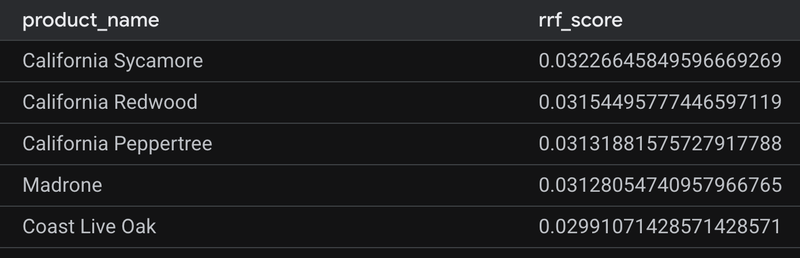
Within a Cloud SQL environment, engineers typically establish an HNSW (Hierarchical Navigable Small World) index for high-dimensional vector similarity search alongside the pg_textsearch BM25 index on the shared base table. By structuring a multi-stage CTE query, the database independently calculates vector similarity distances and BM25 keyword rankings, normalizes the respective position lists, and applies Reciprocal Rank Fusion logic. The resultant performance and output precision match those of AlloyDB, ensuring architectural portability across Google Cloud’s broader PostgreSQL ecosystem.
Industry Implications and Future Outlook
The introduction of native BM25 indexing and streamlined hybrid search within AlloyDB and Cloud SQL signals a broader evolution in enterprise data management. As generative AI transitions from experimental proof-of-concept stages into mission-critical production environments, the demand for low-latency, highly accurate data retrieval has intensified. Traditional database architectures forced a rigid dichotomy between transactional data storage and specialized search infrastructure, creating operational bottlenecks that slowed innovation.
By embedding advanced information retrieval algorithms directly into the operational database layer, cloud providers are redefining what relational database management systems can achieve. Developers are no longer required to master complex synchronization pipelines between vector databases, full-text search engines, and primary data stores. Instead, they can harness the full spectrum of search methodologies—from fuzzy semantic intuition to strict alphanumeric matching—within a unified, transactional, and secure environment. As PostgreSQL 17 adoption accelerates across enterprise landscapes, native hybrid search capabilities are poised to become an indispensable standard for building the next generation of intelligent, data-driven applications.