AlloyDB Accelerates Enterprise AI with Groundbreaking Columnar Engine for Vector Search

AlloyDB, Google Cloud’s fully managed, PostgreSQL-compatible database service, is poised to redefine the landscape of enterprise AI applications with the introduction of its columnar engine-accelerated Hierarchical Navigable Small World (HNSW) indexing for vector search. This significant enhancement, currently in preview, promises to dramatically boost the performance of AI workloads by up to four times compared to standard PostgreSQL, addressing a critical bottleneck in the development and deployment of sophisticated AI solutions.
At its core, AlloyDB is engineered to handle the most demanding enterprise workloads. It masterfully blends the flexibility and familiarity of open-source PostgreSQL with Google’s cutting-edge technological advancements. The result is a database service that delivers unparalleled scalability, robust high availability, and integrated native AI capabilities. Beyond its prowess as a high-performance relational data store, AlloyDB now excels as a unified backend for both vector and full-text search, and as a potent analytics engine capable of outperforming standard PostgreSQL by up to 100 times.
The recent advancements directly address the burgeoning importance of vector search, which serves as the foundational element for modern AI and Retrieval Augmented Generation (RAG) applications. For developers working with PostgreSQL databases, the pgvector extension has become an indispensable tool for storing, indexing, and querying vector embeddings – the numerical representations of data that enable AI to understand and process information. HNSW, a sophisticated graph-based algorithm, is particularly adept at performing approximate nearest neighbor (ANN) searches across complex, multi-layered data structures. By integrating columnar engine acceleration for HNSW, AlloyDB is setting a new benchmark for vector search performance.
The Speed vs. Accuracy Dilemma in Enterprise AI
Enterprise AI applications are perpetually navigating a complex trade-off between computational speed and the accuracy of their results. When tasked with searching through datasets containing millions or even billions of vector embeddings, maximizing Queries Per Second (QPS) is paramount for scaling production workloads. However, this drive for speed must not come at the expense of search quality, often measured by recall – the proportion of relevant items correctly retrieved. The pgvector extension, with its HNSW indexing capabilities, offers a compelling solution to this challenge by significantly speeding up ANN searches. AlloyDB’s innovation lies in its ability to amplify these gains through its columnar engine.
It is crucial to acknowledge that HNSW is but one component of AlloyDB’s comprehensive AI toolkit. The service also features ScaNN, a state-of-the-art index developed from over 14 years of Google Research, offering developers the flexibility to select the optimal index for their specific use case. Furthermore, for scenarios demanding absolute precision, AlloyDB continues to support standard k-nearest neighbor (KNN) search, guaranteeing 100% recall. A detailed guide is available to help users choose the most appropriate vector index strategy for their applications.
Unveiling the AlloyDB Columnar Engine
The AlloyDB columnar engine is an intrinsic, in-memory cache designed to automatically store frequently accessed data in a highly optimized, scan-friendly columnar format. This architecture empowers AlloyDB to execute heavy analytical queries up to 100 times faster than conventional PostgreSQL implementations. More critically for AI workloads, it accelerates ANN searches by keeping the index resident in memory, employing a vectorized memory layout for rapid data traversal, and circumventing the inherent overheads of the standard PostgreSQL buffer manager.
Performance Visualization: Quantifying the Gains
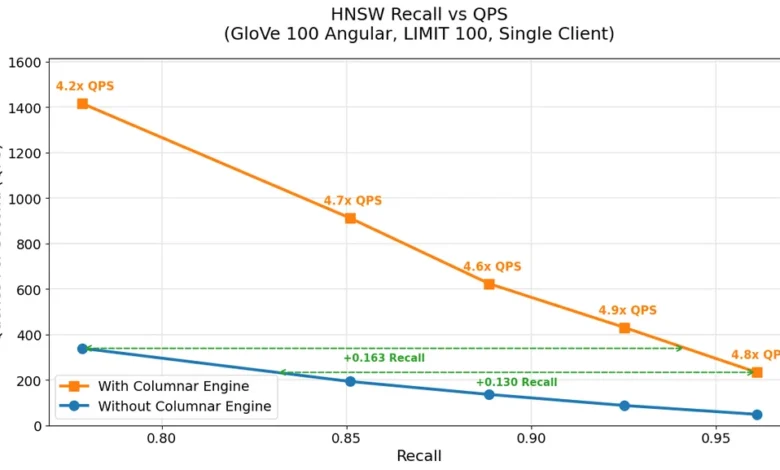
To concretely demonstrate the impact of the columnar engine on HNSW performance, a benchmark was conducted using the GloVe 100 Angular dataset, comprising over one million records. The benchmark script, available for public review, plotted the standard QPS against recall curves, searching for the top 100 nearest neighbors.
The visualization clearly illustrates two transformative benefits derived from the columnar engine-accelerated HNSW. While specific numerical values from the rendered graph are not directly transcribable here, the trend depicted shows a marked improvement in QPS across various recall levels when compared to the baseline. Notably, the baseline performance already assumes the index is fully cached in the PostgreSQL shared buffer cache. The substantial performance gains observed are therefore not merely a consequence of data residing in RAM versus disk, but rather a testament to the superior efficiency of AlloyDB’s memory architecture.

Under the Hood: How Columnar Engine Accelerated HNSW Operates
In traditional PostgreSQL architectures, index operations rely on the shared buffer cache. Even when all relevant index data is resident in memory, the database system must still manage a considerable amount of overhead associated with the buffer manager. This includes intricate operations such as page pinning and unpinning, lock acquisition, buffer table lookups, and the management of Least Recently Used (LRU) data. These processes, while essential for general-purpose database management, introduce latency and consume valuable processing cycles, particularly in high-throughput scenarios like AI vector search.
AlloyDB’s columnar engine fundamentally re-architects this process. By storing data in a specialized, scan-optimized columnar format, it minimizes data movement and maximizes CPU cache utilization. When applied to HNSW indexing, this means:
- In-Memory Index Storage: The HNSW index is held entirely in the columnar engine’s in-memory cache, eliminating disk I/O for index lookups.
- Vectorized Memory Layout: Data is organized in a way that allows for simultaneous processing of multiple data points (vectors), significantly accelerating traversal operations across the HNSW graph.
- Bypassing Buffer Manager Overhead: The columnar engine operates independently of the standard PostgreSQL buffer manager, shedding the associated latency and complexity. This direct memory access and optimized data layout are key to unlocking the dramatic performance improvements.
Why This Advancement Matters for Enterprises
For enterprise-scale AI applications, the benefits of AlloyDB’s columnar engine-accelerated HNSW extend far beyond mere speed. They translate directly into tangible improvements in both cost-efficiency and the quality of AI-driven services.
- Enhanced User Experience: Faster response times for AI-powered features, such as personalized recommendations, intelligent search, and real-time data analysis, lead to a more engaging and satisfying user experience. This can be a critical differentiator in competitive markets.
- Reduced Infrastructure Costs: By achieving higher QPS with the same or even less hardware, organizations can reduce their cloud infrastructure expenditure. The ability to process more data with fewer resources directly impacts the bottom line.
- Scalability for Growing Demands: As AI adoption continues to surge, the ability to scale AI workloads efficiently is paramount. AlloyDB’s performance gains enable businesses to handle increasing data volumes and user traffic without compromising service quality or incurring prohibitive costs.
- Accelerated Innovation Cycles: Developers can iterate and deploy AI models more rapidly when they are not hindered by database performance bottlenecks. This faster innovation cycle allows businesses to bring new AI-powered products and features to market more quickly, gaining a competitive edge.
It is important to note that while the columnar engine utilizes memory, this memory usage is highly optimized. The data is meticulously compressed and managed, ensuring that the memory footprint remains minimal relative to the substantial performance gains. This efficient use of resources makes it a highly attractive proposition for resource-intensive enterprise workloads.
Getting Started with Columnar Engine Accelerated HNSW
Google Cloud is providing a straightforward path for developers and organizations to leverage this new capability. A quick-start guide is available to facilitate the adoption of columnar engine accelerated HNSW in AlloyDB. The process involves two primary steps:
-
Enabling the Columnar Engine and Index Caching:
Users must ensure that two specific configuration flags are enabled for their AlloyDB instance:google_columnar_engine.enabledandgoogle_columnar_engine.enable_index_caching. These settings can typically be adjusted through the Google Cloud console or via command-line tools. -
Adding the HNSW Index to the Columnar Engine:
After an HNSW index has been successfully created using thepgvectorextension, a specific SQL command needs to be executed to instruct AlloyDB to cache this index within the columnar engine. This command ensures that the optimized columnar storage and retrieval mechanisms are applied to the HNSW index, unlocking the performance benefits. The exact SQL syntax will be provided in the official documentation.
The preview release signifies Google Cloud’s commitment to continuously enhancing AlloyDB’s AI capabilities. As the service evolves, further optimizations and expanded features are anticipated, solidifying AlloyDB’s position as a leading database solution for the era of artificial intelligence. The ability to efficiently manage and query vast amounts of vector data is no longer a niche requirement but a fundamental necessity for businesses seeking to harness the full potential of AI. AlloyDB, with its latest advancements, is directly addressing this critical need, empowering enterprises to build and deploy more intelligent, responsive, and cost-effective AI applications.
Related posts: