The Internet of Things (IoT) has evolved far beyond a niche category of simple connected gadgets into a vast, mission-critical ecosystem. Today, it encompasses industrial-grade sensors, advanced medical wearables, smart building automation controls, high-accuracy energy meters, complex asset-tracking devices, automotive telematics modules, wireless power systems, and expansive 5G-connected infrastructure. Within this modern landscape, wireless functionality is rarely just an accessory; it serves as a product’s primary connection to the external world.
This profound architectural shift has elevated radio frequency (RF) testing, electromagnetic compatibility (EMC) evaluation, and regulatory planning to core pillars of product engineering. Modern connected devices are expected to share the finite radio spectrum responsibly, avoid causing or succumbing to harmful electromagnetic interference, tolerate harsh environmental disturbances, protect human operators from excessive RF exposure, and maintain full regulatory compliance even after being integrated into complex host enclosures.
The Growing Complexities of Modern IoT Compliance
Engineering teams developing contemporary connected hardware frequently encounter a unique convergence of technical hurdles. Unlike traditional electronics, IoT devices must seamlessly integrate multiple radios, delicate sensors, intricate software cycles, continuous cloud connectivity, aggressive low-power operating modes, and demanding real-time performance monitoring capabilities into exceptionally compact physical footprints.
According to industry insights shared by Dr. Keyhan Sheshyekani, CEO of Stancer Testing-Lab and Professor of Electrical Engineering at Polytechnique Montréal, primary engineering concerns during EMC evaluation include time-domain emissions, in-band interference, antenna detuning, electrical cross-talk, device proximity issues, low-cost component variability, application criticality, and rigorous functional monitoring.
For today’s manufacturers, regulatory compliance is no longer merely a box-checking exercise focused on transmitter output power or spurious emissions. A certified device must remain entirely functional under severe electromagnetic stress, particularly because the sensor data it gathers is increasingly utilized by applications carrying high operational and safety risks.
A Fragmented Global Regulatory Landscape
Most commercial IoT products incorporate at least one intentional radiator, with many advanced designs combining multiple wireless technologies simultaneously. Common protocols include Wi-Fi, Bluetooth, cellular standards such as LTE-M and NB-IoT, Low-Power Wide-Area Networks (LPWAN) like LoRa, Zigbee, RFID, Ultra-Wideband (UWB), Global Navigation Satellite Systems (GNSS), and proprietary RF links. Each individual transmitter introduces specific legal obligations, and every target geographic market demands compliance with distinct approval frameworks.
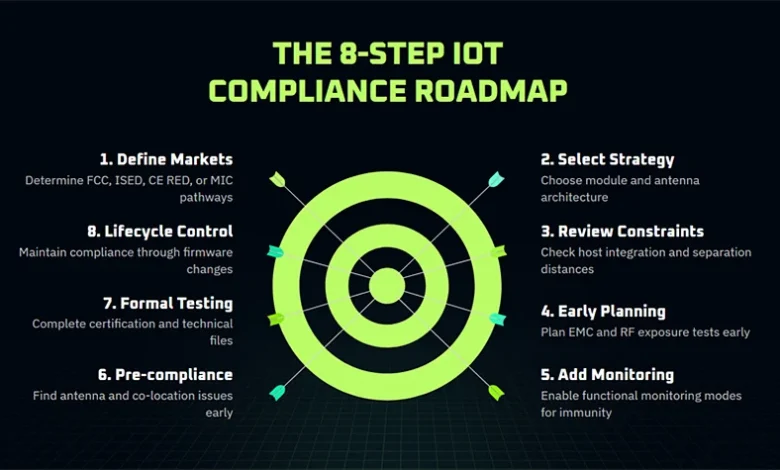
Navigating this international matrix requires careful planning long before a product reaches the manufacturing line. Major global jurisdictions enforce strict, localized requirements:
- United States: Governed primarily by the Federal Communications Commission (FCC), requiring equipment authorization typically under Part 15, Part 90, or other specialized rule parts depending on the deployed technology.
- Canada: Overseen by Innovation, Science and Economic Development (ISED) Canada, enforcing Radio Standards Specifications (RSS) such as RSS-247, RSS-210, RSS-Gen, and RSS-102 for evaluating human RF exposure.
- European Union: Regulated under the Radio Equipment Directive (RED), requiring CE marking, harmonization with ETSI standards, robust EMC and electrical safety validation, spectrum efficiency, and detailed technical documentation.
- Japan: Managed by the Ministry of Internal Affairs and Communications (MIC), requiring mandatory radio approval and the distinctive Giteki mark for applicable wireless hardware.
A critical reality for hardware developers is that regulatory approval in one region does not automatically grant market access elsewhere. A device holding a valid FCC grant for the United States may still require comprehensive ISED certification before legally entering the Canadian market. Similarly, hardware optimized for North America must often undergo rigorous European testing—including EN 300 328, EN 301 489, EN 62368-1, and human RF exposure evaluations—to compile the technical file necessary for a valid CE declaration.
Failing to map out a comprehensive regulatory strategy early in the product lifecycle frequently results in costly customs seizures, mandatory product recalls, unexpected shipment delays, aggressive market surveillance actions, sudden hardware redesigns, or the outright loss of critical market launch windows. Startups and established manufacturers alike must recognize that relying on pre-certified modules mitigates certain risks, but it never completely eliminates host-level compliance responsibilities.
Advanced RF Testing Parameters and System-Wide Impact
Comprehensive RF testing ensures that a wireless apparatus transmits exclusively within its legally authorized spectrum, adheres strictly to maximum power output limitations, suppresses unwanted out-of-band emissions, and utilizes the radio channel in strict alignment with regional governance standards.
Technical evaluations generally analyze several core performance metrics:
- Frequency Error and Channel Occupancy: Verifying that carrier frequencies remain stable and that transmissions occupy only the permitted bandwidth.
- Spurious and Harmonics Emissions: Identifying and quantifying unintended radio frequencies radiated outside the operating channel.
- Modulation Characteristics: Ensuring data encoding adheres strictly to standard protocols without introducing signal distortion.
- Receiver Sensitivity and Selectivity: Confirming that the device can reliably decode intended signals while rejecting adjacent-channel interference.
Industry research demonstrates that when a traditional electronic device incorporates a radio transmitter, applicable regulatory thresholds can become significantly more stringent across specific frequency bands. For example, a standard industrial appliance subject to generic radiated emission limits near the 1–3 GHz range faces entirely different, much tighter compliance criteria once a 2.4 GHz transceiver is introduced. The practical lesson for design engineers is clear: adding wireless functionality alters the compliance burden for the entire assembled product, extending far beyond the isolated radio module.
Uniquely Complex EMC Challenges in IoT Devices
Traditional electromagnetic compatibility testing historically focused on evaluating emissions and immunity profiles while a product operated within clearly defined, static operational modes. IoT architecture breaks this traditional mold. The electrical behavior of a connected device fluctuates dynamically based on firmware execution states, remaining battery capacity, aggressive sleep cycles, active sensor polling, network handshake intervals, cloud synchronization routines, and automated retry protocols following dropped transmissions.
Engineers must account for several distinct IoT-specific EMC phenomena during the development and testing phases:
- Time-domain emissions: Software-driven duty cycling and low-power sleep modes often cause electromagnetic emissions to appear only during extremely brief operating windows, making them difficult to capture using standard sweep times.
- In-band interference: High-density deployments in crowded unlicensed frequency bands frequently cause interference directly inside the intended communication channel.
- Co-location effects: Closely packed internal electronics, micro-antennas, dense battery packs, digital displays, and even proximity to the human body can detune antennas or induce severe electrical cross-talk.
- Application criticality: Identical raw sensor data streams may be utilized for low-risk ambient monitoring in one context, yet feed critical safety or security infrastructure once processed in the cloud.
Consider a practical scenario: a wireless industrial temperature sensor may easily pass a basic benchtop emissions test, yet fail to transmit accurate telemetry data when subjected to radiated immunity testing. A consumer wearable might satisfy maximum output power limits in an open laboratory setting, but exhibit severe impedance mismatches when placed directly against human tissue. A smart grid sensor functioning flawlessly in a controlled lab environment can experience complete communication failure inside a high-voltage substation or a dense, congested urban RF environment.
Strategic Decision-Making: Module Integration vs. Custom RF Design
One of the earliest and most consequential decisions facing an IoT project team is whether to design proprietary radio circuitry in-house or integrate a pre-certified wireless module. Each path carries distinct technical, financial, and regulatory consequences.
In-house RF design grants developers maximum physical control over product size, antenna efficiency, long-term performance scalability, and unit production costs at scale. However, it imposes the highest possible certification burden, placing full legal and financial responsibility for transmitter compliance, EMC validation, RF exposure testing, and exhaustive documentation squarely on the manufacturer.
Conversely, utilizing pre-certified modules significantly reduces upfront certification efforts and accelerates time-to-market. Yet, industry experts emphasize that a pre-certified module is never a compliance shortcut for the final finished product. The assembled host device still requires mandatory evaluation covering digital emissions, power-line conducted disturbances, enclosure integration effects, antenna placement geometry, statutory labeling, user manual compliance statements, human RF exposure, and simultaneous multi-radio transmission conditions.
Host-Level Compliance and Multi-Technology Realities
Module certification covers only the isolated module under the precise test conditions defined in its original grant or certificate. Once that module is physically integrated into a host product, the final assembly must be evaluated as a complete, unified system. Typical host-level requirements mandate rigorous scrutiny of digital logic emissions, power supply interfaces, chassis shielding, and peripheral cable interactions.
This is where the synergy of combined EMC and RF testing becomes invaluable. A product may pass standalone radio tests yet fail overall radiated emissions benchmarks due to unshielded high-speed clocks, noisy DC-DC power converters, bright digital displays, lithium battery charging circuits, or poorly routed printed circuit board (PCB) traces. Conversely, physical design modifications implemented to suppress digital emissions can inadvertently detune the integrated antenna, severely degrading wireless range and connection reliability.
Furthermore, modern IoT devices rarely rely on a single communication standard. A connected medical device might incorporate Bluetooth Low Energy for local clinician pairing, Wi-Fi for hospital network synchronization, inductive wireless charging pads, and a proprietary diagnostic interface. An industrial cellular gateway often combines LTE-M, GNSS positioning, LoRa long-range telemetry, Ethernet ports, USB expansion, and high-speed multi-core processors. Each integrated interface introduces unique compliance parameters that must be harmonized within a unified test plan.
Functional Monitoring and Application Criticality
A persistent hurdle during the physical testing of connected hardware is the challenge of monitoring device functionality during aggressive immunity evaluations. Because many IoT devices operate on internal battery power and communicate exclusively via wireless interfaces, attaching physical monitoring wires can alter the product’s fundamental EMC behavior by inadvertently introducing secondary coupling paths or acting as unintended antennas.
Leading testing laboratories advocate for the integration of dedicated design features that streamline observation during rigorous testing phases, such as:
- Exposing auxiliary diagnostic firmware ports configured to output real-time operational status without disrupting wireless links.
- Implementing optical indicators or direct memory registers that reflect internal processing states.
- Designing specialized test firmware modes that maintain continuous transmission or ping cycles to verify link stability under electromagnetic stress.
Without these provisions, a device undergoing radiated immunity, conducted immunity, or electrostatic discharge (ESD) testing may appear to pass simply because its radio continues to transmit a carrier wave—even though the internal processor is locked, continuously broadcasting stale historical data, or masking critical sensor errors behind internal software averages. A robust compliance roadmap must mandate dedicated test modes that ensure the device remains fully observable throughout the testing cycle.
Beyond physical performance, the broader implications of IoT data ecosystems introduce unique risk-management hurdles. Because IoT data travels continuously to cloud platforms where it is repurposed across diverse applications, the criticality of a sensor is no longer defined solely by its physical hardware. A motion sensor deployed in a commercial building may serve simple indoor lighting automation in one deployment, yet function as a primary intrusion detection alarm in another. Traffic monitoring sensors used for routine statistical analysis by city planners may simultaneously feed emergency response routing systems.
From an engineering and regulatory perspective, this evolution means manufacturers must guarantee that data accuracy, timing precision, traceability, and operational safety are maintained even when the physical hardware is subjected to severe electromagnetic interference.
Administrative Compliance, Lifecycle Management, and Accreditation
Achieving technical compliance is only half the battle; regulatory market entry depends equally on administrative precision. Wireless hardware must display correct statutory labeling, including FCC ID identifiers, ISED certification numbers, HVIN/PMN nomenclature, CE marks, notified body identification numbers where mandated, comprehensive user manual warnings regarding antenna installation conditions, and clear human RF exposure disclaimers. Incomplete technical files or improper labeling routinely trigger market surveillance interventions, even when underlying technical test reports are flawless.
The compliance lifecycle extends far beyond initial product launch. Regulatory authorities retain the legal right to request production samples, audit technical documentation, investigate consumer complaints, and re-test commercial inventory already available in the marketplace. Furthermore, manufacturers must establish formal change-control protocols to manage inevitable engineering updates—such as component obsolescence, PCB layout revisions, battery swaps, enclosure material changes, or firmware upgrades. For software-defined radios, modifying output power, channel access behavior, modulation schemes, or antenna gains can instantly invalidate original compliance filings, necessitating permissive changes or entirely new certifications.
To ensure that test data is universally recognized by international regulators, certification bodies, and global enterprise customers, manufacturers must partner with accredited testing facilities. Laboratories operating under ISO/IEC 17025 accreditation demonstrate recognized technical competence, rigorous equipment calibration, strict measurement traceability, and comprehensive quality oversight. Leveraging accredited partners ensures that compliance documentation withstands intense regulatory scrutiny, safeguarding market access and protecting brand reputation across international supply chains.