The landscape of containerized application management shifted significantly on October 20, 2026, when Amazon Web Services (AWS) officially launched Amazon ECS Gateway. Designed to address long-standing infrastructure complexities for platform engineering groups, this new account-level resource revolutionizes how ingress is handled for Amazon Elastic Container Service (ECS) workloads. By shifting the operational burden of managing individual Application Load Balancers (ALBs), listeners, target groups, security groups, and certificates from individual application development squads to centralized platform teams, AWS aims to streamline enterprise cloud architectures and reduce mounting infrastructure overhead.
Historically, deploying microservices on ECS often meant that each individual service required its own dedicated Application Load Balancer to handle incoming web traffic securely. While this decoupled architecture provided operational autonomy, it introduced massive cost inefficiencies, excessive resource proliferation, and complex internal Terraform or CloudFormation modules designed solely to provision standard networking components. With Amazon ECS Gateway, platform engineers can now provision a single gateway resource at the account level. Individual services then opt in effortlessly by adding a simple configuration parameter during standard create-service or update-service operations, allowing ECS to automatically provision underlying resources and efficiently pack up to 25 services onto a single shared ALB.
The Core Architectural Model: Gateway, Association, Connector, and Route
To understand how Amazon ECS Gateway operates within an AWS environment, one must examine its four core architectural building blocks: the gateway itself, gateway-cluster associations, gateway connectors, and gateway routes.

A gateway acts as a centralized, account-level resource with a unique name assigned per account and AWS Region. However, merely creating a gateway does not modify traffic routing or consume active ALB capacity. Instead, platform operators establish a many-to-many relationship by linking gateways to ECS clusters—permitting up to 10,000 clusters per gateway and up to 5 gateways per cluster.
Traffic routing is ultimately triggered at the workload level via a gateway connector. When developers deploy a service containing this parameter, ECS scans the cluster for any compatible gateway, automatically allocates the service to an ALB with available capacity (or provisions a new one if limits are reached), and dynamically generates all requisite per-service infrastructure components, including hostnames, rules, target groups, security groups, and SSL/TLS certificates.
A critical operational nuance highlighted by AWS documentation involves how ECS selects a gateway. Rather than selecting a gateway explicitly by its name or Amazon Resource Name (ARN), a service connector automatically hooks into every compatible gateway within its cluster that satisfies its matching criteria. Security experts have noted that this behavior requires strict discipline; internal services that must never be exposed to the public internet must explicitly incorporate a PRIVATE filter. Without this security configuration, the subsequent association of an internet-facing gateway with the cluster could inadvertently expose internal microservices to the public web upon their next routine deployment.
Division of Responsibilities: Platform Teams vs. Application Teams
The introduction of Amazon ECS Gateway solidifies a clean separation of concerns between centralized platform engineering teams and decentralized application development squads.

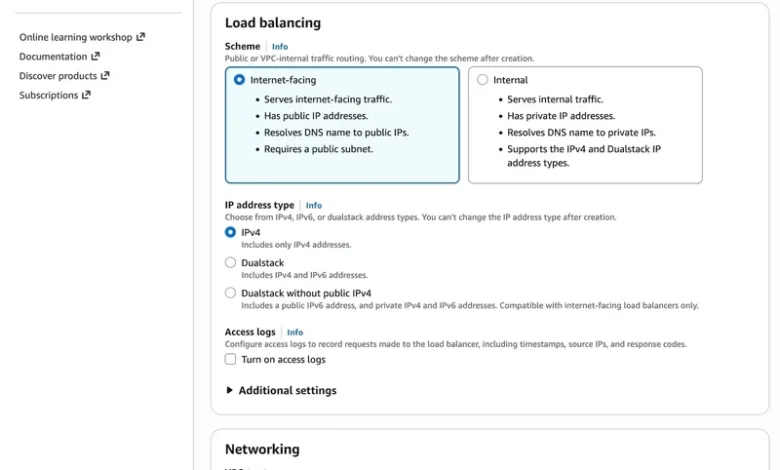
Platform teams retain absolute control over immutable infrastructure parameters established during initial gateway creation, such as gateway names, underlying VPC subnets, availability zone coverage, IP address types (including IPv4, default dual-stack, and dual-stack configurations without public IPv4 addresses), and fixed HTTPS:443 listener configurations. Furthermore, platform teams maintain ongoing authority over mutable properties, including inbound security groups, maximum ALB counts per gateway, AWS WAF web ACL associations, HTTP desync mitigation settings, S3 access log destinations, test traffic header rules for blue/green or canary deployments, and deletion protection flags.
Crucially, platform engineers must proactively manage the maxAlbCount parameter—which defaults to 10 ALBs, supporting up to 250 services—before applications reach scale. If a service attempts to opt in when the gateway has exhausted its allocated ALB capacity, the deployment will fail immediately, and subsequent modifications to raise the limit will not automatically trigger a retry.
Application teams, meanwhile, are freed from the complexities of infrastructure provisioning. By declaring a simple port name mapping in their task definitions and appending the gateway connector configuration within their deployment scripts, development squads can seamlessly publish their services. Using the AWS CLI, developers can execute standard commands to instantiate services with Fargate launch types, apply blue/green deployment strategies, and query service revisions to retrieve automatically generated endpoint URLs and gateway connection statuses.
Financial Impact and Cost Optimization Analysis
One of the most compelling arguments for adopting Amazon ECS Gateway is the potential for substantial cost reductions in multi-service environments. Maintaining dedicated Application Load Balancers for dozens of microservices has historically imposed a heavy financial toll on enterprise cloud budgets.

To illustrate the financial implications, consider a standard production environment running 30 distinct HTTP microservices across three Availability Zones over a standard 730-hour month. Under a traditional architecture where each service utilizes its own dedicated ALB, fixed infrastructure costs accrue rapidly. A single ALB baseline charge of approximately $0.0225 per hour, combined with standard public IPv4 address charges, results in baseline fixed expenditures exceeding $800 monthly for load balancing alone—before factoring in Load Balancer Capacity Unit (LCU) data processing fees.
By migrating those same 30 services to Amazon ECS Gateway, workloads can be efficiently consolidated onto just two shared ALBs, slashing baseline fixed load balancer costs to roughly $55 per month. While variable LCU charges scale proportionally with actual incoming network traffic and cannot be eliminated, the dramatic reduction in idle infrastructure spending offers immediate relief for cloud financial management (FinOps) teams. Organizations leveraging IPv6 can achieve even greater optimization by utilizing dualstack-without-public-ipv4 configurations, completely removing hourly public IPv4 address fees from their monthly AWS bills.
Regional Availability and Industry Implications
Amazon ECS Gateway is available immediately across all commercial AWS Regions that support Amazon ECS, including critical international hubs such as the São Paulo (sa-east-1) Region. Because all generated resources reside entirely within the customer’s account and Region, multi-account enterprises must deploy and manage gateways independently across each account boundary. Security best practices dictate that permissions for actions such as associate-gateway-with-cluster must be heavily restricted via AWS Identity and Access Management (IAM), as these capabilities directly dictate which internal services become publicly accessible during subsequent deployments.
Industry analysts draw close parallels between Amazon ECS Gateway, Kubernetes Gateway API standards, and the AWS Load Balancer Controller’s IngressGroup feature, noting that AWS is successfully bringing native, platform-managed ingress patterns to proprietary container orchestration. While the service currently lacks native support for advanced edge use cases such as path-based routing across entirely distinct domains, mutual TLS (mTLS), Network Load Balancer (NLB) integration, or ALB-native OpenID Connect (OIDC) authentication, its core ability to automate the full lifecycle of shared ingress makes it an indispensable tool for organizations scaling microservices on ECS. As platform engineering continues to mature, automated ingress management tools like Amazon ECS Gateway represent a vital step toward reducing toil and standardizing secure cloud architectures.