Fine-Tuning vs. Frozen Embeddings: When to Adapt the LLM vs. the Sklearn Head

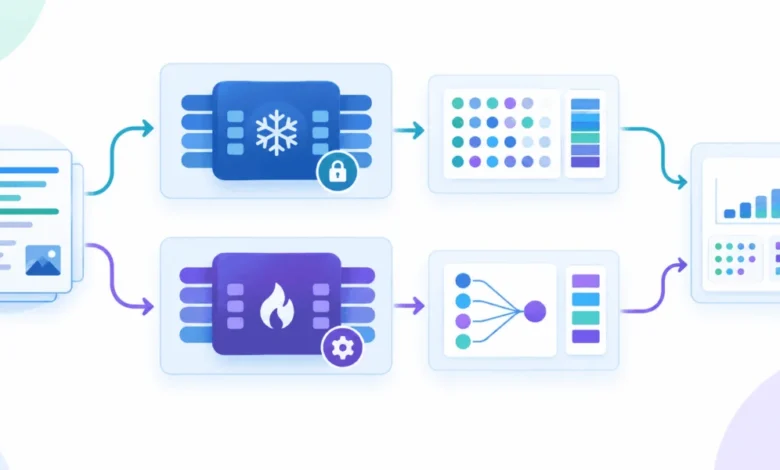
The rapid evolution of Large Language Models (LLMs) has fundamentally altered the landscape of natural language processing (NLP). As businesses and developers look to integrate these models into specialized environments—ranging from medical diagnostics to legal document review—the necessity for domain adaptation has become paramount. While the industry standard has long been the comprehensive fine-tuning of model weights, a parallel methodology utilizing frozen embeddings paired with traditional machine learning classifiers is gaining traction. This debate centers on a critical trade-off: the computational cost and technical complexity of full-parameter or parameter-efficient fine-tuning versus the efficiency and speed of treating an LLM as a static feature extractor.
The Strategic Dichotomy in Model Adaptation
To understand the current technological divide, one must first look at the mechanics of LLM deployment. When a pre-trained model encounters a specific domain—such as the classification of news articles into distinct categories—it often lacks the nuance required for high-accuracy performance. Historically, engineers have employed fine-tuning, which involves updating the model’s internal weights based on a labeled dataset.
In recent years, the introduction of Low-Rank Adaptation (LoRA) has revolutionized this process by injecting trainable, low-rank adapter matrices into the transformer layers. This allows developers to fine-tune only a fraction of the model’s parameters, drastically reducing the VRAM requirements. However, this remains a compute-intensive process. Conversely, the "frozen embedding" approach treats the LLM as a fixed, high-dimensional vectorizer. By passing input text through the model without allowing weight updates, developers can extract the final hidden states—the "embeddings"—and feed them into lightweight, classical classifiers like a Random Forest or Support Vector Machine (SVM) via the scikit-learn library.
Chronology of the Development Cycle
The implementation of these two strategies follows distinct paths. In a standard production environment, the "frozen" workflow begins with the instantiation of a base model—such as the Qwen or Llama series—configured in a 4-bit quantized state to minimize memory footprint. The first phase of the frozen approach is the "extraction pipeline," where text is tokenized and processed through the model to retrieve hidden states. Mean pooling is then applied to these states to derive a singular representative vector for the entire sequence. Once these vectors are stored, they are utilized to train an external classifier, a process that usually completes in seconds.
In contrast, the LoRA fine-tuning workflow requires a more robust training loop. After the base model is frozen and adapters are attached, the developer must configure hyper-parameters such as the learning rate, epoch count, and the rank (r) of the adapter matrices. The training phase involves multiple passes over the dataset, during which the gradients are calculated only for the adapter layers. This process is inherently more time-consuming than training a scikit-learn head, as it involves the complexities of backpropagation within the transformer architecture.
Comparative Data and Performance Metrics
Empirical testing using the AG News dataset—a classic benchmark comprising categorized news articles—illustrates the performance gap between these two methodologies. In controlled trials, the frozen embedding approach, while efficient, consistently reaches a performance ceiling. For instance, a Random Forest classifier trained on these embeddings may achieve an accuracy of approximately 82%. This is a commendable result given the speed and simplicity of the implementation; the training of the classifier takes mere seconds, though the initial feature extraction from the LLM can take upwards of 90 to 100 seconds depending on the hardware.
The LoRA-based approach, meanwhile, demonstrates superior predictive power. In similar benchmarks, QLoRA fine-tuning often pushes accuracy to 87% or higher. However, this 5% gain in accuracy comes with a substantial temporal cost. The fine-tuning process can take three to five times longer than the frozen embedding extraction and training cycle. For small-scale, rapid deployment projects, this duration may be negligible, but as datasets scale into the tens of thousands of samples, the overhead of backpropagation during fine-tuning becomes a significant logistical hurdle.
Industry Perspectives and Practical Implications
The decision between these two strategies is rarely about which method is "better," but rather which is "appropriate" for the specific use case. Proponents of the frozen embedding strategy argue that for many enterprise tasks, 80-85% accuracy is sufficient, especially when the goal is to reduce latency and infrastructure costs. By offloading the classification head to a scikit-learn model, companies can utilize smaller, cheaper inference instances that do not require high-end GPUs to host the full model weight updates.
Conversely, data scientists working on high-stakes applications, such as medical record analysis or technical documentation classification, often prioritize the marginal gains provided by LoRA. Because LoRA allows the model to learn the specific linguistic patterns and terminology of a niche domain more deeply, it is often seen as an essential step when accuracy is non-negotiable.
Broader Impact: The Shift Toward Efficiency
The current focus on these two methods reflects a broader trend in the AI industry: the democratization of model optimization. The rise of libraries like Hugging Face’s transformers and peft (Parameter-Efficient Fine-Tuning) has allowed developers with limited resources to compete with large-scale research labs.
The implications of this shift are twofold. First, the barrier to entry for building domain-specific AI has never been lower. A small startup can now achieve state-of-the-art results using a T4 GPU on Google Colab, provided they choose the correct strategy. Second, the industry is increasingly moving toward "hybrid" architectures. We are seeing a rise in systems that use frozen embeddings for preliminary filtering or broad categorization, while reserving full fine-tuned models for the final, critical stages of decision-making.
Analysis of Future Trends
As LLMs continue to grow in size and capability, the "frozen" strategy may face challenges. Larger models often produce more sophisticated embeddings, which could theoretically allow for even higher accuracy with simple classifiers. However, the cost of extracting these embeddings will also increase, potentially making the "frozen" approach just as expensive as fine-tuning in terms of raw compute time.
The future of model adaptation likely lies in automated selection tools. We can anticipate the development of "meta-frameworks" that automatically benchmark a dataset against both frozen embeddings and various adapter configurations, recommending the optimal path based on user-defined constraints—whether those constraints are latency, accuracy, or budget.
Ultimately, the choice between fine-tuning with LoRA and training a scikit-learn head on frozen embeddings represents the fundamental tension in modern engineering: the trade-off between absolute performance and operational agility. For the developer, the lesson is clear: assess the domain, define the tolerance for error, and calculate the cost of time. Whether choosing the speed of the scikit-learn head or the depth of the LoRA adapter, the ability to tailor LLMs to specific needs remains the most critical skill in the current technological era. By mastering these two distinct paths, developers ensure that they are not just using AI, but actively shaping it to meet the precise requirements of their unique domains.