The Lifecycle of an LLM: From Training to Production Drift
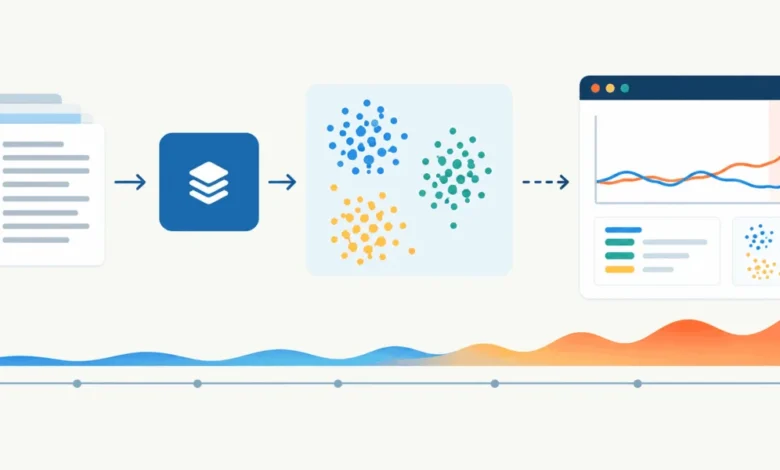
The lifecycle of an LLM is not a static process. During the development phase, models are trained on curated datasets that capture a specific distribution of information. Once these models are exposed to public-facing applications, they encounter "live" data. User behavior is inherently dynamic; as language evolves, new slang emerges, and global events shift the topics of public discourse, the input data distribution naturally migrates away from the baseline established during training.
In technical terms, embedding drift occurs when the probability distribution of the input vectors in a production environment deviates significantly from the distribution observed during the model’s development or initial baseline calibration. Traditional monitoring tools, which were designed for tabular data, often struggle with the high dimensionality of embeddings. While a tabular dataset might consist of dozens of features, an embedding vector typically contains hundreds or thousands of dimensions, making simple statistical checks insufficient.
A Chronology of Model Decay
The degradation of model performance follows a predictable, albeit often ignored, timeline. In the initial phase, known as the "Model Deployment" phase, the system operates with high precision because the production data aligns with the training distribution. Shortly thereafter, the "Drift Onset" phase begins, characterized by subtle changes in user queries.
If left unmonitored, the system enters the "Degradation Phase." During this stage, the model’s internal vector space, which was optimized for the original training data, begins to misinterpret new, out-of-distribution inputs. For instance, a customer service bot trained on technical troubleshooting documentation might perform poorly if users suddenly start asking about a new product launch or a sudden service outage. Finally, the "System Failure" phase ensues, where the model provides inaccurate, irrelevant, or potentially harmful outputs, directly impacting user trust and business metrics.
Detection Methodologies: The Domain Classifier Approach
One of the most effective strategies for identifying this drift is the implementation of a domain classifier. This method treats the detection of drift as a supervised learning problem. By training a secondary, lightweight model—such as a Random Forest or a Logistic Regression classifier—the system learns to distinguish between "baseline" (reference) data and "production" (live) data.
If the classifier can easily distinguish between the two sets, it indicates that the production data has shifted. This can be quantified using metrics like the Receiver Operating Characteristic Area Under the Curve (ROC-AUC). If the ROC-AUC score exceeds a predefined threshold (e.g., 0.65), it acts as a signal that the underlying data distribution has drifted enough to warrant a retraining or fine-tuning cycle. This method is particularly powerful because it can capture non-linear relationships and complex shifts in high-dimensional space that simpler distance metrics might overlook.
The Centroid Method: A Computationally Efficient Alternative
For organizations requiring real-time monitoring with minimal overhead, the centroid, or "center of mass" method, serves as a vital alternative. This approach involves calculating the mean vector (centroid) of the baseline embedding set and comparing it to the mean vector of the current production window.
The distance between these two centroids—typically measured using cosine distance or Euclidean distance—provides a clear indicator of how far the current data has migrated from the original baseline. While this method is computationally efficient, it does have limitations. By collapsing a complex, high-dimensional distribution into a single point, the centroid method may fail to detect multi-modal shifts or structural changes where the overall mean remains stable but the variance or shape of the data cluster changes significantly. Despite these limitations, it remains a standard industry practice for detecting macro-level trends in data shift.
Integrating Scikit-LLM for Production Readiness
The integration of libraries such as Scikit-LLM provides a standardized framework for embedding generation and drift monitoring. By utilizing wrappers for large language models, developers can easily transform raw text into numerical representations that are compatible with existing machine learning workflows.
Consider a scenario where a company uses the all-MiniLM-L6-v2 model to power a RAG pipeline. If the company updates its product offerings, the input queries will shift from basic account management questions to specific, complex product queries. Using the domain classifier approach, the system can automatically flag this shift. In practice, this looks like:
- Data Collection: Accumulating a batch of production queries over a 24-hour period.
- Vectorization: Transforming these queries into 384-dimensional embeddings.
- Classification: Running the drift detection classifier against a stored reference set.
- Alerting: Triggering an automated alert if the ROC-AUC score exceeds the sensitivity threshold, notifying the data engineering team that the model requires updated training data.
Broader Implications for AI Governance
The necessity of monitoring embedding drift extends beyond mere model performance; it is a critical component of AI governance and safety. As organizations face increasing scrutiny regarding the reliability of their AI systems, the ability to demonstrate that a model is performing within its "trained envelope" is essential.
Unchecked embedding drift can lead to "silent failures," where a system continues to operate but provides increasingly poor results without crashing. This is arguably more dangerous than a total system outage, as it can lead to incorrect decisions, biased outputs, and a gradual erosion of user confidence. Furthermore, as the industry moves toward more autonomous agents that rely on continuous data streams, the integration of automated drift detection will become a standard requirement for compliance and risk management.
Strategic Recommendations
To effectively manage embedding drift, organizations should adopt a multi-layered approach:
- Establish Baselines: Maintain a high-quality "Gold Standard" dataset that represents the ideal distribution for the model’s intended use case.
- Automate Monitoring: Implement continuous monitoring pipelines that compare incoming production data against the baseline at regular, scheduled intervals.
- Define Thresholds: Calibrate sensitivity thresholds based on the specific risk tolerance of the application. A critical medical diagnostic tool will require much tighter drift controls than a marketing content generator.
- Retraining Loops: Develop a CI/CD pipeline for machine learning that allows for seamless retraining or fine-tuning when drift is detected.
In conclusion, while the power of modern LLMs lies in their ability to process vast amounts of unstructured data, their susceptibility to distribution shift is a reality of the production environment. By employing techniques like domain classification and centroid distance analysis, engineering teams can build resilient, self-monitoring systems. As the landscape of generative AI continues to evolve, the maturity of these monitoring practices will distinguish robust, enterprise-grade AI applications from those that remain fragile and unpredictable. The transition from reactive fixing to proactive, data-driven monitoring is not merely a technical optimization; it is a prerequisite for the long-term sustainability of the artificial intelligence ecosystem.