Volt Typhoon Shifts Tactics: How the State-Sponsored Cyber Espionage Group Leveraged Silent Train to Compromise Critical Infrastructure

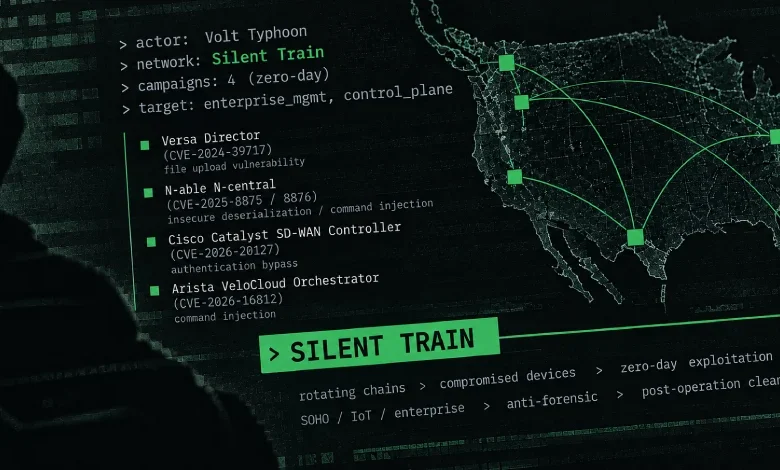
Cybersecurity researchers have uncovered sophisticated new operational methods deployed by the China-nexus cyber espionage group known as Volt Typhoon. According to a comprehensive threat intelligence report published by Lumen Technologies’ Black Lotus Labs, the state-sponsored threat actor utilized a now-disrupted covert access and relay network designated as Silent Train. This advanced framework was engineered specifically to facilitate zero-day exploitation, credential harvesting, data exfiltration, and long-term strategic access against high-value targets across the globe.
The Silent Train infrastructure represents a significant evolution in how advanced persistent threat (APT) groups maintain operational security while conducting large-scale cyber espionage campaigns. By leveraging rapidly rotating chains of compromised small office/home office (SOHO) routers, Internet of Things (IoT) gadgets, and enterprise-grade network infrastructure, Volt Typhoon successfully obscured its digital footprint, minimized attribution risks, and evaded detection from network defenders and law enforcement agencies.
Anatomy of the Silent Train Framework
First emerging in late 2023, Silent Train functions as a multi-layered, multi-hop relay network. Rather than relying on traditional, persistent command-and-control (C2) servers that security solutions can easily fingerprint and block, Volt Typhoon engineered an ephemeral architecture designed for single-use sessions.

The framework operates by routing malicious traffic through a carefully curated sequence of compromised devices before the traffic ultimately reaches its intended victim. Each device in the operational chain is assigned a specific, compartmentalized role. For example, threat intelligence data revealed that certain modem models, such as those manufactured by Intelbras, were strictly utilized as preliminary relay nodes. Conversely, high-end enterprise appliances like Netgear Orbi routers and Fortinet FortiGate firewalls frequently served as U.S.-based intermediary and exit points designed to interact directly with targeted environments.
Security analysts at Black Lotus Labs noted that the average lifespan of a Silent Train operational session was approximately four hours, with some sessions lasting mere minutes. During these brief windows, operators exploited exposed web interfaces on relay devices, deployed temporary secure shell (SSH) services, established configuration files, and utilized native "living off the land" utilities to advance their objectives. Crucially, at the conclusion of each operation, the threat actors executed rigorous post-operation cleanup protocols—removing all temporary artifacts, wiping SSH keys, and dismantling the operational chain to prevent forensic analysis.
The Shift Toward Ephemeral Infrastructure
The development of Silent Train closely mirrors international disruption efforts directed against earlier infrastructure utilized by Chinese state-sponsored actors. In late 2023 and early 2024, law enforcement agencies and cybersecurity firms dismantled the notorious KV-botnet, an IoT botnet heavily leveraged by Volt Typhoon and associated threat groups.
Faced with the public exposure and neutralization of the KV-botnet, Volt Typhoon accelerated the deployment of Silent Train. The group completely pivoted away from long-term, persistent infrastructure toward transient, highly resilient networks built on diverse device classes and multi-geographic nodes. By continuously assembling and dismantling these temporary chains, the hackers established a secure framework capable of weathering ongoing security interventions.

By early 2025, however, researchers observed a strategic maturation in the platform. Silent Train evolved from a purely ephemeral network into a hybrid architecture. While retaining multi-hop SOHO relay capabilities, the threat group began incorporating high-grade enterprise devices that remained embedded within the network for periods ranging from one to three months. Furthermore, the operators introduced advanced reverse-tunneling variants utilizing open-source proxy tools such as Chisel and FRP to channel traffic securely from infected endpoints to upstream infrastructure.
Targeting Strategy and Zero-Day Exploitations
Silent Train has been tied to sweeping compromise campaigns impacting hundreds of organizations across vital economic and governmental sectors. Confirmed victims include telecommunications providers, government agencies, defense contractors, satellite communication operators, universities, information technology firms, and essential critical infrastructure. Affected sectors span water, energy, transportation, maritime, rail, aviation, and emergency services.
Geographically, operations within the United States have heavily concentrated on Hawaii, California, and Texas. Analysts attribute this regional focus to the heavy presence of major military installations, critical logistics hubs, telecommunications backbones, and defense manufacturing facilities within these states. Security experts infer that maintaining persistent access to these specific ecosystems forms part of a broader contingency strategy designed to support intelligence gathering during geopolitical tensions or crises in the Indo-Pacific region.
Throughout its operational history, Volt Typhoon has systematically targeted centralized management platforms and perimeter security devices. Notably, Black Lotus Labs confirmed that Silent Train served as the delivery mechanism for multiple zero-day exploitation campaigns. Among these was the exploitation of a critical file upload vulnerability in Versa Director, tracked as CVE-2024-39717, which the group utilized in mid-2024 to deploy a custom web shell named VersaMem. This malware enabled unauthorized credential harvesting and sustained downstream access.

In addition to the Versa Director flaw, researchers linked Silent Train to at least three other confirmed zero-day campaigns. Furthermore, retrospective analysis suggests the threat actor capitalized on an undocumented vulnerability affecting Quest KACE appliances prior to its official patch disclosure in October 2025, impacting over 30 distinct enterprise victims.
Implications for Enterprise Security and Global Defense
The identification and analysis of Silent Train underscore the growing sophistication of state-sponsored cyber espionage operations targeting network edge infrastructure. By weaponizing third-party routers, IoT appliances, and enterprise firewalls, threat actors have effectively turned the interconnected nature of modern digital environments against defenders.
The reliance on short-lived sessions and anti-forensic cleanup challenges traditional incident response models, which traditionally depend on persistent C2 artifacts and long-term log retention. Consequently, cybersecurity authorities and network defenders are urging organizations—particularly those operating within critical infrastructure and defense supply chains—to implement robust asset inventory management, enforce strict multi-factor authentication, monitor edge device logs for anomalous SSH activity, and apply prompt firmware updates to all SOHO and enterprise routing equipment.
As nation-state threat actors continue to refine their operational security protocols, the disruption of frameworks like Silent Train highlights the critical necessity of public-private partnerships, continuous threat intelligence sharing, and proactive resilience measures across the global cybersecurity landscape.