AWS Weekly Roundup: Generative AI, Security Enhancements, and Cloud Infrastructure Updates Dominates Enterprise Technology

Amazon Web Services (AWS) has rolled out a comprehensive series of updates spanning enterprise security, artificial intelligence, serverless container networking, and high-performance machine learning hardware. The announcements reflect an industry-wide pivot toward automated vulnerability remediation, low-latency generative interfaces, and the mitigation of compressed patch windows that challenge modern security teams.
The release cycle emphasizes the changing realities of enterprise technology adoption. As generative artificial intelligence transitions from experimental workloads to core operational infrastructure, cloud providers are racing to secure underlying systems while expanding accessibility through localized voice interfaces, native hardware integrations, and simplified serverless management.
Advanced Threat Intelligence and Automated Vulnerability Remediation
The most critical security announcement of the week is the general availability of AWS Continuum, a service designed to fundamentally reframe vulnerability management from a passive reporting mechanism into an active, end-to-end remediation pipeline. Traditional vulnerability management tools typically rely on automated scanners that generate extensive lists of CVEs, leaving security operations and engineering teams overwhelmed by triage.
AWS Continuum changes this paradigm by constructing a dynamic context graph that maps code repositories directly to live AWS environments. The system evaluates findings based on their proximity to business-critical systems, assigns concrete evidence levels, and actively reproduces exploitable vulnerabilities inside an isolated sandbox using generated proof-of-concept code. Rather than delivering abstract severity metrics, the service demonstrates the tangible risk of a flaw and automatically generates a pull request containing the required fix.
At present, safety guardrails remain strict: every proposed remediation requires human review and explicit approval before merging. However, AWS has indicated that future iterations will introduce autonomous fix classes governed by configurable confidence thresholds.
The urgency behind this automated approach was underscored by simultaneous findings from Amazon Threat Intelligence regarding active exploitation timelines. Telemetry data from AWS MadPot honeypots revealed that the PHP2Shell exploit (associated with vulnerabilities CVE-2026-109618 and CVE-2026-109619) was actively weaponized in the wild on October 17. This activity occurred four days prior to public disclosure and roughly twelve hours before embargoed proof-of-concept code began circulating online.
Security analysts note that these findings effectively dissolve the traditional multi-day patch window. Organizations can no longer assume that vulnerability identification precedes exploitation. In response, AWS released immediate mitigation strategies utilizing AWS Web Application Firewall (WAF) rules to protect affected systems while permanent patches are deployed. AWS Continuum is currently available in the US East (N. Virginia) and US West (Oregon) regions.

Streamlining Container Networking with Amazon ECS Gateway
In infrastructure and container orchestration, AWS introduced Amazon ECS Gateway to resolve long-standing organizational friction between network administration teams and application developers. Historically, exposing containerized services running on Amazon Elastic Container Service (ECS) required complex coordination over subnets, security groups, Transport Layer Security (TLS) certificates, listener configurations, and AWS WAF web access control lists.
Amazon ECS Gateway divides these responsibilities cleanly. Platform engineering teams define a single, centralized gateway encompassing network-level configurations such as organization subnets and security policies. Application teams then opt into the architecture simply by attaching a gateway connector to their service definitions.
Once connected, Amazon ECS automatically provisions and manages an AWS Certificate Manager (ACM) certificate, a unique DNS hostname, necessary listener rules, target groups, and isolated security groups that restrict inbound traffic exclusively to the designated Application Load Aligner (ALB).
The economic and operational efficiency of the system is substantial. A single ALB can now support up to 25 distinct services, with ECS dynamically provisioning load balancers upon initial connection and deprecating them when services are removed. Furthermore, a single gateway can associate with up to 10,000 clusters, with a maximum of five gateways per cluster. Enterprises can adopt the architecture incrementally using the UpdateService API without disrupting existing load balancers. The service is available at no additional charge in all commercial AWS regions where Amazon ECS operates.
Expanding Multilingual Generative AI and Voice Capabilities
In the artificial intelligence sector, Amazon Polly received a major upgrade to its generative speech engine, expanding its catalog to 57 generative voices spanning 11 languages and 25 locales. The update introduces 14 new voices across nine locales, introducing Hindi and Finnish to the generative engine for the first time.
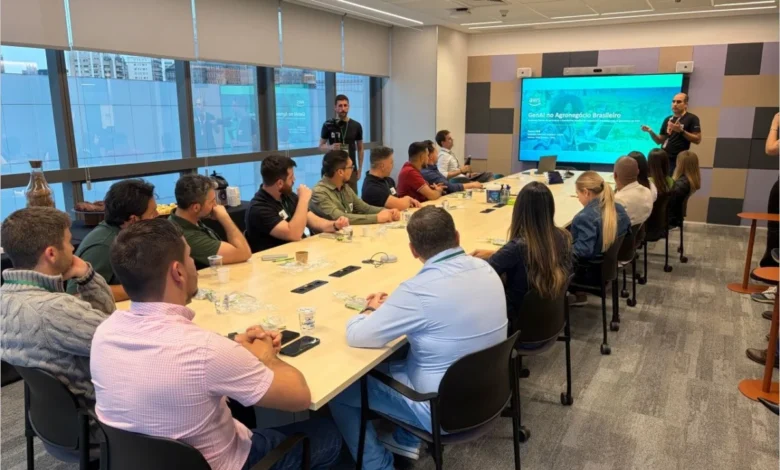
Crucially for international markets, the release incorporates two new Brazilian Portuguese voices, named Leo and Carolina. This technical advancement builds upon ongoing discussions regarding the practical delivery of AI tools in traditional industries, such as agribusiness. Industry leaders note that in operational environments where workers are constantly mobile—such as drivers navigating between agricultural facilities—the human-computer interface must be auditory rather than visual.
The Polly upgrade functions as a drop-in replacement, preserving existing voice names, API parameters for the SynthesizeSpeech call, and pricing structures while delivering significantly more natural, context-aware speech synthesis.
Hardware Flexibility and Model Customization on AWS
Hardware choice and model training also saw significant developments with the public beta release of TorchNeuron. This open-source PyTorch backend enables developers to execute machine learning models on AWS Trainium hardware simply by changing model instantiation to .to('neuron'), preserving eager execution and torch.compile compatibility without requiring extensive code rewrites. Integrating directly with the Neuron Kernel Interface, the backend supports custom operators across Trainium2 and Trainium3 instances, reinforcing the principle that hardware acceleration should not lock software developers into proprietary frameworks.

Simultaneously, Amazon SageMaker AI introduced managed training sessions designed to remove the operational overhead of managing GPU infrastructure during the post-training loop. Developers retain full control over custom loss functions and reward signals while SageMaker handles distributed execution, hardware allocation, fault recovery, and checkpoint storage.
Billing is metered strictly by the tokens processed, pausing automatically while reward functions evaluate model batches. The platform simultaneously expanded foundational model support to include Muse Glimmer, Qwen 3.8, and Ministral 3.
To improve reliability in enterprise data pipelines, Amazon Bedrock introduced native support for structured JSON outputs across all Anthropic Claude models. Accessible via both bedrock-runtime and bedrock-mantle endpoints, the feature eliminates the need for complex custom parsing, regex filtering, and retry logic when automating tasks such as parsing clinical health notes, routing technical support tickets, or extracting mandatory fields from complex financial reports.
Database Migrations and Agentic Tool Discovery
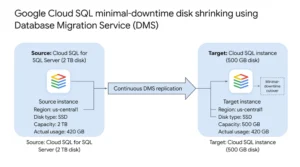
In enterprise database modernization, AWS highlighted a successful large-scale migration executed by U.S. Bank, which transitioned four Oracle Exadata databases totaling 119 terabytes to Amazon RDS for Oracle. Utilizing a configuration-driven pipeline powered by Oracle XTTS, AWS DataSync, and Amazon EFS over bandwidth-constrained Direct Connect links, the initial baseline data copy was completed in approximately seven days with zero data loss. Subsequent system cutovers averaged four hours per database.
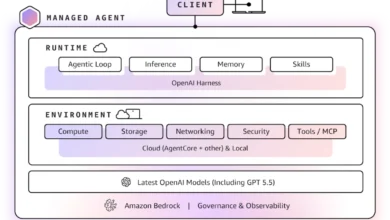
In cloud-native application architecture, the introduction of AWS Agent Registry provides a managed catalog for Model Context Protocol (MCP) servers, agents, and agent skills. The registry allows AI orchestrators to dynamically discover, instantiate, and execute approved tools at runtime rather than hardcoding capabilities during build time, returning connection metadata while strictly safeguarding invocation credentials.
Additionally, Amazon ElastiCache Serverless for Valkey announced zero-downtime online migration capabilities. Organizations can now migrate self-managed Valkey or Redis OSS instances running on Amazon EC2 directly into ElastiCache Serverless without employing third-party replication tools or suffering client-facing errors during system cutovers.
As the industry prepares for upcoming events—including AWS re:Invent, scheduled for November 30 through December 4 in Las Vegas, which features more than 2,200 technical sessions—cloud architects and enterprise leaders continue to focus on operational resilience, automated security mitigation, and the practical deployment of generative AI at scale.