Liquid Web Named Best VPS Hosting Provider Overall in New Comprehensive Industry Assessment

Established in 1997, Liquid Web has spent over two decades carving out a specialized niche in the enterprise hosting sector, pivoting away from cheap, consumer-grade shared hosting packages to focus on robust infrastructure designed specifically for businesses, digital agencies, developers, and high-traffic online storefronts. The company’s core service portfolio centers heavily on cloud virtual private servers (VPS), managed VPS, dedicated server configurations, and specialized managed WordPress and WooCommerce hosting solutions. This dedication to advanced architecture grants the provider a level of technical depth that far surpasses many mainstream competitors, though it simultaneously introduces a more complex matrix of service tiers and pricing structures for prospective enterprise buyers.
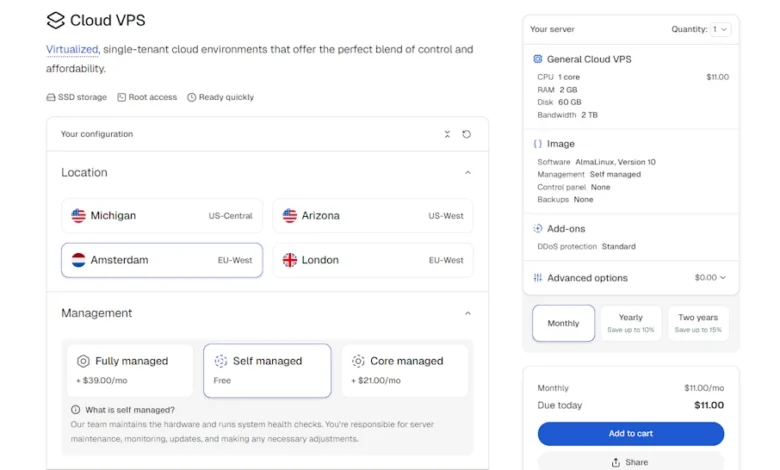
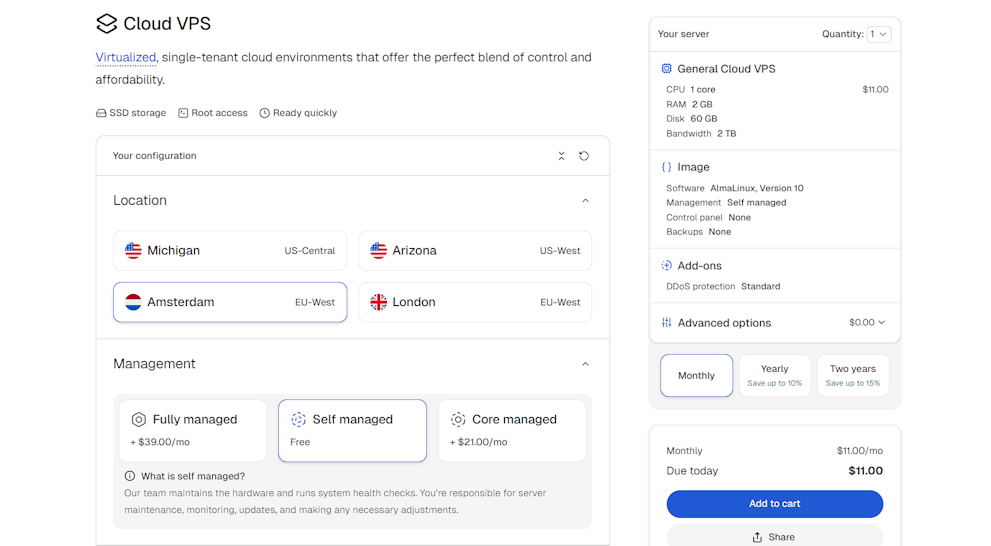
Evaluating the true cost of enterprise-grade virtual infrastructure requires looking past headline-grabbing entry figures. While Liquid Web’s sales team quotes an initial entry Cloud VPS configuration—comprising a single CPU core, 2GB of RAM, 60GB of solid-state drive (SSD) storage, and 2TB of monthly bandwidth—at an attractive $11 per month, this base package comes with significant operational caveats. The entry-level price point applies exclusively to self-managed servers operating without a pre-installed control panel or automated backup solutions, placing the full burden of operating system deployment, ongoing security hardening, software updates, and application troubleshooting squarely on the customer. Furthermore, regional availability does not dictate pricing variance, as the Amsterdam data center option matches the cost of US-based infrastructure.
A closer examination of the platform’s pricing reveals discrepancies between public marketing materials and live sales offerings. During recent market evaluations, public landing pages continued to advertise legacy 1GB server configurations that customer service representatives confirmed were obsolete and replaced by the current $11 baseline. Promotional incentives do occasionally surface, such as temporary discounts reducing a 4GB, two-vCPU server from $17 down to $8.50 for the initial two months, but these nuances require navigating a purchasing funnel that can prove confusing for buyers accustomed to straightforward, all-inclusive hosting bundles.
The Financial Reality of Fully Managed Infrastructure
The financial calculus changes radically once enterprise clients transition from self-managed setups to Liquid Web’s signature managed services. Industry data confirms that outfitting the 2GB server with a comprehensive management package and a cPanel Admin Cloud 5 license elevates the total monthly expenditure to $86. Integrating an automated backup solution, such as the entry-level Acronis plan providing 100GB of storage with customizable retention schedules spanning seven daily, four weekly, and one monthly restore point, adds another $22, bringing the total monthly investment to $108. Standard managed VPS packages natively start at a baseline of $72 per month for configurations featuring two vCPUs, 4GB of RAM, 80GB of SSD storage, and 3TB of data transfer, before factoring in additional software licensing or enterprise add-ons.

Conversely, enterprises seeking dedicated WordPress environments can access more approachable pricing via managed tiers like Spark Launch. Billed annually, these entry points start at $5 per month to support a single website with 15GB of storage and 2TB of bandwidth, alongside unlimited site visits, seven-day daily backup retention, staging environments, Cloudflare Enterprise integration, distributed denial-of-service (DDoS) protection, and a built-in web application firewall. While VPS infrastructure remains the optimal choice for organizations requiring granular, server-level control and heavy resource allocation, these managed WordPress packages provide a streamlined alternative for single-site operators.
Compounding these cost considerations is Liquid Web’s strict policy regarding procurement commitments. The company does not offer a free trial for its Cloud VPS solutions, and corporate sales policies dictate that monthly Cloud VPS purchases are strictly non-refundable. This lack of a safety net places a high premium on meticulous upfront planning, requiring IT administrators to definitively establish their geographic data center requirements, management tiers, software control panels, and disaster recovery strategies before completing an order.
Granular Customization and Deployment Ease
In terms of platform usability, Liquid Web’s deployment configurator offers an exceptionally granular array of choices tailored to precise technical specifications. Depending on the chosen product line, administrators can select exact server sizing, preferred geographic data centers, underlying operating systems—including various Linux distributions—and support tiers ranging from self-managed to core-managed and fully managed variants. Control panel integration supports industry standards such as InterWorx, Plesk, and cPanel. Under self-managed arrangements, clients maintain root-level access and assume complete administrative oversight, whereas fully managed agreements shift the burden of operating system maintenance, security patch deployment, server monitoring, infrastructure troubleshooting, and firewall optimization to Liquid Web’s internal engineering teams.
Although the customer portal lacks a live sandbox or demo account for pre-purchase exploration, hands-on evaluations of the management interface reveal a clean, intuitive architectural layout. Standard operations, such as deploying a fresh WordPress instance or leveraging integrated AI-driven site-building tools to construct preliminary layouts, execute seamlessly. Furthermore, importing pre-configured WordPress and WooCommerce archives proceeds without the database authorization errors and credential mismatches frequently encountered on competing platforms like InMotion Hosting.
For organizations transitioning existing digital properties, Liquid Web provides a dedicated professional migration team. For clients subscribed to managed services, this team coordinates the seamless transfer of website files, email accounts, databases, and control panel configurations while actively minimizing operational downtime. This white-glove migration assistance serves as a primary justification for investing in managed tiers, particularly for digital agencies and e-commerce enterprises migrating revenue-generating platforms. However, domain name registration services are not bundled into server packages, cementing Liquid Web’s identity as an infrastructure provider rather than an all-in-one consumer web services bureau.
Benchmark Performance and Infrastructure Reliability
Performance metrics represent Liquid Web’s most compelling market differentiator. In rigorous WordPress server benchmarking suites designed to stress-test CPU computation speed, memory allocation efficiency, file system operations, database query execution, and network throughput, Liquid Web achieved an impressive overall server score of 8.1, outperforming competitors like InMotion Hosting, which registered a 6.1.
Granular breakdown of the benchmark data highlights exceptional capabilities:
- Small-file I/O operations scored a perfect 10.
- Local file copying and access scored 9.66.
- Simple database queries registered 9.72.
- Complex database queries achieved 9.64.
- Network download speed testing recorded 9.53.
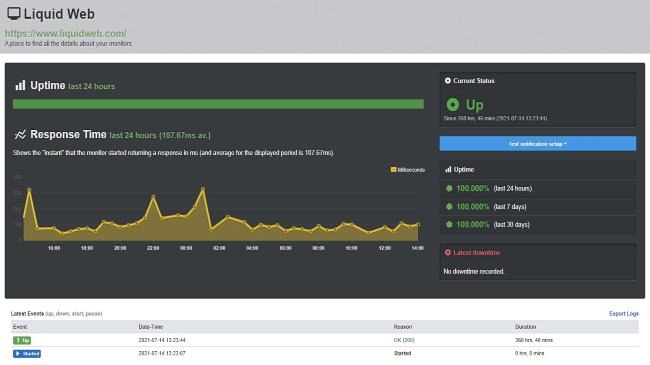
These empirical results underscore the platform’s viability as a high-performance engine for demanding business applications. Independent web performance monitoring via tools like GTmetrix frequently yields top-tier efficiency grades, though comprehensive page-load diagnostics indicate that real-world deployment speeds depend heavily on site optimization. Long-term availability tracking via continuous uptime monitors reveals zero recorded downtime over extended multi-week testing cycles, accompanied by rapid average response times hovering around 107 milliseconds, validating the platform’s operational stability.
Underpinning these performance metrics is a robust network uptime Service Level Agreement (SLA) guaranteeing 100% infrastructure availability. The contractual wording specifies that core routing devices within Liquid Web’s proprietary network will remain globally reachable, a standard that exceeds the traditional 99.9% or 99.99% availability guarantees common across the broader web hosting industry.
Customer Support Infrastructure and Response Timings
Customer support operations function on a continuous 24/7/365 basis, with the depth of technical assistance directly tied to the client’s chosen management tier. While self-managed accounts are strictly restricted to hardware and network-level troubleshooting, core-managed and fully managed plans unlock comprehensive assistance covering operating system maintenance, active monitoring, software configuration, and control panel support. Documentation resources are exhaustive, and clients can initiate support interaction via live ticketing or direct chat portals.
Pre-sales inquiries demonstrate adherence to internal service targets: human acknowledgement typically occurs within 20 seconds, comfortably eclipsing the advertised 59-second initial response threshold. While initial automated or human greetings arrive rapidly, substantive technical resolution requires a brief preparatory window as agents pull precise documentation and pricing policies. Representatives maintain a transparent approach regarding discontinued promotions, geographical pricing parity, and the precise components included in base server tiers, ensuring buyers receive comprehensive data prior to financial commitment.
Competitive Landscape: ScalaHosting and Cloudways
When positioning Liquid Web within the broader managed hosting ecosystem, several key competitors emerge. ScalaHosting presents a strong alternative for users seeking managed VPS infrastructure without the mounting licensing costs associated with cPanel. ScalaHosting’s proprietary SPanel ecosystem bundles essential administrative tasks into a lower-cost package, and direct benchmark comparisons reveal closely matched performance scores, with ScalaHosting achieving an 8.3 to Liquid Web’s 8.1. Nevertheless, Liquid Web maintains an advantage in deep infrastructure customization and enterprise-grade scalability.
Cloudways adopts a different architectural philosophy by functioning as a platform-as-a-service (PaaS) layer that manages underlying cloud infrastructure sourced from third-party providers such as DigitalOcean, Vultr, AWS, and Google Cloud. While Cloudways offers approachable entry pricing and simplifies cloud server deployment—particularly for WordPress workflows—it does not provide native cPanel integration or the deep administrative relationship characteristic of a traditional managed host. Organizations prioritizing dedicated infrastructure control, expert migration assistance, and direct server-level support continue to lean toward Liquid Web.
Implications and Final Market Verdict
Liquid Web solidifies its standing as a premier hosting solution for businesses requiring serious virtual private server performance rather than lightweight, budget-tier web space. Exceptional benchmark scores, granular server configurability, and technically proficient support structures justify its recognition as a leading VPS provider for demanding websites, digital agencies, and enterprise clients prioritizing managed reliability.
However, the platform is not ideally suited for casual users or casual hobbyists. The headline $11 starting price represents a bare, self-managed environment, promotional discrepancies can confuse first-time buyers, strict non-refundable purchase policies demand absolute certainty, and fully configured managed stacks with cPanel and automated backups frequently push monthly expenditures past the $100 threshold. Small business operators managing a single, modest web property are generally better served by dedicated managed WordPress accounts or entry-level shared hosting platforms.
Ultimately, organizations should invest in Liquid Web when raw performance, configuration freedom, migration support, and expert administrative backup outweigh the allure of the lowest possible monthly bill. For buyers prioritizing simplified entry pricing, alternatives like ScalaHosting or Cloudways warrant consideration, but Liquid Web’s premium infrastructure experience commands respect across the enterprise hosting market.