In modern enterprise cloud architectures, database management is rarely confined to the static provisioning of yesterday. While database engineers have historically viewed migration utilities as one-time onboarding bridges designed to shift workloads from on-premises data centers into multi-tenant cloud ecosystems, the operational paradigm is shifting. Google Cloud has expanded the capabilities of its Database Migration Service (DMS), empowering organizations to utilize continuous database replication as an everyday utility for day-two operations, storage management, and infrastructure optimization. Specifically, by supporting Cloud SQL for SQL Server as an active source, DMS unlocks advanced non-traditional operational patterns that allow database administrators to circumvent some of the most frustrating maintenance bottlenecks in relational database management.
Among these operational hurdles, none is more persistent than disk storage management. In typical enterprise production environments, database storage operates on a strictly upward trajectory. Features such as Cloud SQL automatic storage increase are indispensable safeguards, preventing catastrophic out-of-space outages triggered by unexpected traffic surges, large-scale batch imports, intensive index maintenance operations, or temporary staging loads. However, as applications mature over their lifecycle, their storage requirements frequently contract. Organizations routinely archive historical records to cold storage tiers, purge obsolete transactional data, drop unused indexes, or apply modern data compression algorithms. Despite these space-saving measures, reclaiming that physical capacity on the cloud infrastructure has historically required prohibitive maintenance windows.
The Storage Dilemma: Understanding Bloated Disk Allocations
To fully comprehend the value proposition of utilizing DMS for storage optimization, one must examine how SQL Server manages internal file space versus how cloud infrastructure allocates physical persistent disks. When data is deleted from a relational database, SQL Server marks the freed space inside its primary (.mdf) and secondary (.ndf) data files as reusable for future write operations. Similarly, transaction log file (.ldf) truncation frees up internal space within the log structures.
However, the database files themselves steadfastly refuse to release that physical space back to the underlying operating system unless explicitly instructed to do so. While administrators can enable the AUTO_SHRINK database option, database professionals universally advise against this setting in production environments due to the severe index fragmentation and performance degradation it introduces.
Alternatively, administrators can execute manual shrink operations using the DBCC SHRINKFILE Transact-SQL command. While this releases unused space from the internal database files back to the partition, the underlying Cloud SQL persistent disk remains permanently pinned at its peak allocated capacity. If an application undergoes a major data archiving initiative—such as permanently migrating historical records to BigQuery—or recovers from a runaway transaction that temporarily triggered a multi-terabyte storage expansion, the organization is left paying for provisioned disk capacity it no longer utilizes.
Traditionally, reclaiming this idle capacity required utilizing Cloud SQL’s built-in storage shrink feature. While functional, this native mechanism demands instance downtime that scales in direct proportion to the total allocated disk size. For multi-terabyte enterprise databases, executing a native shrink can translate to hours of offline maintenance, directly violating strict production Service Level Agreements (SLAs).
Under the Hood: Continuous Replication via DMS
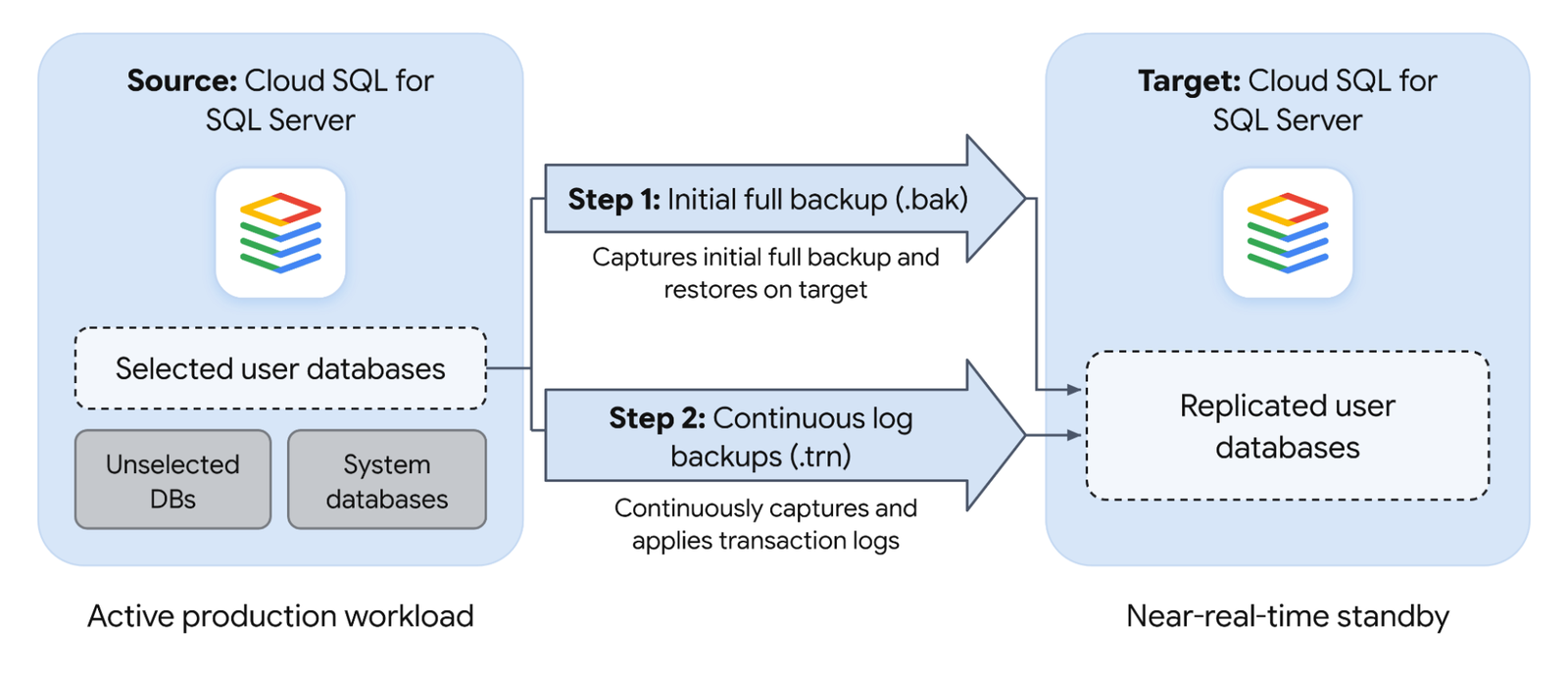
To address the limitations of native downtime-heavy maintenance, Google Cloud has positioned DMS as a continuous replication engine. Rather than treating migration as a binary event, DMS coordinates a synchronization workflow that mirrors native SQL Server log shipping principles between Cloud SQL instances.
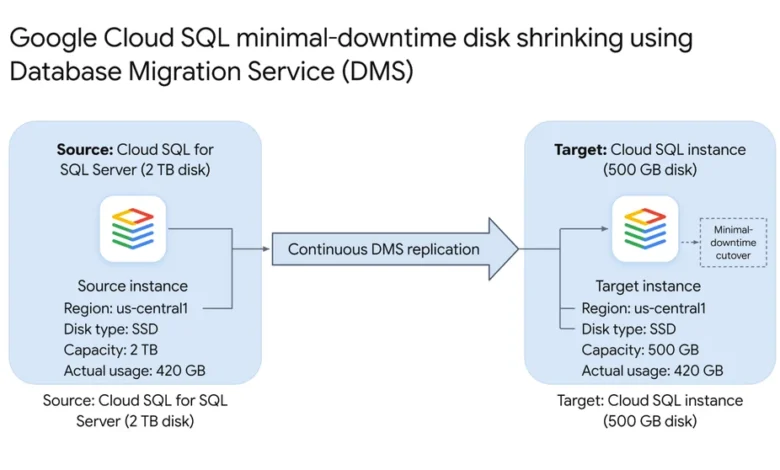
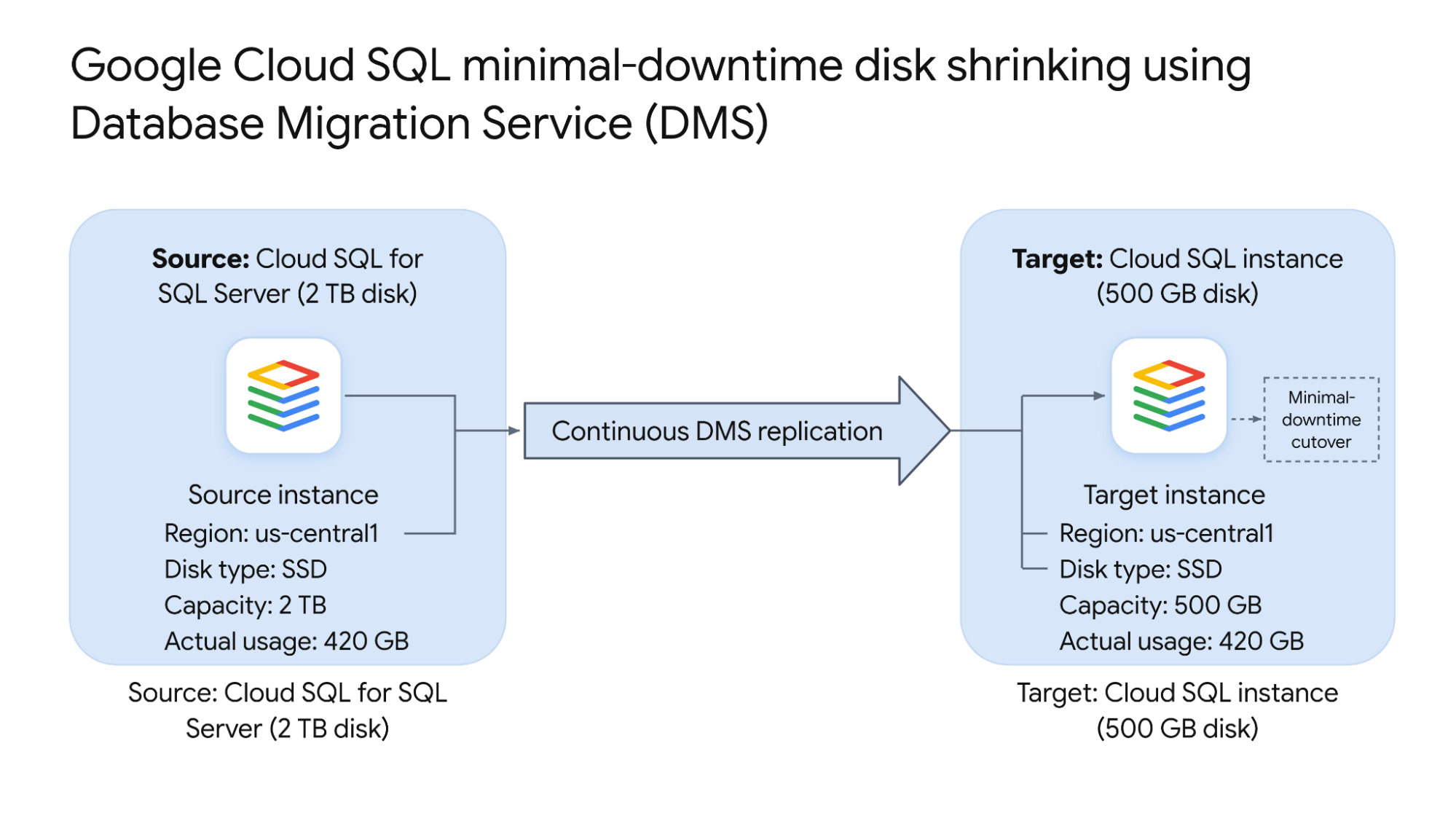
The replication architecture operates by establishing a secure, managed pipeline where changes occurring on the primary source database are continuously captured, transmitted, and replayed on a target instance. Because this synchronization occurs at the individual user-database level, administrators can provision a brand-new target Cloud SQL instance configured with a strictly right-sized, smaller persistent disk. While the production application remains fully online and processing live user traffic, DMS streams incoming changes to the newly provisioned standby instance.
This architecture fundamentally alters the economics of storage reclamation. Instead of taking a production database offline to shrink a bloated disk in place, engineers can orchestrate a seamless migration to a properly dimensioned environment, reducing the required maintenance window to a matter of seconds during the final application cutover.
Step-by-Step Operational Workflow for Minimal-Downtime Disk Shrinking
Executing a storage reduction via Google Cloud Database Migration Service requires a disciplined operational runbook divided into distinct phases: preparation, continuous synchronization, and final cutover.
The process begins with storage auditing and baseline assessment. Database administrators utilize Cloud Monitoring metrics to analyze provisioned disk quotas against actual database file usage, identifying instances where allocated capacity vastly exceeds practical requirements. Once an optimization target is identified, engineers provision a new Cloud SQL for SQL Server target instance with a reduced, right-sized persistent disk configuration.
Next, a migration job is initiated within the DMS console, linking the source production instance to the newly provisioned target. DMS performs an initial data snapshot and subsequently establishes a continuous replication stream. During this phase, production applications continue to read from and write to the original source instance without disruption.
While DMS efficiently handles user databases, it operates at a granular level that excludes server-level configurations. Consequently, engineers must proactively script and recreate all necessary server-level objects on the destination instance prior to cutover. This includes establishing server logins, configuring linked servers, scheduling SQL Server Agent jobs, and defining appropriate security permissions.
Overcoming Cutover Challenges: Managing Server Logins and Orphaned Users
When the replication lag reaches zero and the organization is prepared to execute the cutover, applications are briefly paused to redirect connection strings to the new Cloud SQL instance. However, because logins created on the destination instance are generated with unique Security Identifiers (SIDs) that do not match the historical SIDs preserved within the migrated databases, database users will default to an orphaned state. Orphaned users are incapable of authenticating, presenting a critical post-cutover remediation challenge.
To resolve this, database administrators must execute a targeted runbook immediately following the cutover. First, engineers connect to each migrated user database and run diagnostic queries to identify any unlinked user accounts. Once identified, administrators execute the ALTER USER command within the context of the respective database, cleanly re-mapping the database user principal to the newly minted Cloud SQL server login and restoring secure application connectivity.
Industry Implications and Strategic Value
The evolution of Database Migration Service from a transitional onboarding tool into an active day-two operational utility highlights a broader shift in enterprise cloud strategy. As cloud-native relational database deployments scale, cost containment and resource efficiency have become paramount board-level concerns. Over-provisioned storage represents a silent, compounding expenditure that erodes cloud ROI over time.
By decoupling storage optimization from downtime-heavy maintenance windows, Google Cloud provides enterprises with a practical mechanism to continuously align infrastructure expenditures with actual data footprints. Database administrators are no longer forced to choose between exorbitant long-term storage costs and disruptive production outages. Through innovative uses of managed replication pipelines, organizations can maintain high-availability standards while dynamically right-sizing their operational environments, signaling a mature new phase in enterprise cloud database administration.