French cooperative banking giant Crédit Mutuel Arkéa has found itself at the center of a major cybersecurity incident after hackers successfully exploited a third-party service provider to initiate unauthorized financial transactions. The attackers managed to move up to €118 million—roughly equivalent to $133 million—out of the institution’s accounts and rapidly laundered a significant portion of the funds through cryptocurrency exchanges before authorities could intervene.
The breach has once again cast a spotlight on the vulnerability of the broader financial ecosystem to sophisticated supply chain attacks. While Crédit Mutuel Arkéa has moved swiftly to contain the damage, reassure its millions of members, and collaborate with law enforcement, the incident highlights the ongoing challenges financial institutions face as cybercriminals adopt increasingly advanced methods to siphon funds and launder them via decentralized digital assets.
Anatomy of a High-Stakes Financial Cyberattack
The security breach at Crédit Mutuel Arkéa was not the result of a traditional ransomware deployment or a direct brute-force attack against the bank’s core infrastructure. Instead, the perpetrators executed a sophisticated intrusion by leveraging a vulnerability or compromised credential within a third-party service provider’s platform connected to the bank’s network. Bank officials explicitly ruled out human error on the part of internal employees and clarified that its digital subsidiary, Fortuneo, was entirely unaffected by the compromise.
Once inside the network perimeter, the threat actors bypassed traditional security controls by utilizing Crédit Mutuel Arkéa’s own corporate accounts to initiate high-value transactions directly to other domestic and international banking organizations. Crucially, the bank has repeatedly emphasized that retail customer assets were completely insulated from the breach. Individual bank accounts, savings portfolios, and personal investments remained untouched, with the primary operational fallout for everyday clients limited to temporary processing delays on certain transfer requests.
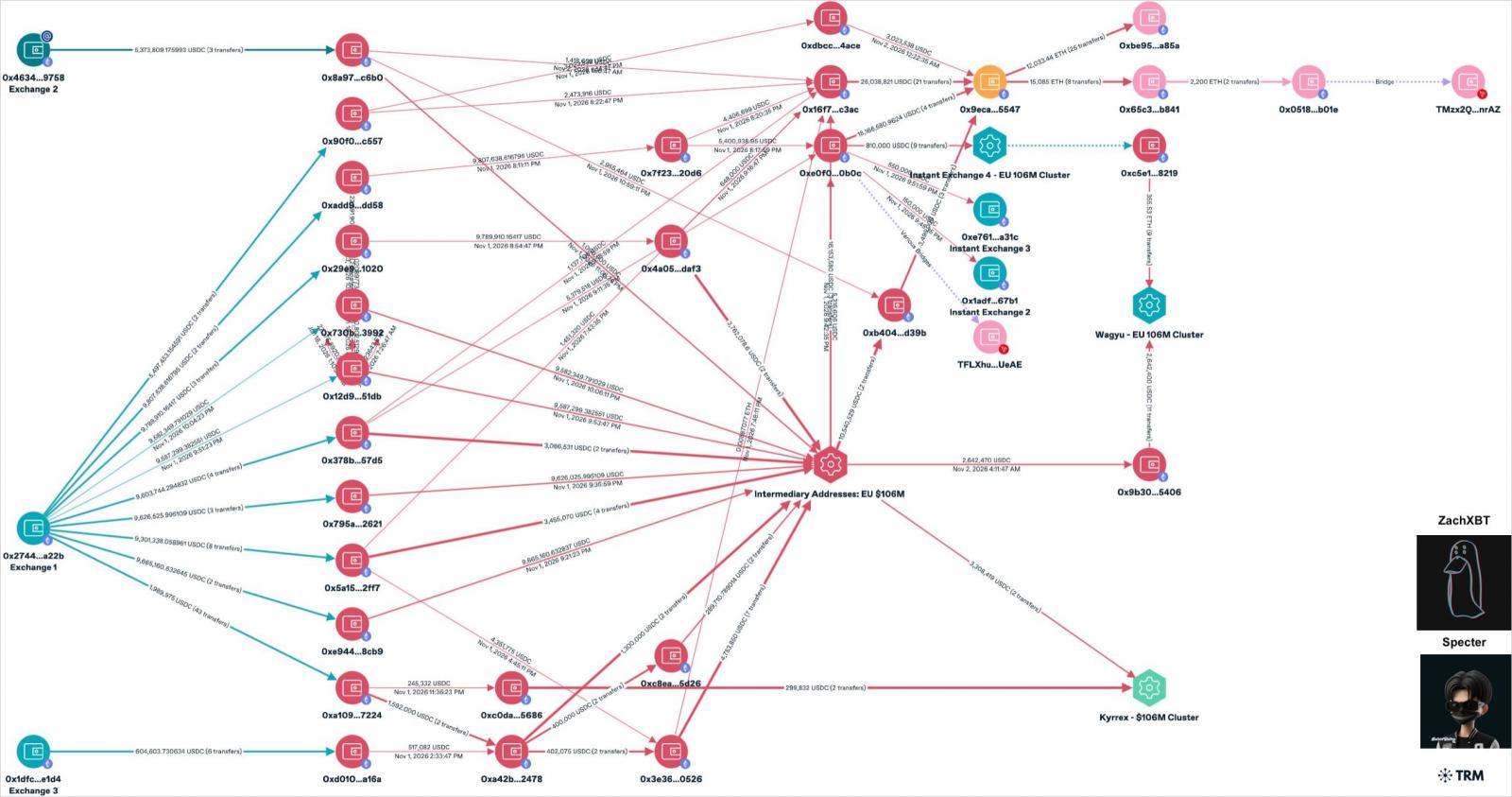
However, the financial toll on the institution itself is substantial. Blockchain investigators and security researchers estimate that the unauthorized transfers peaked at approximately €118 million ($133 million). The perpetrators systematically converted these funds into mainstream stablecoins, specifically USDC and USDT, effectively moving capital out of the traditional banking sector and into the decentralized finance (DeFi) ecosystem, where tracing and freezing assets presents unique jurisdictional and technical hurdles.
A Chronological Breakdown of the Incident
The timeline of the breach reveals a critical window of opportunity exploited by the cybercriminals to launder stolen capital before public disclosures could trigger widespread asset freezes.
The sequence of events unfolded over several days:

November 1: The unauthorized transactions begin. Malicious actors leverage the compromised third-party service provider access to move funds from Crédit Mutuel Arkéa’s accounts to centralized cryptocurrency exchanges. Multiple large-scale withdrawals are executed across various platforms.
November 2: Blockchain intelligence breaks the story. Independent blockchain fraud investigator ZachXBT publishes the first public warnings regarding anomalous, large-scale unauthorized withdrawals from centralized exchange accounts occurring a day prior. ZachXBT identifies that up to €118 million has been siphoned and converted into stablecoins, though the specific financial institution victimized is not named in the initial alert.
November 3: Rapid laundering of funds. Due to the lack of immediate public disclosure or attribution by the targeted bank, the cybercriminals successfully launder approximately $30 million. This window allows the threat actors to move funds through various blockchain mixers and decentralized protocols, shielding the capital from potential EU law enforcement intervention and asset seizures.
November 4: Official acknowledgment and containment. Crédit Mutuel Arkéa formally discloses the cyberattack to the public and regulatory bodies. The bank declares that the incident is "now closed and under control" and that normal operational workflows are gradually being restored across its various federations and subsidiaries.
Post-November 4: Ongoing investigations and defense activation. The bank establishes dedicated support channels, launches detailed FAQ pages for concerned clients, and partners closely with judicial authorities and law enforcement agencies to map out the exact modus operandi and trace the remaining immobilized funds.
The Role of Blockchain Intelligence and Public Disclosure
The public revelation of the Crédit Mutuel Arkéa hack underscores a growing trend in modern cybersecurity: the vital role played by on-chain investigators in exposing corporate and institutional breaches. Long before traditional financial institutions or public relations departments issue formal statements, decentralized finance watchdogs monitor real-time blockchain ledgers for anomalous whale movements and suspicious liquidity flows.
In this instance, ZachXBT’s early public alerts brought international attention to the movement of tens of millions of dollars in stablecoins. However, the incident also reignited a long-standing debate within the cybersecurity and financial communities regarding the tension between rapid transparency and containment strategies.
Security analysts have noted that because the victimized bank did not immediately reveal its identity or the scale of the theft on November 2, the perpetrators were granted a crucial 24-to-48-hour window. During this period, an estimated $30 million was laundered beyond the immediate reach of European law enforcement agencies. Conversely, financial institutions frequently argue that premature disclosures during an active incident can tip off attackers, disrupt internal forensic investigations, or trigger unwarranted retail panic.
Crédit Mutuel Arkéa’s Official Response and Mitigation Efforts

Crédit Mutuel Arkéa is a cornerstone of the French cooperative banking landscape. Serving more than 5.8 million members and managing a staggering €211.5 billion in assets across its extensive network of federations and subsidiaries, the institution represents a high-value target for sophisticated cybercriminal syndicates.
In the wake of the attack, executive leadership at Arkéa prioritized transparent communication directed at its expansive client base. Through official press releases and comprehensive informational web pages, the bank sought to calm fears regarding retail solvency.
"Crédit Mutuel Arkéa wishes to reassure all its clients—across its federations and subsidiaries—that this incident has no impact on their assets; it has merely resulted in a delay in the execution of certain transfer transactions," the bank stated in its official communication.
While the organization declined to formally verify ZachXBT’s exact estimation of €118 million, it acknowledged that the financial impact was of a significant "order of magnitude" and confirmed that judicial authorities had successfully managed to block and freeze a portion of the illicitly transferred funds.
Furthermore, recognizing that cybercriminal groups frequently capitalize on major data breaches by launching secondary social engineering campaigns, Arkéa issued a stern warning regarding an elevated risk of phishing. The bank urged all customers to remain exceptionally vigilant against unsolicited emails, text messages, and phone calls purporting to be from bank representatives. Clients were instructed never to disclose sensitive security credentials, account numbers, or personal identification details over informal channels, and to verify any suspicious communications by contacting their dedicated bank advisors directly.
Broader Implications for the European Banking Sector
The cyberattack against Crédit Mutuel Arkéa carries profound implications for the European banking sector and highlights systemic vulnerabilities that extend far beyond a single financial institution. As traditional banks continue to digitize their operations, integrate advanced cloud architectures, and outsource critical auxiliary functions to third-party vendors, their digital attack surfaces expand exponentially.
Supply Chain and Third-Party Risk
The revelation that the attackers breached Arkéa’s network via a third-party service provider platform underscores the persistent threat of supply chain vulnerabilities. Modern financial institutions rely on complex webs of external software vendors, IT support contractors, and cloud infrastructure providers. If a single vendor maintains lax cybersecurity hygiene or substandard identity and access management (IAM) controls, it can serve as an open back door into the most secure financial institutions in the world.
Regulators across the European Union, including those enforcing the stringent Digital Operational Resilience Act (DORA), have increasingly focused on third-party ICT (Information and Communication Technology) risk management. Incidents like the Arkéa breach provide empirical evidence as to why such regulatory frameworks are necessary, mandating rigorous security audits, continuous monitoring, and strict accountability for external service providers.
The Evolution of Cyber Laundering via Stablecoins
The mechanics of the Arkéa attack also shed light on the sophisticated methodologies modern cybercriminal syndicates employ to monetize corporate breaches. Historically, hackers relied on complex networks of offshore shell companies, traditional wire transfers to high-risk jurisdictions, or physical cash mules to launder stolen funds. These methods left substantial paper trails that allowed international law enforcement agencies to freeze accounts and trace illicit revenues over time.
In contrast, the rapid conversion of millions of euros into decentralized stablecoins like USDC and USDT represents an evolution in financial crime. Stablecoins offer the borderless, instantaneous settlement capabilities of cryptocurrencies while mitigating the extreme price volatility associated with assets like Bitcoin or Ethereum. By routing funds through decentralized exchanges, cross-chain bridges, and privacy-enhancing protocols, threat actors can obscure the origin of capital with alarming speed.
Nevertheless, the high visibility of public blockchains also acts as a double-edged sword for cybercriminals. Advanced blockchain analytics tools utilized by firms like Chainalysis, combined with proactive monitoring by independent investigators such as ZachXBT, enable law enforcement and centralized exchange operators to blacklist specific wallet addresses, flag suspicious transactions, and collaborate with stablecoin issuers to freeze assets before they can be fully cashed out into fiat currency.
Path Forward for Crédit Mutuel Arkéa
As the investigation into the Crédit Mutuel Arkéa cyberattack continues, the bank remains in active collaboration with specialized police units and judicial authorities to map the full lifecycle of the intrusion. Forensic experts are working to determine the precise entry point within the third-party provider’s ecosystem, identify the individuals or state-sponsored syndicates behind the operation, and recover the remainder of the un-frozen funds.
For Arkéa, the incident serves as an expensive and high-profile lesson in perimeter defense, vendor risk management, and crisis communication. While the bank successfully protected its retail customers from direct financial loss and avoided catastrophic structural damage, the reputational and financial sting of a €118 million breach will undoubtedly prompt a rigorous overhaul of its third-party integration security protocols.
As financial institutions worldwide brace for an era of increasingly sophisticated, AI-enhanced, and supply-chain-focused cyber threats, the swift containment of the Arkéa breach demonstrates that while absolute prevention remains an elusive goal in modern cybersecurity, institutional resilience, rapid incident response, and cross-sector collaboration remain the ultimate lines of defense against financial cybercrime.
Related posts: