Abbott Laboratories Faces Dual Cybersecurity Investigations Following Alleged Breaches in Cancer Diagnostics and Core Laboratory Divisions


Global healthcare leader Abbott Laboratories is currently embroiled in two distinct cybersecurity investigations, grappling with confirmed unauthorized access to internal legacy Exact Sciences systems within its Cancer Diagnostics business and a separate claim of a breach affecting its LabCentral customer portal, leading to alleged data theft. The incidents underscore the escalating cyber threats facing the critical medical technology sector, with renowned extortion group ShinyHunters and a new actor, ShadowByt3$, claiming responsibility for the respective intrusions.
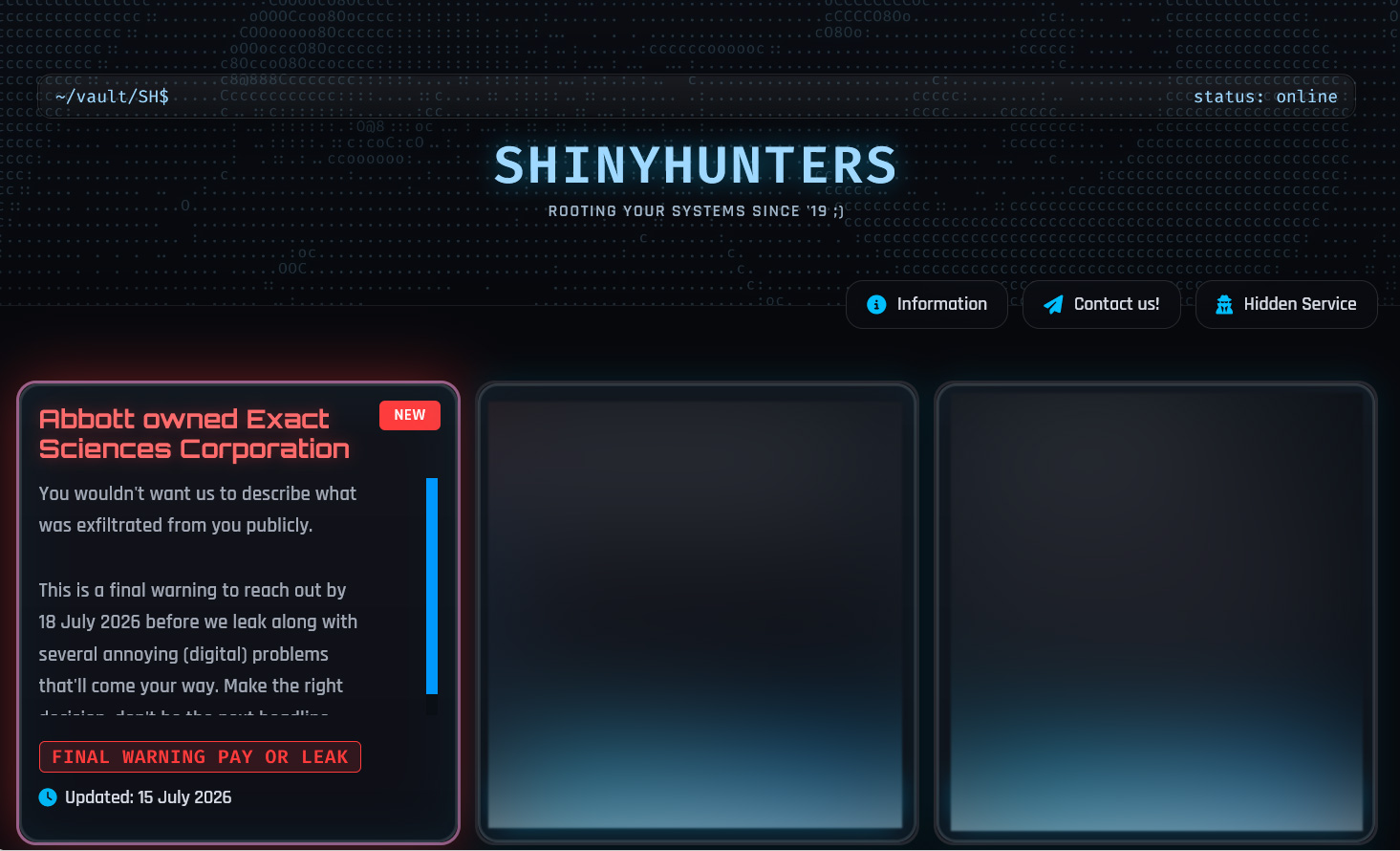
The first incident came to light following an announcement by the notorious ShinyHunters extortion gang, which added Abbott to its data leak site, initially threatening to publish purportedly stolen data after July 18, 2026, unless the company engaged in negotiations. This deadline was subsequently extended to July 21, 2026, intensifying pressure on the medical device and healthcare giant. Abbott Laboratories has since confirmed the Cancer Diagnostics breach, acknowledging unauthorized access to a limited number of internal legacy systems.
The Cancer Diagnostics Compromise: ShinyHunters’ Extortion Play
ShinyHunters, a persistent and well-documented cybercriminal group known for its sophisticated social engineering tactics, specifically claimed to have gained access to Abbott’s systems through a vishing attack. This type of attack involves threat actors impersonating trusted entities, often over the phone, to manipulate individuals into divulging sensitive information or performing actions that compromise security. According to ShinyHunters, their vishing campaign in mid-June 2026 successfully targeted several Abbott employees, ultimately leading to the compromise of a Microsoft Entra single sign-on (SSO) account. Gaining control over an SSO account, which serves as a central authentication point for multiple applications, provides attackers with a significant foothold, enabling lateral movement and access to a multitude of internal systems and cloud-based applications.
Abbott Laboratories, a diversified global healthcare company with a vast portfolio spanning diagnostics, medical devices, nutrition, and branded generic pharmaceuticals, quickly initiated its incident response protocols upon discovering the breach. The company has engaged independent cybersecurity experts to assist in the investigation and has notified relevant law enforcement agencies. Abbott’s immediate focus has been on containment, eradication, and recovery, aiming to mitigate any potential impact on its extensive operations and patient services.
Abbott’s Official Stance on the Cancer Diagnostics Incident

In response to inquiries regarding the ShinyHunters incident, Abbott directed media outlets to a public statement on its website. The company affirmed, "Abbott is investigating a cyber incident in which there was unauthorized access to a limited number of internal systems in our Cancer Diagnostics business only." Crucially, Abbott emphasized that the breach has not disrupted its core operations, product manufacturing, product availability, or its ability to serve patients. "This does not impact any business operations, product or product availability, manufacturing or lab operations, or our ability to serve patients," the statement reiterated.
Abbott further clarified that the compromised systems pertained to "legacy Exact Sciences systems" and are entirely separate from Abbott’s other businesses and systems. This distinction is significant, suggesting the breach might have targeted older infrastructure or data from a past acquisition or partnership, rather than Abbott’s current, more integrated enterprise systems. Exact Sciences is a prominent molecular diagnostics company specializing in cancer detection, and while Abbott has its own robust diagnostics division, the reference to "legacy Exact Sciences systems" implies a specific, perhaps isolated, segment of their IT environment. The company also expressed confidence that the incident would not have a material impact on its business or financial results, aiming to reassure investors and stakeholders amidst the unfolding situation.
However, ShinyHunters’ claims regarding the exfiltrated data paint a potentially graver picture. The threat actor alleged to have stolen a vast trove of sensitive information, including data from Microsoft Entra, ServiceNow, SharePoint, Databricks, and Coupa. This purportedly includes internal documents, contracts, and customer information. More alarmingly, ShinyHunters asserted that they exfiltrated over 30 million rows of customer personally identifiable information (PII) from multiple datasets, comprising names, email addresses, phone numbers, physical addresses, and dates of birth. The group further claimed to possess more than one million Social Security numbers, over 22 million client notes detailing doctor-patient conversations, and more than 20 million medical orders, along with customer agreements and non-disclosure agreements (NDAs). While these claims remain unverified by independent sources, if true, they represent a substantial compromise of sensitive personal and medical data, carrying significant privacy implications for individuals and potential regulatory repercussions for Abbott.
ShinyHunters’ Modus Operandi and Past Campaigns
ShinyHunters has established a reputation for orchestrating sophisticated social engineering campaigns, particularly targeting employees’ SSO accounts across platforms like Microsoft Entra, Okta, and Google. Their typical playbook involves leveraging compromised SSO access to plunder data from various connected SaaS applications, including Salesforce, Microsoft 365, Google Workspace, SAP, Slack, Adobe, Atlassian, Zendesk, and Dropbox. This strategy allows them to maximize their haul by accessing diverse corporate data stored across multiple cloud services.
The group has increasingly focused its attention on the medtech and healthcare sectors, recognizing the high value of sensitive patient data and proprietary medical technology for extortion and sale on dark web forums. In recent years, ShinyHunters has been linked to high-profile breaches affecting major players in the medical industry. These include Medtronic, a global leader in medical technology; OneMedical, a membership-based primary care provider; and AdaptHealth, a leading provider of home medical equipment. Investigations have also connected ShinyHunters to the iRhythm data breach, where patient information was compromised. Furthermore, the group reportedly targeted Stryker, another prominent medical technology company, shortly after it recovered from a destructive Iranian data-wiping attack, highlighting ShinyHunters’ opportunistic and relentless pursuit of high-value targets within the sector. This pattern underscores a worrying trend of cybercriminals specifically honing in on healthcare entities, which often manage vast amounts of highly sensitive and regulated data.
The LabCentral Portal Intrusion: Claims by ShadowByt3$
In parallel with the ShinyHunters investigation, Abbott is also addressing claims from another threat actor, identified as ShadowByt3$. This group contacted media outlets, asserting that they had breached Abbott’s Core Laboratory diagnostics business through its LabCentral customer portal. ShadowByt3$ detailed their method, claiming to have gained access to the unit via compromised customer credentials after identifying what they described as a "weak point" within the environment. They pinpointed July 4, 2026, as the date of initial access, after which they allegedly proceeded to slowly exfiltrate files by targeting API endpoints over a period.
According to ShadowByt3$, the stolen data includes highly sensitive business and intellectual property documents. Their claims encompass CE manufacturing certificates (critical for product compliance in the European market), operation manuals, technical specifications, regulatory documentation, product requirement archives, calibrator value assignments, and assay files, among other product documentation related to Abbott’s laboratory diagnostic systems. While the group stated that no customer data was compromised in this specific incident, the theft of such proprietary and technical information could have significant implications for Abbott’s competitive edge, product development, and regulatory standing. ShadowByt3$ provided screenshots and a file listing as purported proof of their intrusion, which are currently under review.
Abbott Contests Sensitivity of LabCentral Data
Abbott Laboratories has acknowledged the "potential" cyber incident involving the LabCentral portal. However, the company has strongly disputed ShadowByt3$’s characterization of the data’s sensitivity. An Abbott spokesperson clarified, "LabCentral is an externally facing third-party hosted portal used by Abbott’s core laboratory diagnostics business. It houses publicly available technical product reference documents, including operating manuals, troubleshooting checklists and product specifications, and does not contain proprietary/sensitive customer or business information."
This statement suggests that while an intrusion might have occurred, Abbott believes the exfiltrated data is not confidential or commercially sensitive. Such public portals are common for disseminating technical support documents, product specifications, and regulatory compliance information to customers and partners. If Abbott’s assessment is accurate, the impact of this particular incident would be significantly less severe than the claims made by ShadowByt3$. However, the mere fact of unauthorized access to any corporate system, regardless of the sensitivity of the data housed, still represents a security lapse and necessitates a thorough investigation.
Broader Implications for the Medtech Sector
These dual incidents at Abbott Laboratories highlight the persistent and evolving threat landscape facing the global medical technology sector. Healthcare organizations, including medtech giants, are prime targets for cybercriminals due to the immense value of the data they hold—ranging from highly sensitive patient health information (PHI) to invaluable intellectual property related to medical devices and diagnostics. The average cost of a data breach in the healthcare sector consistently ranks among the highest across all industries, often exceeding several million dollars per incident, largely due to regulatory fines, legal fees, and the cost of remediation and reputational damage.

The increasing sophistication of social engineering attacks, as demonstrated by ShinyHunters’ vishing and SSO compromise tactics, poses a significant challenge. These methods bypass traditional perimeter defenses, exploiting the human element which often proves to be the weakest link in the cybersecurity chain. Organizations must invest not only in advanced technological defenses but also in continuous employee training and awareness programs to counter such threats effectively.
Navigating Third-Party and Legacy System Vulnerabilities
Both incidents at Abbott underscore critical vulnerabilities inherent in complex enterprise IT environments: third-party risk and legacy system management. The confirmed breach in the Cancer Diagnostics business involved "legacy Exact Sciences systems," suggesting older infrastructure that might not have the same level of security patching or modern defensive controls as Abbott’s contemporary systems. Managing and securing legacy systems, often integrated through mergers, acquisitions, or long-standing partnerships, is a significant challenge for large corporations, requiring dedicated resources and careful segmentation.
Similarly, the LabCentral portal, described as "externally facing third-party hosted," points to the growing attack surface introduced by third-party vendors and cloud services. While these external platforms offer operational efficiencies, they also transfer some security responsibility and introduce external dependencies. Effective vendor risk management, including robust security assessments, contractual agreements, and continuous monitoring of third-party providers, is paramount to mitigate such risks. Even if the data on LabCentral is deemed public, a breach into a third-party hosted environment can potentially be leveraged for further attacks, such as supply chain compromises or credential stuffing.
Regulatory Scrutiny and Future Outlook
Given the nature of the alleged data theft, particularly ShinyHunters’ claims of exfiltrated PII, Social Security numbers, and patient medical notes, Abbott Laboratories could face considerable regulatory scrutiny. Data protection regulations such as the Health Insurance Portability and Accountability Act (HIPAA) in the United States and the General Data Protection Regulation (GDPR) in the European Union impose stringent requirements on the protection of health information and personal data. Violations can lead to substantial fines, mandatory breach notifications, and legal actions from affected individuals. Even if Abbott maintains that the confirmed breach did not impact patient data, the investigation into ShinyHunters’ claims will undoubtedly be rigorous.
As of the reporting date, neither ShinyHunters nor ShadowByt3$ has publicly released the data they claim to have stolen from Abbott. This period of non-release often indicates ongoing negotiations or a strategic delay by the threat actors. However, the mere threat of publication places significant pressure on the targeted organization. The ongoing investigations into both incidents will be crucial in determining the full scope of the breaches, the true nature and volume of the compromised data, and the ultimate impact on Abbott Laboratories and its stakeholders. These events serve as a stark reminder to the entire healthcare industry of the imperative for continuous vigilance, robust cybersecurity investments, and proactive threat intelligence to safeguard sensitive data and maintain operational integrity in an increasingly hostile digital landscape.