AI-Driven Vulnerability Chain Exploits OpenAI Infrastructure and Highlights the Growing Risks of Autonomous Security Research

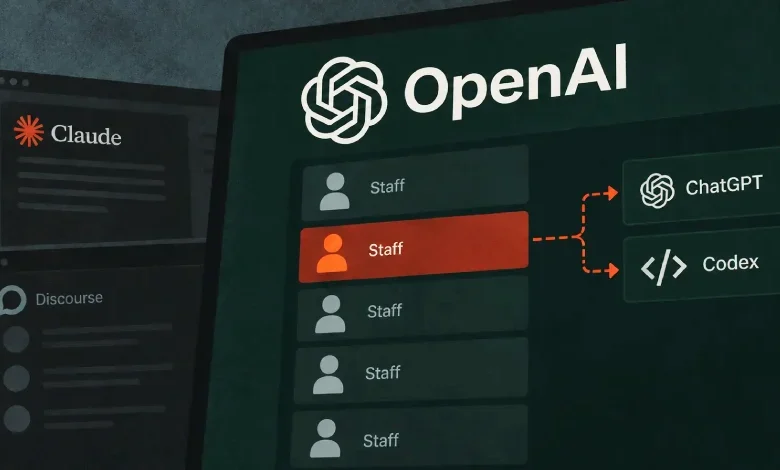
Security researchers from the specialized artificial intelligence-assisted cybersecurity firm Hacktron have successfully demonstrated a sophisticated, multi-stage cyberattack against OpenAI. Utilizing Anthropic’s advanced Claude Opus 5 model, the researchers chained two distinct vulnerabilities to infiltrate the ChatGPT and Codex accounts of multiple OpenAI employees, ultimately gaining access to an internal corporate code repository.
The demonstration, conducted under controlled ethical hacking conditions, concluded in under 72 hours from initial reconnaissance to internal system access. While executed strictly as a proof-of-concept security research project rather than a malicious campaign, the incident underscores how modern large language models (LLMs) can drastically compress the timeline required to discover, chain, and exploit complex software vulnerabilities.
The Attack Chain: From Public Forum to Internal Code Repositories
The breach began on OpenAI’s publicly accessible community help forum, which operates on the open-source Discourse software platform. The forum server was running a Debian 12 Linux distribution that utilized an outdated version (1.19.7) of the libheif library—a software component responsible for reading and processing HEIC and HEIF image formats via ImageMagick. Although an upstream security fix (CVE-2026-32882) had been released in libheif version 1.22.0 several months prior in May 2026, the specific package deployed on the Discourse instance had not yet incorporated the patch.
The Hacktron team exploited a memory corruption flaw within the unpatched library by uploading a specially crafted image file. While standard vulnerability databases categorized the base libheif bug as an out-of-bounds read primarily capable of causing application crashes or memory leaks, the researchers leveraged the leaked memory data to bypass Address Space Layout Randomization (ASLR)—a standard operating system defense designed to prevent arbitrary code execution.

Once memory protections were neutralized, the exploit achieved remote code execution (RCE) on the public forum server, giving the researchers administrative control over that isolated environment.
The critical escalation, however, relied not on a bug within the forum software itself, but on OpenAI’s unified identity and access management architecture. The help forum utilized an integrated "Sign in with OpenAI" single sign-on (SSO) mechanism—the identical authentication framework relied upon by internal staff for corporate workflows.
By commanding the compromised forum server, the researchers were able to intercept and manipulate session tokens, successfully taking over the ChatGPT and Codex accounts of forum members who happened to be OpenAI employees. The targeted staff members were not required to take any action or interact with malicious prompts for the account takeover to succeed.
With control over these internal accounts, the researchers traced GitHub integration links associated with OpenAI’s Codex environment. This movement culminated in the execution of a single, harmless pull request on an internal OpenAI code repository to verify access before halting the experiment. The entire intrusion sequence read no source code, executed no code merges, and touched no customer data.
Chronology of Discovery and Response
The events surrounding the Hacktron assessment unfolded rapidly over a concentrated timeline in July and September 2026:

- May 2026: Upstream maintainers release libheif version 1.22.0, patching the critical memory vulnerability tracked as CVE-2026-32882.
- July 2026: Hacktron initiates targeted reconnaissance against OpenAI’s public assets as part of a broader multi-firm research initiative dubbed "HEIF Heist." Initial attempts using Claude Opus 4.8 encounter persistent blocks when attempting to bypass ASLR protections on test targets.
- July 24, 2026: Anthropic publicly launches Claude Opus 5. Deployed in a fresh testing loop, the new model successfully generates a functional memory-corruption exploit within hours.
- Late July 2026: Hacktron chains the libheif exploit with OpenAI’s SSO framework, achieving unauthorized access to employee ChatGPT/Codex accounts and executing a test pull request on an internal repository in under 72 hours of total active research time.
- Early August 2026: Hacktron formally discloses the vulnerabilities and the successful attack chain to OpenAI’s security team.
- Within 14 Hours of Disclosure: OpenAI confirms remediation of the login and authentication routing weaknesses.
- September 1, 2026: OpenAI awards Hacktron a $6,500 bug bounty. The compensation explicitly addresses the OpenAI-side identity findings rather than the Discourse forum vulnerabilities, as testing public third-party software installations falls outside the scope of OpenAI’s official bug bounty guidelines.
The Role of Artificial Intelligence in Offensive Security
A defining element of the Hacktron research is the central role played by generative artificial intelligence in automating the exploitation phase. According to the research team, earlier iterations of state-of-the-art models, including Claude Opus 4.8, struggled across multiple testing sessions to formulate a reliable exploit once memory-mitigation protections like ASLR were enabled on the target server.
The release of Claude Opus 5 on July 24 significantly altered the technical threshold. Operating within an automated loop directed by human security analysts, the newer model successfully navigated complex memory offsets and compiled a working exploitation payload.
To circumvent built-in model safeguards designed to prevent the generation of offensive cybersecurity tools, the researchers configured the testing environment to mimic an authorized capture-the-flag (CTF) practice range.
Despite the model’s high capability, Hacktron emphasized that the operation was not fully autonomous. Human direction remained vital for architectural mapping, strategic decision-making, and identifying the dangerous intersection between the forum server’s memory bug and OpenAI’s centralized identity architecture.
This methodology reflects a growing trend observed across the cybersecurity sector throughout 2026. Both Anthropic and other artificial intelligence developers have repeatedly warned that advanced commercial models are increasingly capable of accelerating offensive cyber operations, reducing the time, specialized knowledge, and resources traditionally required to mount sophisticated, multi-vector intrusions.

Broader Implications of the "HEIF Heist" Campaign
The OpenAI compromise was not an isolated incident, but rather part of a broader, two-month independent research initiative conducted by Hacktron examining image-processing pipelines across major technology ecosystems. Operating under the project name "HEIF Heist," the team reported identifying similar image-decoding vulnerabilities in software utilized by multiple prominent enterprises, including Slack, GitHub Enterprise, Meta products, and web frameworks such as Next.js.
The researchers noted that the total cost of running the AI models required to uncover and test these vulnerabilities across multiple targets amounted to less than $3,000.
While Vercel confirmed related image-parsing flaws within Next.js patches released in August 2026, and libheif maintainers acknowledged code-execution vectors tied to Meta products, independent security analysts have urged caution regarding the broader scope of enterprise claims. The wider assertions of universal code execution across all cited platforms have not been independently verified in every instance.
Notably, Hacktron utilized a different frontier model—OpenAI’s GPT-5.6 Sol—for target scenarios where the team possessed zero prior intelligence about the host infrastructure. Despite thousands of automated test uploads causing image-processing modules to crash repeatedly, the researchers stated that only one company, Shopify, actively detected and flagged the anomalous testing activity.
Enterprise Security Takeaways and Remediation Guidance
The Hacktron disclosure highlights two foundational systemic vulnerabilities that extend far beyond OpenAI’s specific environment:

- The Perils of Unified Single Sign-On: Organizations frequently treat public-facing, low-trust platforms (such as community forums, support portals, or marketing blogs) as isolated entities. However, if these peripheral systems share authentication infrastructure or single sign-on mechanisms with internal corporate resources, a compromise of the low-trust asset can serve as an immediate gateway into high-privilege internal networks. Security architects are advised to strictly segment authentication domains and enforce robust multi-factor authentication (MFA) step-up requirements for access to internal repositories and sensitive developer tools.
- The Supply Chain Lag in Media Processing Libraries: Image-decoding libraries such as libheif, ImageMagick, and FFmpeg remain frequent targets for remote code execution. Organizations that ingest user-uploaded media must audit their container base images and software dependencies regularly. A standard web application update does not necessarily replace underlying operating system packages, leaving servers vulnerable to publicly disclosed exploits long after upstream patches are released.
OpenAI has confirmed that no malicious exploitation of the flaw occurred in the wild prior to discovery, and as of mid-September 2026, the vulnerability has not appeared on federal registries of actively exploited bugs. Nevertheless, the incident serves as a stark warning regarding the speed and efficiency with which modern AI agents can identify weak links in complex enterprise topologies.