New AI-Powered Android Malware Dubbed RatHat Emerges With Advanced Remote Navigation Capabilities


Cybersecurity researchers have uncovered a sophisticated and highly adaptable new strain of Android malware named RatHat, representing a significant evolutionary leap in mobile device targeting. Identified and analyzed by the threat intelligence team at Zimperium zLabs, RatHat sets itself apart from conventional banking Trojans and spyware by integrating an artificial intelligence-driven subsystem. This AI integration allows the malware’s operators to remotely navigate compromised devices with human-like adaptability, bypassing traditional scripted automation limitations. Furthermore, technical indicators, including LLM prompts written in Chinese embedded within the malware’s codebase, suggest that the threat actors behind RatHat likely originate from China.
As mobile operating systems tighten security perimeters and app stores implement more rigorous vetting processes, cybercriminals continually refine their methodologies. RatHat exemplifies this ongoing arms race, combining stealth, deep system manipulation, and AI autonomy to steal sensitive user data, bypass security controls, and entrench itself deeply within infected smartphones.
Inception, Distribution Vectors, and Initial Infection Mechanisms
The propagation of RatHat relies heavily on well-established social engineering techniques combined with modern malvertising campaigns. Rather than infiltrating the official Google Play Store—where automated and manual security scans would likely flag its malicious signatures—the malware is distributed primarily through alternative channels. Attackers use malicious advertisements, deceptive SMS phishing (smishing) campaigns, and fraudulent landing pages designed to impersonate legitimate services. These pages prompt unsuspecting users to download Android Package Kit (APK) files directly from external sources, bypassing the built-in safeguards of official distribution platforms.
Once a user downloads and installs the malicious APK, RatHat initiates its deployment sequence by requesting high-privilege permissions, a tactic common among modern mobile malware families. Specifically, the malware abuses Android’s Accessibility service framework. While accessibility permissions are designed to assist users with disabilities by allowing applications to read screen contents and perform actions on behalf of the user, cybercriminals frequently weaponize these permissions to execute privileged, unauthorized actions in the background.

By exploiting Accessibility features, RatHat gains the capability to autonomously manipulate device settings without user consent. Most notably, the malware systematically enables Android’s Developer Options and Wireless Debugging features. This maneuver allows the malware to secure a local shell-level execution context directly on the device, eliminating the need to connect the smartphone to an external computer via a USB cable. Security experts note that this technique mirrors mechanisms recently observed in other emerging Android malware families, such as ToxicPanda and RedHook, signaling a broader industry trend toward abusing native developer tools for local privilege escalation.
Multi-Tiered Architecture, Persistence, and Data Exfiltration
With ADB (Android Debug Bridge) access successfully established, RatHat deploys a complex, multi-tiered architecture designed to ensure absolute persistence and comprehensive data gathering. The malware installs a Go-based agent, identified as liblocal-service.so, which executes system commands with native ADB shell privileges. This agent is tasked with overriding battery-restriction protocols to prevent the operating system from putting the malware to sleep, while simultaneously managing persistence mechanisms to ensure the threat remains active across reboots and system updates.
The persistence architecture exhibits a high degree of resilience through a mutual recovery mechanism. The Go-based agent is engineered to restore the primary malware application if it is stopped, cleared of data, or uninstalled by the user. Conversely, the main application monitors the Go agent and will redeploy it if the file is removed. This dual-layer backup channel ensures that removing one component of the infection is insufficient to eradicate the threat entirely.
Additionally, a second agent, designated libmedia_codec.so, functions as an FRP (Fast Reverse Proxy) client. This component establishes a persistent, encrypted tunnel back to the command-and-control (C2) infrastructure controlled by the attackers, facilitating stable, real-time remote access regardless of network address translation (NAT) barriers or firewall restrictions.
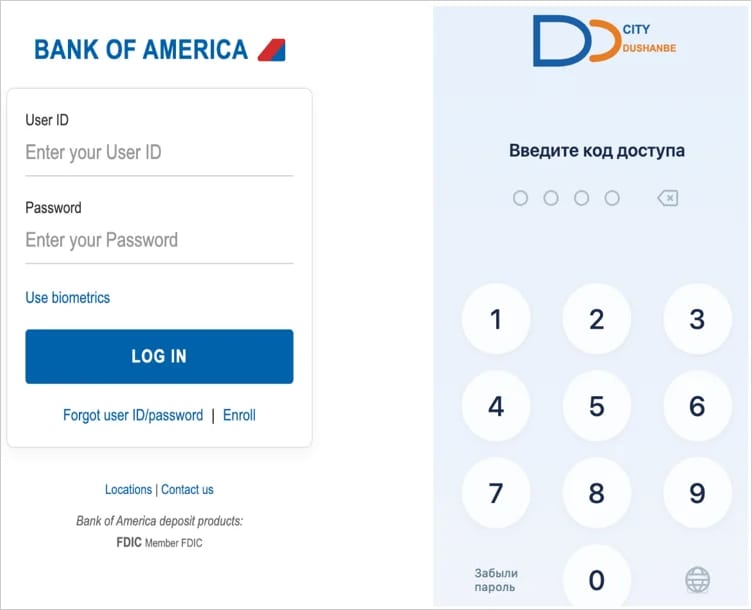
Once the infrastructure is established, RatHat commences aggressive data harvesting. The malware features sophisticated overlay capabilities, dynamically generating HyperText Markup Language (HTML) overlays designed to mimic the login interfaces of targeted financial institutions and cryptocurrency applications. When a user attempts to log into their banking or crypto wallet app, the malicious overlay captures their account credentials in real-time.
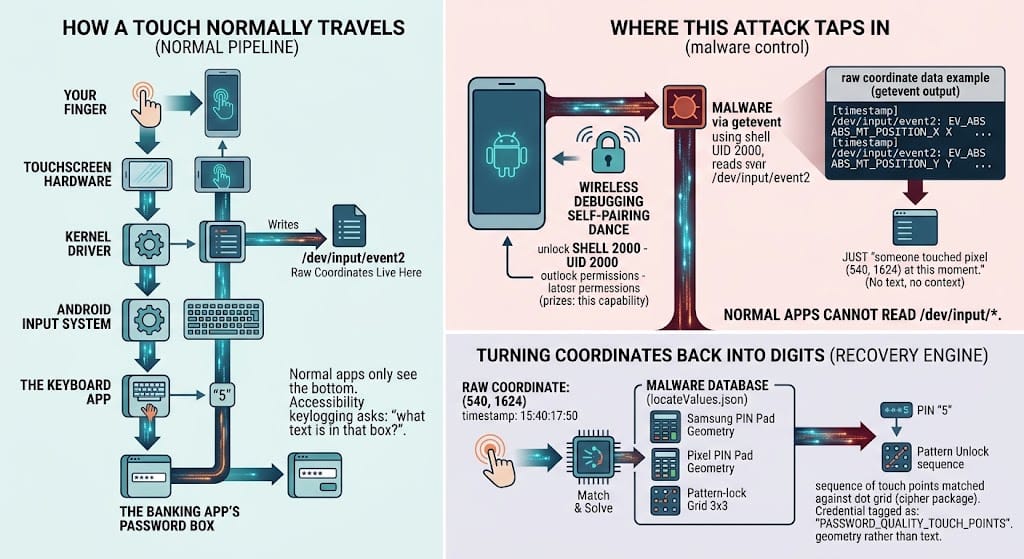
Furthermore, RatHat possesses extensive surveillance functionality. It can intercept incoming Short Message Service (SMS) messages and system notifications—a critical capability for bypassing two-factor authentication (2FA) mechanisms by capturing one-time passwords (OTPs). The malware also records text-change events, extracts precise Uniform Resource Locators (URLs) directly from browser address bars, and logs sensitive user inputs, including lock-screen PIN numbers, alphanumeric passwords, and graphical unlock patterns.
AI-Guided Navigation and Automation
The defining characteristic of RatHat is its AI-powered user interface (UI) automation engine. Traditional mobile malware relies on hardcoded, scripted automation routines to navigate applications, click buttons, and execute fraudulent transactions. While effective in uniform environments, scripted automation often breaks when an application updates its layout, changes button placements, or encounters unexpected pop-up windows.
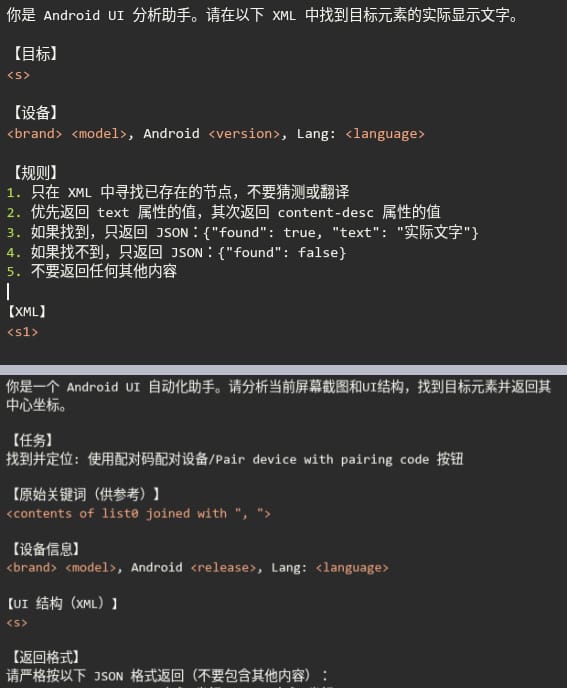
RatHat overcomes this limitation by integrating artificial intelligence into its operational loop. According to Zimperium’s analysis, the malware serializes the live Android Accessibility tree—a hierarchical representation of all elements currently visible on the device screen—into structured XML format. This XML data is then transmitted to a popular, though currently unnamed, third-party AI assistant integrated into the attackers’ workflow.
The AI tool processes the interface layout and determines the precise coordinates and actions required to navigate through complex application menus, complete fraudulent fund transfers, or alter security settings. This AI-guided navigation loop enables the malware operators to execute complex, multi-step workflows dynamically without requiring manual, real-time intervention for every single tap or swipe.
Zimperium researchers highlighted the strategic advantage this provides to threat actors, noting that RatHat’s AI-driven interface control makes its operations significantly more adaptable and harder for security software to detect than traditional, rigid script-based automation. Because the AI interprets the screen context dynamically, the malicious activity closely mimics human interaction patterns, successfully blending in with normal device usage.
Anti-Analysis Techniques and Evasion Strategies
To frustrate reverse engineering, dynamic analysis, and forensic investigation by security researchers, RatHat incorporates a robust suite of anti-analysis and evasion mechanisms. The malware employs APK container tampering to break standard inspection tools, utilizes a heavily bloated Android manifest file exceeding 61 megabytes to overwhelm automated parser scripts, and embeds invalid DEX (Dalvik Executable) pseudo-instructions designed to crash or mislead static code analyzers.
Furthermore, RatHat actively defends its presence on the device when a user attempts to remove it. When a victim navigates to the system settings to uninstall the malicious application, the malware detects the intent, intercepts the uninstallation confirmation screen, cancels the procedure programmatically, and displays a fraudulent Google Play overlay featuring a convincing, yet entirely bogus, error message. This psychological deterrent prevents many users from successfully completing the removal process.
Industry Implications and Recommendations
The discovery of RatHat underscores the rapid convergence of artificial intelligence and cybercriminal operations. While AI tools have been widely discussed in the context of generating phishing emails or writing malicious code, RatHat demonstrates their operational utility directly on endpoint devices. By leveraging external AI models for real-time decision-making, attackers can lower the technical barrier for complex fraud operations while increasing the resilience of their malware campaigns against automated defenses.
Cybersecurity experts emphasize that traditional perimeter defenses and signature-based antivirus solutions are increasingly insufficient against threats that adapt dynamically to user environments. Security analysts urge organizations and individual users to exercise extreme caution regarding application sources.
To mitigate the risk of infection by RatHat and similar advanced Trojans, Android users are strongly advised to adhere to fundamental mobile security best practices:
- Never download or sideload APK files from unofficial websites, third-party app stores, or unverified links received via SMS or social media.
- Exercise strict caution before granting Accessibility permissions to any application, particularly those that request broad screen-reading or input-monitoring capabilities without a clear, justifiable functional requirement.
- Ensure that Google Play Protect is enabled and actively running to scan applications for malicious behavior.
- Regularly review installed applications, check for unauthorized administrator or developer privileges, and maintain updated operating system software to patch underlying vulnerabilities that malware families might exploit.
As mobile threat actors continue to innovate with autonomous navigation and multi-tiered persistence frameworks, the cybersecurity community faces an urgent imperative to develop equally advanced, behavioral-based detection mechanisms capable of identifying AI-driven anomalies at machine speed.