AI Stocks Stage Relief Rally Following Global Rout as Investors Weigh Correction Against Tech Bubble Fears


Artificial intelligence stocks experienced a modest recovery on Friday, offering a temporary reprieve to public markets after a severe, cross-border selloff that originated on Wall Street and cascaded through Asian exchanges. Despite the single green trading session, the broader financial community is left grappling with an unsettled question heading into the weekend: Is this week’s drastic downturn a healthy, overdue market correction, or does it mark the preliminary bursting of a speculative artificial intelligence bubble?
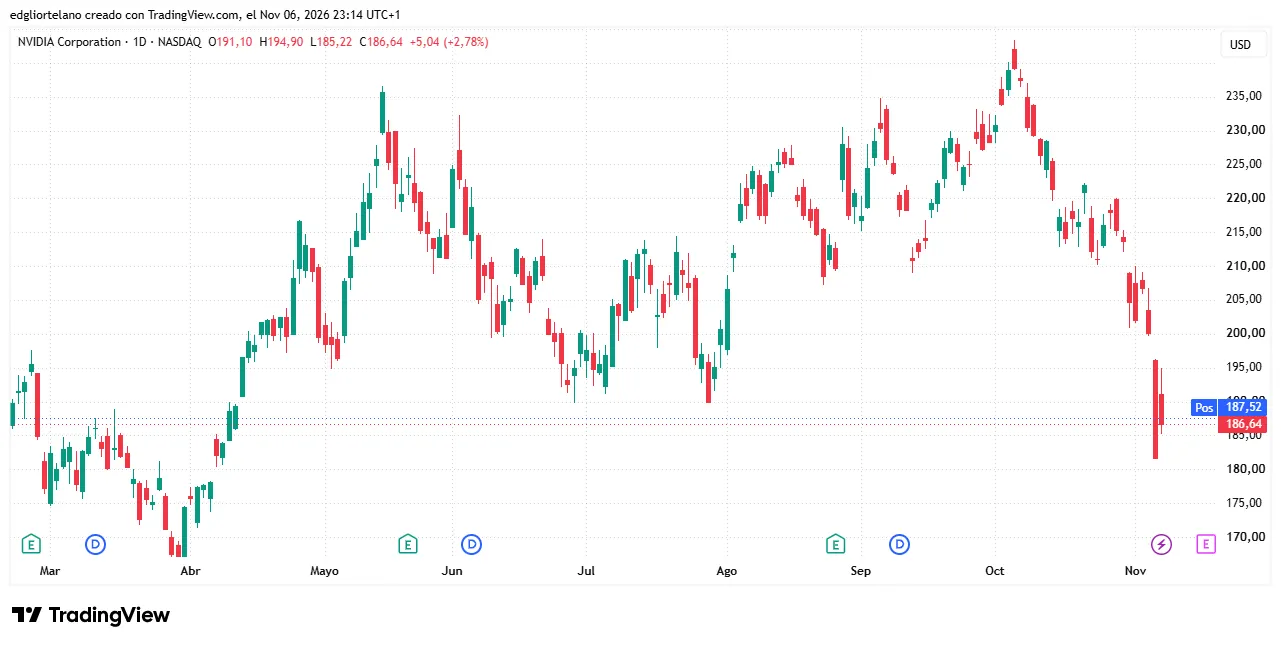
Market activity on Friday reflected cautious stabilization rather than a full recovery. Nvidia shares ticked upward by 2.78% to close at $186.64, attempting to claw back ground after plunging an alarming 9.3% in a single session earlier in the week. Advanced Micro Devices (AMD) similarly bounced back to $449.04, recovering from a brutal 17.3% collapse a day prior. Despite these gains, both semiconductor giants remain severely depressed compared to their all-time highs reached in October, underscoring how minor a relief rally is when measured against the scale of recent losses.
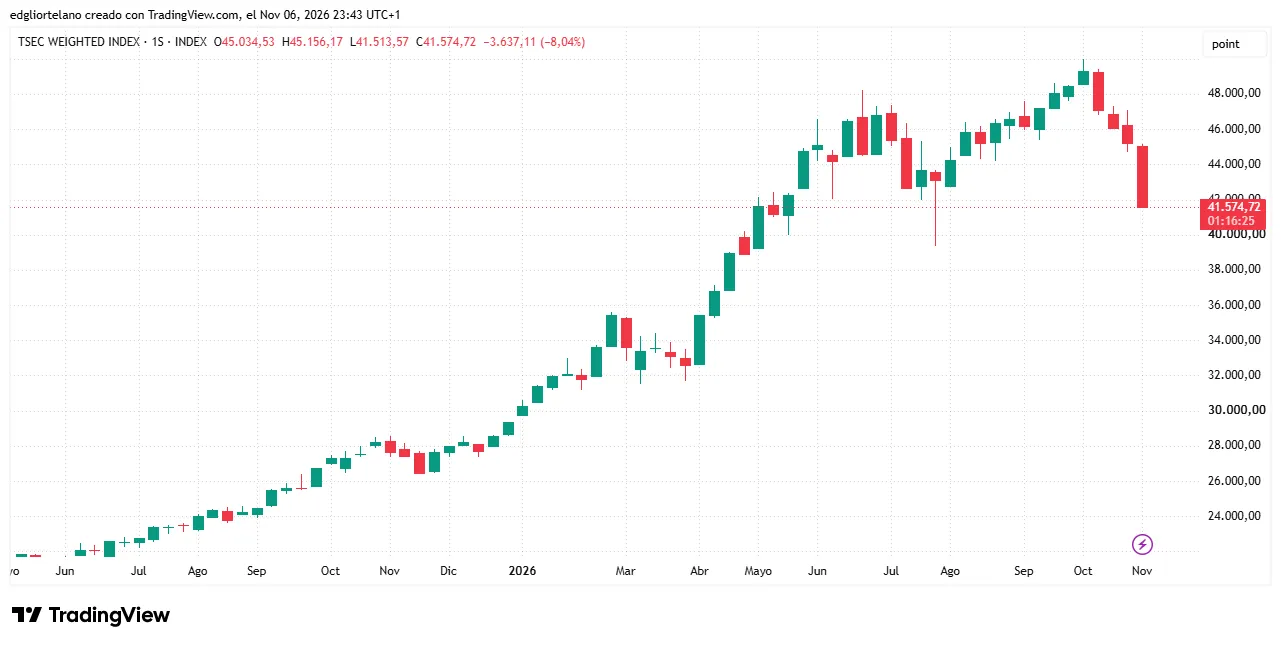
The contagion extended far beyond domestic U.S. equities, hitting Asian markets with particular severity. South Korea’s benchmark KOSPI index suffered a 6% loss on Friday, while Taiwan’s stock market experienced its worst weekly performance in months, tumbling more than 8% over the course of five days. During the height of the panic, contract chipmaking titan Taiwan Semiconductor Manufacturing Company (TSMC) hit its daily limit-down threshold. According to reports from Reuters, the intensity of the rout prompted Taiwanese financial authorities to intervene, urging state-owned banks to deploy capital to support share prices and stem systemic panic.
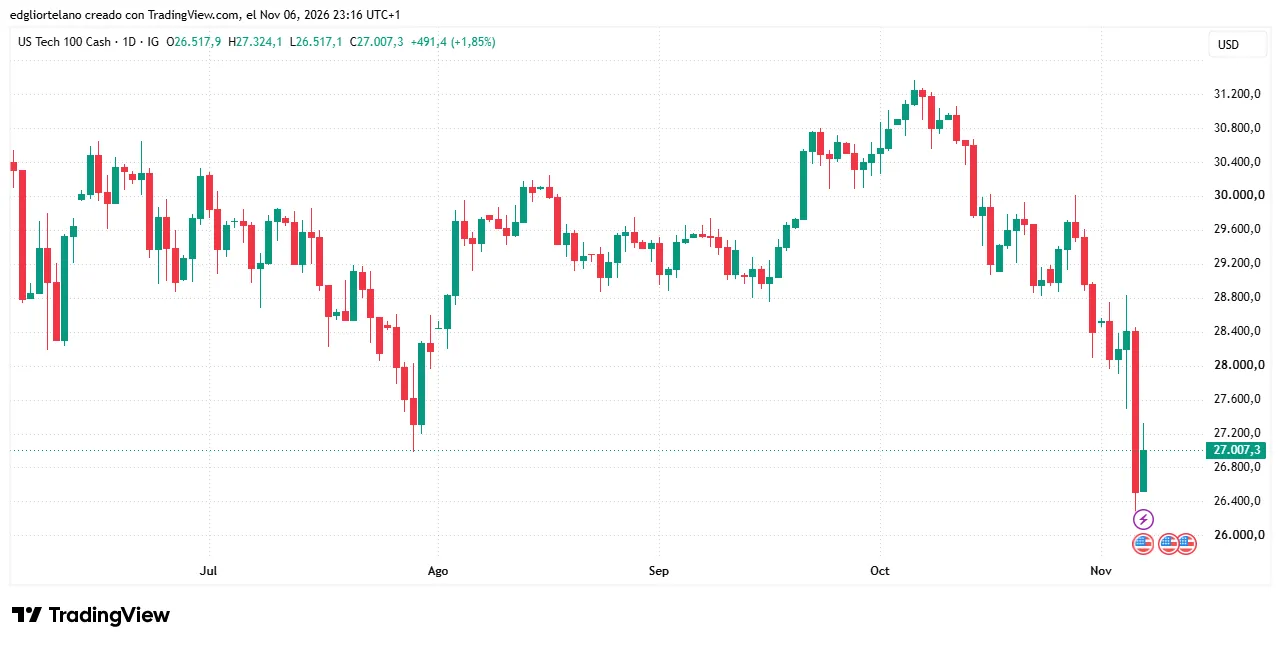
Meanwhile, the US Tech 100 cash-market proxy managed a 1.85% gain to settle at 27,007.3, bringing its weekly loss to roughly 5.5%. Technical charts reveal that this rebound occurred far below October’s peak levels, indicating that the market has transitioned out of its previous upward trajectory and into a phase of heightened volatility and structural reassessment.
Catalysts Behind the AI Trade Unravelling

The sudden reversal in artificial intelligence sentiment was catalyzed by a convergence of political headwinds, tightening monetary conditions, and structural realization regarding the pace of infrastructure monetization.
Domestically, the U.S. midterm elections accelerated anxieties regarding the regulatory and local political landscape facing AI infrastructure. Election results on November 3 revealed an overwhelming wave of local pushback against the rapid expansion of digital infrastructure. According to data compiled by Ballotpedia, local voters in 40 out of 41 municipal and county ballot contests voted to restrict or outright limit data center development, frequently rejecting pro-construction zoning measures. While some of these local votes were purely advisory in nature, the political signal sent to federal and state lawmakers was unmistakable.
This localized resistance presents a direct threat to the semiconductor and hardware supply chain, as hyper-scale data centers represent the primary engine of growth for chipmakers. Modern artificial intelligence training and inference operations require immense capital expenditures dedicated to high-performance processors, specialized servers, advanced liquid cooling systems, and massive electrical grids. Any regulatory friction, municipal zoning bans, or construction delays risk bottlenecks in hardware demand, forcing capital expenditure reductions or pushing development toward more expensive jurisdictions.
However, market doubts had begun accumulating well before the midpoints of election week. Technology firms and their corporate enterprise customers have been aggressively deploying capital to build out capacity, often racing to secure hardware before achieving clear, sustainable return on investment metrics. This aggressive spending strategy has collided head-on with a macroeconomic environment defined by elevated borrowing costs. As capital becomes more expensive to service, leveraged bets on speculative technology infrastructure become increasingly difficult to sustain.
Prominent market strategists noted that the segment had become dangerously overvalued. Steve Sosnick, a leading financial analyst, pointed out to Reuters that heavily owned technology and semiconductor stocks were already "priced to perfection," leaving zero margin for operational error or slowing demand.
Decoding the Distinction: Correction Versus Bubble Burst
To understand the current market turmoil, analysts emphasize the fundamental economic difference between a routine market correction and the catastrophic bursting of a financial bubble.
A market correction is technically defined as a decline of 10% or more from a recent asset price peak. Crucially, a correction does not inherently imply that the underlying business fundamentals or profitability of the sector are shrinking. For instance, consider a leading semiconductor manufacturer whose shares trade at a multiple of 60 times annual earnings because investors anticipate explosive industry growth. If macroeconomic sentiment shifts and investors become willing to pay only 40 times those identical earnings, the equity valuation can drop by a third even while corporate net profits remain entirely stable.
Conversely, the bursting of a market bubble is a systemic event driven by structural reality checking. It occurs when speculative expectations prove entirely unachievable, leading to a sudden evaporation of the liquidity and capital supporting the boom.
Financial history provides instructive parallels. During the infamous dot-com crash at the turn of the century, the Nasdaq composite index plummeted roughly 77% between March 2000 and October 2002. The internet itself was far from a passing fad; it fundamentally reshaped global commerce and society. However, investors radically overestimated the speed at which startup enterprises could monetize digital infrastructure and generate sustainable cash flows.
During that era, telecommunication operators poured fortunes into laying transoceanic fiber-optic cables long before consumer or enterprise demand materialized. Companies such as Global Crossing, which constructed massive international communication networks, ultimately filed for Chapter 11 bankruptcy protection in 2002. While the underlying technology survived and flourished over the ensuing decades, the equity holders and speculative firms funding the initial infrastructure wave were wiped out.
Economic Implications of Overleveraged Infrastructure
The artificial intelligence sector currently faces a comparable structural mismatch between long-term technological promise and near-term financial realities. While secondary markets are innovating—evidenced by former cryptocurrency miners repurposing hardware for cloud rentals and a proliferation of inference startups—the foundational financing model carries significant risk.
Consider a hypothetical cloud infrastructure provider borrowing billions of dollars to construct a massive data center filled exclusively with Nvidia accelerators, relying on the assumption that enterprise clients will rent that computing power at premium margins for years to come. If corporate clients pull back on spending, if construction is delayed by municipal zoning opposition, or if borrowing costs increase further, the accumulated debt obligations remain fixed and must be serviced.
Should revenues fall short of projections, the infrastructure operator may be forced to cancel or defer multi-billion-dollar chip orders. This cancellation ripples backward through the economy: chip designers lose revenue, contract manufacturers suffer reduced utilization rates, and utility providers that planned multi-billion-dollar electrical capacity upgrades face stranded assets. Furthermore, lenders and institutional investors holding the operator’s corporate debt face substantial impairments, turning a localized technology stock selloff into a broader macroeconomic challenge.
A Crucial Structural Difference from 2000
Despite these glaring structural similarities to the dot-com era, financial analysts emphasize an essential structural difference: the financial health of the largest industry players. Unlike the speculative, pre-revenue dot-com startups of 2000, the primary architects of the artificial intelligence boom—Microsoft, Alphabet, Amazon, and Meta Platforms—are intensely profitable, cash-generative conglomerates with diversified, established enterprise customer bases. These mega-cap technology firms possess the balance sheet strength required to absorb operational setbacks and cyclical downturns far better than smaller, independent AI-cloud providers that depend entirely on continuous debt financing to fund expansion.
Consequently, it remains entirely possible for artificial intelligence to successfully transform global industries over the long term while simultaneously driving individual, highly leveraged AI-focused corporations into financial distress—and leaving investors who overpaid for market leaders nursing heavy losses.
Early Warning Signs in Corporate Credit
Financial warning lights are flashing most brightly in private credit and specialized lending markets. On Friday, Reuters reported that the cost of purchasing credit default swaps—financial insurance designed to protect against a default—on specialized AI-cloud provider CoreWeave climbed past the critical threshold of 1,000 basis points. As the pricing for this default protection rises, institutional investors are signaling acute anxiety regarding the company’s long-term debt repayment capabilities.
By contrast, broader sovereign and investment-grade corporate bond markets have continued to operate with relative stability. This divergence indicates that financial strain is currently concentrated within the riskiest, highly leveraged corners of AI financing rather than signaling an immediate, system-wide banking crisis.
Outlook and Upcoming Catalysts
The coming week will subject the artificial intelligence trade to rigorous fundamental tests far more reliable than daily stock chart candles. Upcoming financial earnings reports and operational updates from CoreWeave, Applied Materials, and Cisco Systems are scheduled for release, offering concrete visibility into whether enterprise customers are maintaining their equipment orders or quietly scaling back capital expenditures.
Concurrently, upcoming macroeconomic inflation releases will dictate the trajectory of central bank interest rate policy and borrowing costs. If corporate hardware orders remain resilient and debt refinancing proves manageable, market defenders will find empirical backing for the correction narrative. Conversely, repeated project cancellations, failed debt refinancings, and shrinking sales figures would indicate that the financial foundations of the artificial intelligence boom are beginning to fracture. Ultimately, the central question facing global markets is not whether artificial intelligence possesses a transformative future, but whether every enterprise currently betting billions on that future possesses the financial runway required to survive the journey.