AWS Expands Local Development Capabilities with AWS Emulator and Strengthens Infrastructure Security Across Global Cloud Services

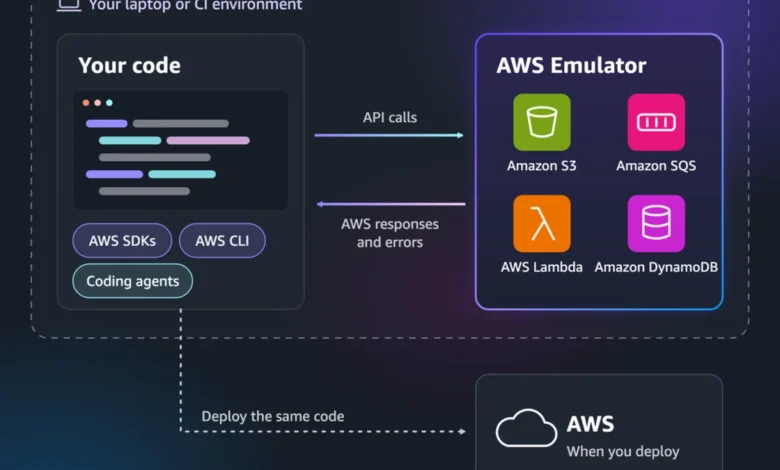
The landscape of cloud-native software engineering shifted significantly this week with the general availability release of AWS Emulator, a local development tool designed to mirror Amazon Web Services API interactions directly on a developer’s machine or within continuous integration pipelines. Announced as the flagship feature in a broader wave of updates, the emulator eliminates the historical necessity of provisioning live cloud environments for preliminary API testing, code iteration, and coding agent verification. Alongside this local-first development release, Amazon Web Services introduced a robust slate of updates spanning hardware-isolated virtual environments, OAuth 2.0 token delegation enhancements, state-of-the-art machine learning model integrations, serverless search expansions, and multi-region disaster recovery mechanisms.
Main Facts and Local Development Revolution: The AWS Emulator
The centerpiece of the recent product rollouts is the AWS Emulator, which allows developers and autonomous coding agents to execute standard AWS API interactions locally. By redirecting the endpoints of the AWS Command Line Interface (CLI) or standard AWS SDKs to a local HTTPS endpoint, developers can perform standard read, write, and administrative routines—such as initializing an Amazon DynamoDB table, populating records, and querying data—without consuming billable cloud resources or requiring an active AWS account.
The tool provides an immediate local feedback loop, a critical requirement for modern software engineering workflows that incorporate automated coding agents. Proponents of the tool emphasize that giving an agent the ability to run calls, inspect HTTP responses, and dynamically self-correct code in a frictionless local loop drastically reduces development cycles. However, technical documentation outlines explicit operational boundaries: the emulator does not replicate Identity and Access Management (IAM) permissions, resource-policy enforcement, cross-account protocols, or cross-region dynamics. Unimplemented API calls return an explicit HTTP 501 status code, requiring developers to rely on comprehensive testing inside live AWS environments before production deployment. The software is distributed via Linux packages, Docker images optimized for macOS and Windows, and open-source repositories hosted on GitHub.
Infrastructure Isolation and Compute Security: Nitro Sandboxes
Addressing the pressing enterprise requirement for multi-tenant workload security and isolated execution environments, AWS launched Nitro Sandboxes. This new architectural capability brings enterprise-grade hardware isolation directly to individual Kubernetes pods within Amazon Elastic Kubernetes Service (EKS), tasks within Amazon Elastic Container Service (ECS), and virtual machines running on Amazon Elastic Compute Cloud (EC2).
By leveraging the underlying AWS Nitro System, Nitro Sandboxes allow distinct workloads to share a single host EC2 instance while maintaining absolute cryptographic and hardware-level boundaries. The feature operates in two primary modes: isolated mode, which separates peer workloads residing on the same hardware, and confidential mode, which offers advanced cryptographic attestation and protection against node operators. This functionality is particularly advantageous for enterprise tenant segregation, high-risk build pipelines, and executing untrusted code generated by autonomous artificial intelligence agents. The service carries no additional software surcharges on supported instance types.
Chronology of Recent Updates and Core Platform Launches
The rapid pace of cloud infrastructure innovation was underscored by a series of targeted platform enhancements rolled out concurrently throughout the week.
In authentication and access control, Amazon Cognito expanded its protocol support to include OAuth 2.0 token exchange. This update enables applications to exchange an existing user token for a narrowly scoped, single-audience downstream token without transmitting refresh tokens. For autonomous agents operating on behalf of authenticated users, this enables principle-of-least-privilege delegation while maintaining traceability via act claims identifying the intermediary.
Within the artificial intelligence and machine learning portfolio, Anthropic’s advanced foundational model, Claude Fable 5.2, became globally accessible via Amazon Bedrock and the Claude Platform on AWS. Marketed as a premier model for complex software engineering, scientific research, and advanced quantitative finance, the model’s deployment on AWS is subject to standardized enterprise data retention requirements—specifically, a 30-day retention window for abuse detection, paired with a temporary zero-retention exception for eligible internal enterprise workloads. Furthermore, the runtime infrastructure for Amazon Bedrock AgentCore transitioned its next-generation architecture to default status, delivering session startup times under two seconds, dynamic scaling profiles up to 8 vCPUs and 32 gigabytes of RAM, scale-to-zero idle capabilities, and up to 68 percent memory cost reductions while preserving isolated microVM boundaries per session.
Data storage and search capabilities also experienced critical architectural upgrades. Amazon ElastiCache Serverless for Valkey introduced native support for hybrid, vector, and full-text search combined with server-side aggregations. Running on Valkey version 9, the update enhances real-time product recommendations, semantic search architectures, and memory-retrieval mechanisms for AI agents operating on high-velocity datasets. Concurrently, Amazon OpenSearch Service rolled out managed cross-region disaster recovery for domains running version 3.7 and later, guaranteeing recovery point objectives (RPO) of under one minute for data loss and recovery time objectives (RTO) under twenty minutes for planned and unplanned regional failovers.
Operational management and governance saw the introduction of account-level log retention policies within Amazon CloudWatch Logs. Platform engineering teams can now automate compliance and log management by establishing baseline retention timelines across all log groups or specific name-prefixes globally, eliminating the administrative overhead of individual log group configurations.
Enterprise Implications and Economic Efficiency
Industry analysts and enterprise cloud architects have noted that this cluster of updates reflects a concerted strategic effort by AWS to address two of the most pressing challenges facing modern technology organizations: rising artificial intelligence operational expenses and the operational complexity of distributed multi-region architectures.

The integration of local emulators and optimized agent runtimes directly targets the economic friction of software development. By allowing coding agents to iterate locally at zero infrastructure cost, enterprises can optimize prompt engineering and validation loops before incurring API and compute expenses on live cloud clusters. Simultaneously, features such as automated cross-region disaster recovery for OpenSearch and centralized account-level log retention address long-standing enterprise compliance and resilience pain points, reducing the manual engineering hours required to maintain strict disaster recovery postures and regulatory auditing standards.
Real-world architectural case studies published concurrently, such as Zillow’s deployment of 100 million daily notifications using AWS Step Functions Express Workflows, illustrate the growing industry reliance on serverless orchestration, idempotent design patterns, and rigorous local state testing via APIs prior to large-scale production deployment.
Broader Market Context and Upcoming Industry Events
As cloud providers continue to compete intensely on developer velocity, artificial intelligence execution efficiency, and infrastructure security, these latest releases position AWS to capture an increasing share of agentic workflow development and secure multi-tenant cloud operations.
The developer community will have the opportunity to dissect these architectural patterns and platform updates in person at the upcoming AWS re:Invent conference, scheduled in Las Vegas from November 30 to December 4. Featuring over 2,200 technical sessions, deep-dive workshops, and global livestreams, the annual gathering is expected to provide further clarity on the long-term roadmap for local emulation tools, hardware-isolated sandboxes, and enterprise artificial intelligence integration. Developers and cloud architects seeking ongoing collaboration and technical resources can also access the AWS Builder Center and participate in regional AWS Community Days hosted globally throughout the year.