The Evolution of Semantic Search
For decades, traditional information retrieval systems relied on keyword-based matching. These systems functioned by creating inverted indices that mapped specific words to document locations. While effective for exact matches, they struggled with synonymy and context. If a user searched for "feline," a keyword-based system would fail to retrieve documents containing only the word "cat."
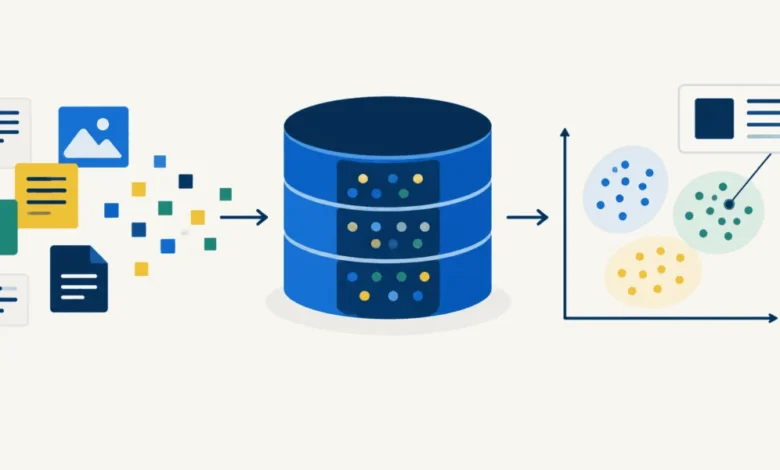
Vector databases represent a paradigm shift in data retrieval. Instead of indexing strings, they index "embeddings"—mathematical representations of text translated into high-dimensional vectors. In this coordinate space, vectors that are closer together in terms of their angle or distance share similar semantic meaning. By performing a mathematical operation known as the dot product, a computer can determine how closely a query matches a piece of stored information, regardless of whether they share a single common word.
Technical Foundations and Prerequisites
The journey to building a functional vector database begins with a minimalist technical stack. By utilizing the sentence-transformers library, developers can transform raw text into dense numerical vectors. When paired with NumPy, these vectors become manageable matrices that allow for lightning-fast comparisons.
To begin the implementation, a developer must establish a workspace containing three foundational files: vector_db.py, which contains the database logic; corpus.py, which provides a sample dataset of 25 documents; and test.py, which ensures the integrity of the database operations. The installation of dependencies is straightforward, requiring only pip install numpy sentence-transformers.
A Ten-Step Chronology of Development
The construction process follows a logical sequence, beginning with basic initialization and progressing toward high-performance scaling.
- System Setup: The initial phase involves configuring the environment and creating helper functions for displaying data. This stage ensures that search results are formatted to show scores, topics, and snippets, providing immediate visual feedback on the quality of retrieved data.
- Index Construction: Once the environment is ready, the
VectorDBclass is initialized. This step involves loading an embedding model—typically a lightweight model likeall-MiniLM-L6-v2—which converts text into 384-dimensional vectors. - Initial Query Execution: A basic search demonstrates the power of semantic matching. When querying "what keeps a cell supplied with energy," the system successfully identifies mitochondria-related documents, even when the query does not perfectly align with the document syntax.
- Semantic Nuance: This step highlights the ability of the system to perform "zero-word-match" retrieval. By testing queries like "why does my loaf taste sour," the system correctly identifies documents about sourdough fermentation, proving that the model understands the underlying concepts rather than just matching characters.
- Understanding Scoring: Every result returned by the database includes a confidence score. This score is derived from cosine similarity. By normalizing vectors, a simple dot product becomes a measure of similarity, allowing developers to set a "floor" for relevance in production environments.
- Metadata Filtering: Real-world databases require the ability to narrow search results based on specific criteria, such as topic or date. The implementation of a
wherefilter allows the database to ignore irrelevant documents, such as a pop-culture reference to "mitochondria" when the user is specifically looking for biological research. - Constraint Management: A robust database must handle cases where a filter is more restrictive than the number of results requested. The implementation ensures that the system does not "pad" results with irrelevant matches, maintaining high precision.
- Operational Guard Rails: To prevent data corruption, the system includes error handling for common mistakes, such as passing a string where a list is expected or providing mismatched metadata.
- Persistence and Serialization: The system must be able to save its state. The implementation saves vector data into compact
.npyfiles and stores text metadata in.jsonformat, ensuring that the database can be reloaded without re-encoding the entire corpus. - Performance Scaling: The final step addresses the scalability of the architecture. Testing against a synthetic dataset of 100,000 vectors reveals that as the database grows, the bottleneck shifts from the initial encoding to the computational cost of the matrix multiplication required for ranking.
Performance Analysis and Industry Implications
The efficiency of this approach is rooted in the linear algebra capabilities of NumPy. When a database contains 1,000 documents, a search takes approximately 0.01 milliseconds. Even as the size increases to 100,000 documents, the scan time remains highly competitive at roughly 3.73 milliseconds. This performance is achieved because the entire corpus is treated as a single matrix, allowing the computer to leverage highly optimized BLAS (Basic Linear Algebra Subprograms) routines.
The implications for developers are significant. While managed services like Pinecone, Milvus, or Weaviate offer advanced features such as distributed storage and real-time updates, the core functionality is mathematically accessible. Understanding the "under-the-hood" mechanics allows engineers to optimize their data pipelines, choose appropriate embedding models, and debug retrieval issues with greater precision.
Expert Perspectives on Vector Databases
Industry analysts note that the rise of vector databases is a direct response to the limitations of Large Language Models (LLMs). LLMs suffer from "hallucinations" and a lack of access to private, real-time data. By coupling an LLM with a custom-built vector database, organizations can implement Retrieval-Augmented Generation. This approach anchors the AI’s output in verified, retrieved documents, significantly improving the accuracy and reliability of automated responses.
As AI adoption accelerates, the demand for local, performant, and transparent database solutions is expected to grow. Whether a project requires a few hundred documents or several million, the fundamental principles of vector search remain consistent.
Conclusion
Building a vector database from scratch serves as more than just an educational exercise; it provides a foundational understanding of the modern AI stack. By mastering these ten steps—from initial vectorization to efficient matrix-based ranking—developers gain the ability to build, optimize, and scale intelligent search systems. The simplicity of this implementation underscores a broader trend in the tech industry: the most powerful tools in artificial intelligence are often built upon elegant, well-understood mathematical principles rather than opaque, proprietary black boxes. As the ecosystem continues to evolve, the ability to manage and query vector data will remain a critical skill for any developer operating in the age of generative AI.
Related posts: