Bridging the Divide: How Agentic Reasoning and Traditional Machine Learning Create a New Paradigm in AI Systems

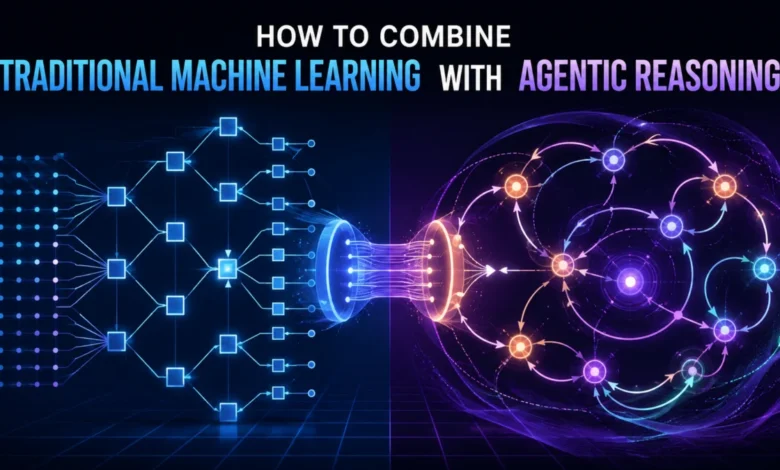
The rapid evolution of artificial intelligence has moved beyond the simple, singular capabilities of predictive models into a complex landscape where software must now plan, iterate, and execute. For over a decade, traditional machine learning (ML) has served as the backbone of digital automation, excelling at static tasks like classification and regression. However, as business requirements shift toward end-to-end process management, the limitations of these models have become increasingly apparent. The emergence of agentic reasoning represents a critical inflection point, offering a framework to integrate these predictive powerhouses into autonomous, goal-oriented systems capable of managing multi-step workflows.
The Evolution of Machine Learning: A Brief Chronology
To understand the current shift, one must look at the historical trajectory of AI. In the 2010s, the "Deep Learning Revolution" centered on the efficacy of supervised learning. During this era, engineers focused on the "Input-Output" paradigm. A model was trained on a fixed dataset—such as millions of labeled images or transaction logs—to map specific inputs to a predetermined output. By 2018, the industry reached a plateau of sorts; models were highly accurate, yet they remained "black boxes" that could not interact with the outside world.
The 2020s introduced the era of Large Language Models (LLMs) and, subsequently, the agentic framework. While traditional ML provides the what—the statistical probability of an event—agentic reasoning provides the how—the logic required to maneuver through a sequence of tasks to achieve a business goal. This evolution from static prediction to dynamic orchestration marks a fundamental shift in how software architectures are constructed.
Understanding the Predictive Ceiling of Traditional ML
Traditional machine learning models, such as Random Forests, Gradient Boosting Machines, and Convolutional Neural Networks, are essentially static mathematical functions. Once the weights are frozen following the training phase, the model loses the ability to learn from new, unseen circumstances in real-time.
Industry data underscores why this is both a strength and a weakness. According to recent benchmarks in financial services, fraud detection models can achieve precision rates exceeding 99% in controlled environments. However, these models operate in a vacuum. If a transaction appears anomalous, a traditional model outputs a high probability score, but it lacks the agency to cross-reference the user’s recent login history, flag the account for temporary suspension, or send a verification SMS. The "predictive ceiling" is reached when the task requires an intervention that exists outside the static feature vector provided at the start of the inference process.
The Rise of Agentic Reasoning: Beyond Simple Inference
Agentic reasoning functions as an "executive layer" for AI. Unlike a standard model, which is a reactive processor, an agent is an active participant in a workflow. These systems typically utilize an LLM as a "reasoning engine" capable of breaking down complex objectives into smaller, manageable sub-tasks.
The four pillars of agentic functionality include:
- Planning: The ability to decompose a high-level directive (e.g., "Investigate the insurance claim") into a series of actionable steps, such as document retrieval, data verification, and cross-referencing.
- Tool Integration: Agents act as the bridge to external APIs. If an agent determines that it needs current market data to make a decision, it can trigger a search or a database query, effectively extending its knowledge base beyond its original training cutoff.
- Iterative Adaptation: If a specific path fails—for instance, if an API call returns an error—an agent can attempt a fallback strategy, a degree of resilience previously unavailable in static ML systems.
- Autonomous Execution: Agents can trigger workflows, such as updating a CRM, sending an email, or modifying a database record, moving the system from a passive observer to an active operator.
Synergistic Architecture: Where Models Meet Agents
The most sophisticated AI systems currently in production are not choosing between ML and agents; they are layering them. Industry experts from leading AI research firms suggest that this hybrid architecture is the key to enterprise-grade reliability.
In this model, the machine learning component acts as the "specialist." If a company needs to perform high-speed image analysis on millions of medical scans, a dedicated ML model remains the most efficient, cost-effective, and accurate tool for the job. The agentic system acts as the "generalist" or "manager." It dictates the workflow, decides when to trigger the ML model, interprets the output, and integrates that result into the broader clinical decision-making process.
By decoupling the high-speed, repetitive tasks from the reasoning-intensive tasks, organizations can achieve a level of efficiency that neither approach could manage in isolation. The ML model handles the high-volume math, while the agent handles the high-level context and decision logic.
Case Study: Modernized Insurance Claims Processing
Consider the implications of this architecture in the insurance industry. Historically, claims processing was a slow, manual labor-intensive task. Traditional ML helped prioritize claims, but it could not resolve them.
In a modern, agentic-driven claims office, the workflow is automated:
- The Intake Agent: Receives a claim and parses the unstructured text.
- The Specialist ML Model: Analyzes the claim data to produce a fraud risk score.
- The Reasoning Agent: Evaluates the score. If the risk is low, it checks policy coverage against the database and prepares a draft payout. If the risk is high, it triggers a "Deep Audit" protocol, searching public records for duplicate filings or suspicious patterns, and compiles a comprehensive report for a human adjuster.
This transition reduces the time-to-resolution from days to minutes. The implications for the workforce are significant; human adjusters are shifted from manual data entry and basic sorting to high-value decision-making, focusing only on the complex cases that the agentic system has flagged as requiring human intuition.
Broader Economic and Operational Implications
The integration of agentic reasoning into existing ML infrastructure has far-reaching consequences for the global economy. Firstly, it democratizes access to complex automation. Previously, building a system that could handle multi-step reasoning required brittle, rule-based coding that was expensive to maintain and impossible to scale. Agentic systems, being largely driven by natural language and adaptable logic, are more flexible and easier to update.
Secondly, the shift addresses the "last mile" problem of AI. Many businesses have invested heavily in predictive models that underperform simply because the models cannot interface with the rest of the business software ecosystem. By wrapping these models in an agentic layer, organizations are finally realizing the return on investment for their legacy AI assets.
However, this transition also presents new challenges in governance and safety. As agents begin to take autonomous actions—such as writing to databases or calling APIs—the risks of "hallucinated" actions or unintended consequences grow. Consequently, the next phase of development will focus heavily on "guardrails," ensuring that while agents have the power to act, their operations remain within strictly defined ethical and operational boundaries.
Conclusion: The Future of Hybrid AI
The narrative that AI will be dominated by a single, all-encompassing model is increasingly being replaced by the reality of a modular, hybrid future. Traditional machine learning provides the precision required for specialized tasks, while agentic reasoning provides the orchestration needed for complex, real-world operations.
As businesses move toward more autonomous processes, the ability to weave these technologies together will define the leaders of the next decade. The goal is no longer just to build a model that can see or predict; it is to build systems that can understand the context of a problem and work systematically toward a resolution. The age of the static model is ending, and the age of the intelligent, acting agent has begun.