The syndicated loan and private credit markets have long formed the bedrock of global corporate finance, channeling vital capital to businesses of all sizes. Yet, these massive markets have historically operated on archaic, highly fragmented infrastructure. Characterized by manual legal interpretations, multi-week settlement cycles, valuation opacity, and persistent operational friction, the traditional corporate lending ecosystem has struggled to keep pace with the demands of modern digital finance. To address these systemic inefficiencies, fintech innovator Nammu21 has announced a groundbreaking proof-of-concept developed in collaboration with Google Cloud. By leveraging advanced artificial intelligence to structure complex legal agreements and instantiating them as smart contracts on the Google Cloud Universal Ledger (GCUL), the initiative automates the entire loan lifecycle, promising to dramatically accelerate settlement times and enhance overall market liquidity.
The Urgent Need for Modernization in Corporate Lending
While the global loan market provides trillions of dollars in vital funding annually, its operational backbone remains remarkably analog. Issuing and managing syndicated credit requires continuous, manual coordination among diverse stakeholder groups, including facility agents, corporate borrowers, and complex lender syndicates. Furthermore, credit agreements are rarely standardized; they are highly bespoke documents featuring dynamic tranches, intricate financial covenants, and rigid operational mechanics.
Relying on fragmented, manual interpretation of these dense legal texts creates significant operational drag and entrenched data silos. According to recent data from the Loan Market Association (LMA), secondary market settlement times for par and near-par loans in the fourth quarter of 2024 averaged an arduous 42 days, with a median timeline of 27 days. These sluggish settlement windows tie up substantial institutional capital, elevate counterparty risk, and impose a heavy administrative reconciliation burden on back-office personnel across the financial sector.
Transforming Bespoke Agreements into Programmable Assets
To dismantle these structural bottlenecks, Nammu21 has engineered a proprietary methodology that converts complex credit documents into scalable, programmable assets. The platform renders each credit facility’s governing terms into a Digital Credit Instrument (DCI). This DCI meticulously maps every provision—including complex eligibility criteria, required consents, operational mechanics, and restrictive covenants—directly back to its originating legal text. These elements are then translated into executable behaviors that govern the live state of the loan.
To bring these instruments to life, the proof-of-concept leverages the secure, high-performance execution environment of the Google Cloud Universal Ledger. GCUL is an institutional-grade, permissioned distributed ledger designed specifically to automate complex multi-party financial workflows. Unlike public blockchains, which often suffer from transactional volatility and acute security vulnerabilities, GCUL delivers deterministic, near-instant transaction finality coupled with predictable operational costs.
A Purpose-Built Technical Stack for Institutional Finance

The synergy between Nammu21’s data intelligence and Google Cloud’s distributed ledger infrastructure provides a robust foundational stack for modern credit markets. Designed expressly to meet the stringent privacy, scalability, and regulatory requirements of institutional finance, GCUL ensures that high-value financial settlements occur with absolute precision.
Programmable contracts on the platform are written in gculpy, GCUL’s domain-optimized programming language. Formulated as a strict, statically-typed subset of Python, gculpy prioritizes safety, human readability, and rigorous auditability, making it exceptionally well-suited for processing intricate financial logic. For heavily regulated financial institutions, the language offers profound operational advantages over traditional ledger programming models. It streamlines development by eliminating the need for complex memory management or workarounds for restrictive call stack limits, enabling software engineers and financial analysts to focus squarely on the underlying business logic.
Additionally, GCUL addresses a major security hurdle plaguing public distributed networks: the "unsolicited asset" problem. On public networks, unauthorized or malicious entities can deposit unwanted tokens directly into an organization’s digital wallet, creating severe compliance, tax, and accounting complications. GCUL features robust, built-in permissioning that requires explicit, proactive user authorization before any contract can store data or interact with a wallet. This ensures that financial institutions maintain absolute oversight over every asset and transaction.
Modelling a Multi-Billion-Dollar Loan Lifecycle
The technical viability of this architecture was vividly demonstrated through a comprehensive proof-of-concept modeling a $1.945 billion Term Loan B—a major tranche within a larger multi-facility corporate financing transaction. In this simulation, the agent bank, corporate borrower, transferor, and transferee all operated from a synchronized, permissioned view of a single on-ledger digital twin.
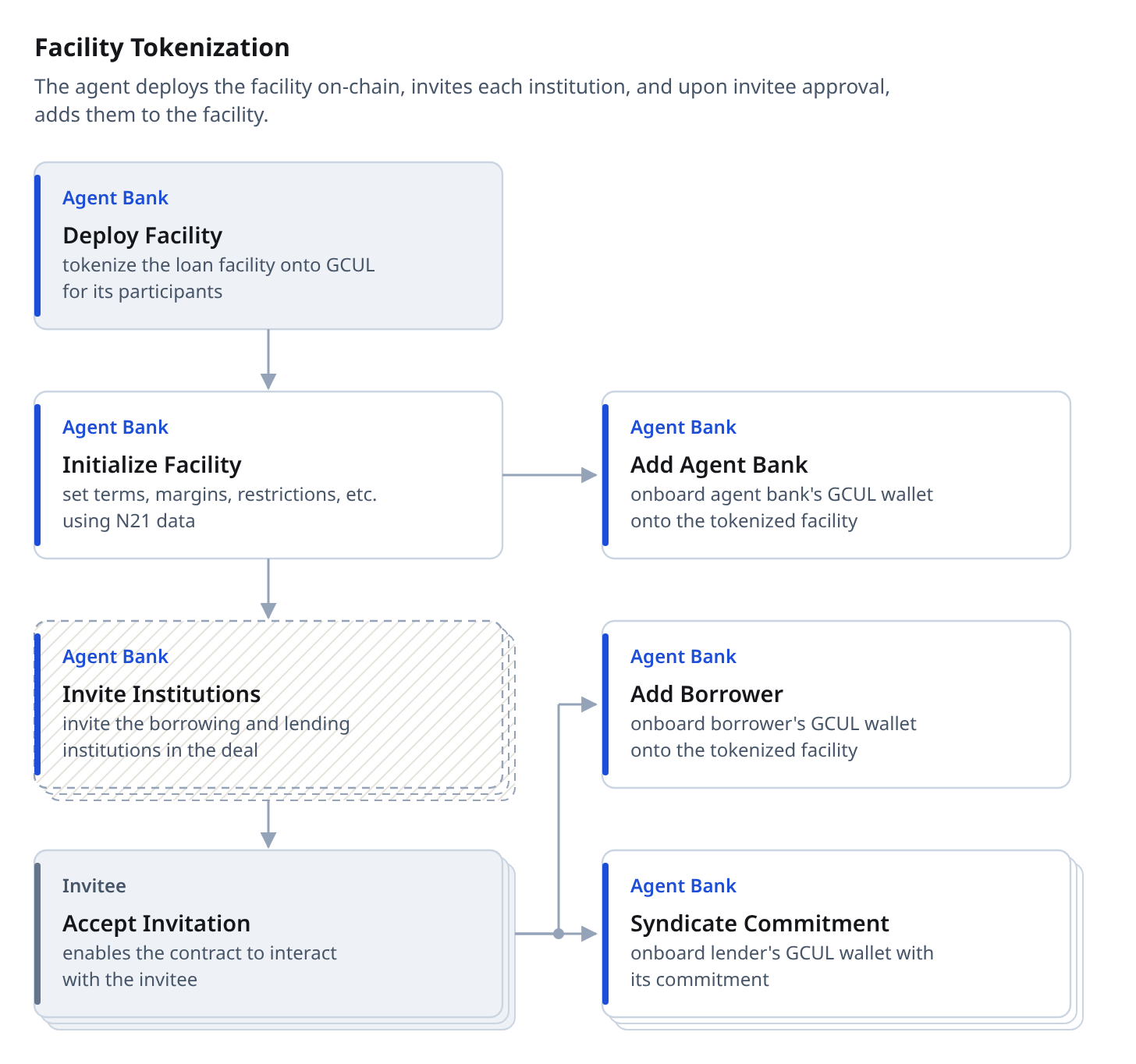
The end-to-end lifecycle commenced when the agent bank selected a credit agreement previously parsed and structured by Nammu21. The platform instantly extracted the codified terms to instantiate a unique gculpy contract on GCUL. Following this initialization, the agent bank initiated the digital onboarding of the borrower and various participating lenders. In strict adherence to a multi-lateral, consent-driven model, each participant reviewed the onboarding terms and provided explicit digital approval through their respective user interfaces.
Once onboarding concluded, the agent bank recorded an immutable cryptographic hash of the loan’s primary terms on-ledger, creating an unalterable attestation that the digital state precisely matched the canonical off-ledger records. Subsequent lifecycle events—such as secondary market position transfers, routine interest payments, and final loan close-outs—were executed as automated, multi-step workflows. For instance, any secondary market transfer of a loan position required the synchronized consent of the incoming lender, the borrower, and the agent bank before executing atomically on the ledger. All financial settlements utilized tokenized commercial bank money directly on GCUL, entirely bypassing legacy external payment rails.
Core Pillars of the Digital Credit Architecture
The integration of Nammu21 and Google Cloud establishes an institutional-grade framework anchored by three fundamental design pillars:
-
Compliance via Gated Execution: By embedding governing legal terms directly into
gculpycontracts, every proposed action is automatically validated against the original agreement prior to execution. This preemptively mitigates covenant breaches and invalid transfers while eliminating silent operational failures. -
Role-Based Privacy: GCUL enforces granular, role-based access controls. Proprietary trading strategies, sensitive portfolio positions, and confidential loan metrics remain strictly shielded, visible solely to authorized transaction counterparties.
-
Deterministic Settlement Finality: Provisional, reconciliation-heavy workflows are replaced by real-time verification. Every on-ledger action completes near-instantly, anchored permanently to canonical data derived straight from the original credit documentation.
Broader Market Impact and Economic Implications
The successful execution of this proof-of-concept signals a profound structural evolution in how private credit and syndicated loan markets can function. Industry analysts note that while financial figures and payment values are routinely reconciled bilaterally, the overarching governance logic governing these transactions has historically been interpreted independently by each participating institution. This decentralized, manual interpretation is the primary root cause of market friction.
By centralizing and automating governance logic on an immutable distributed ledger, the industry can overcome the administrative hurdles that have plagued it for decades. Compressing secondary settlement times from over a month down to near-instantaneous execution unlocks trapped capital, dramatically improves portfolio liquidity, and mitigates counterparty risk by design rather than through manual oversight.
As financial institutions face increasing pressure to modernize their operations and optimize capital efficiency, the adoption of AI-driven legal parsing combined with secure distributed ledger technology offers a clear path forward. The successful collaboration between Nammu21 and Google Cloud demonstrates that the digitization of complex credit instruments is no longer a theoretical concept, but an achievable reality poised to reshape the future of corporate finance.