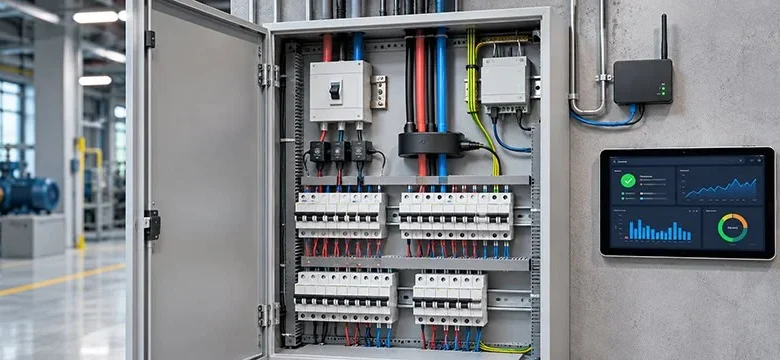
A typical Monday morning service call to a commercial cold-storage facility often follows a frustrating script: a residual current breaker has tripped twice over the weekend, unexpectedly shutting down the primary refrigeration compressors and threatening thousands of dollars in perishable inventory. Upon arrival, the facility manager points proudly to a modernized "smart" distribution panel equipped with a multifunction incoming meter, an edge gateway, and a sophisticated cloud-based dashboard displaying immaculate kilowatt-hour consumption charts. Yet, despite the high-tech installation, the system is entirely blind to the root cause. It cannot identify which specific feeder circuit experienced the fault, quantify the leakage current, or reveal whether the electrical degradation had been quietly creeping upward for weeks.
This technological gap remains remarkably common across modern industrial and commercial facilities. Many electrical distribution panels marketed as "smart" are, in practice, merely metered. They capture aggregate energy consumption effectively while offering virtually zero visibility into individual branch feeders, and even less capability regarding the minute, stray currents escaping toward the earth. As facilities increasingly adopt complex power electronics, automated machinery, and rigorous sustainability targets, the demand for precise, granular electrical monitoring has reached a critical juncture. Bridging this gap requires a fundamental reassessment of how modern electrical distribution systems acquire, process, and interpret internal data from the terminal block up to the enterprise cloud.
The Evolution and Limitations of Industrial Electrical Monitoring
For decades, industrial electrical panels operated as isolated, passive infrastructure—mechanical enclosures that could function untouched for twenty years without a technician ever opening the door. However, the modern transition toward Industrial Internet of Things (IIoT) architectures has elevated the distribution panel from a passive safety container to an active node of facility intelligence. The business case for retrofitting or specifying advanced instrumentation in these panels is typically driven by four primary operational pressures: unplanned downtime avoidance, regulatory compliance, energy efficiency mandates, and the integration of volatile distributed energy resources like rooftop solar photovoltaic systems and electric vehicle charging infrastructure.
Despite these advanced objectives, most monitoring strategies rely heavily on fundamental current measurements. While voltage provides a macroscopic view of systemic health, current reveals the micro-behavior of individual loads, highlighting shifting operational states and impending insulation failures before they cascade into catastrophic equipment damage. Consequently, the selection of current sensors—often referred to as current transformers or CTs—determines the total cost, measurement accuracy, and physical installation complexity of the entire IIoT monitoring ecosystem.
Engineering teams frequently discover that standard monitoring configurations fall short during troubleshooting phases. Voltage fluctuations affect entire busses uniformly, but current anomalies isolate specific components. Without accurate, high-resolution current data mapped to individual circuits, facility operators remain reactive, forced to troubleshoot electrical faults manually after safety mechanisms have already disrupted business operations.
Core Current Sensing Technologies and Their Industrial Trade-Offs
No single current-sensing technology is universally optimal for every point within a complex distribution panel. Engineers must navigate a matrix of compromises regarding galvanic isolation, direct current (DC) capability, frequency bandwidth, physical footprint, and manufacturing cost. Shunts, Hall-effect sensors, conventional current transformers (CTs), and Rogowski coils each serve distinct roles in measuring primary load current, while zero-sequence current transformers (ZCTs) fulfill an entirely separate protective function.
A shunt resistor operates by inserting a precise, low-value resistance directly into the power path, allowing monitoring systems to track the proportional voltage drop across it. While highly accurate for both AC and DC measurements, shunts lack inherent galvanic isolation and dissipate significant heat at high current ratings. Conversely, magnetic-effect sensors isolate the measurement circuit from high voltages. Hall-effect sensors utilize semiconductor elements to measure AC, DC, and complex mixed waveforms, making them indispensable in photovoltaic inverters and EV charging stations, though they require external power supplies and are susceptible to thermal drift.
Conventional iron-core CTs rely on magnetic induction to measure alternating current at mains frequency, serving as the industry standard for feeder sub-billing. However, they are strictly limited to AC circuits and can easily saturate under excessive primary currents or DC bias. For large busbars and tight retrofit spaces, flexible Rogowski coils—which utilize an air-cored winding that cannot magnetically saturate—have gained immense popularity for power quality analysis.
| Technology | What it Measures Best | Typical Limitation | Common Industrial Applications |
|---|---|---|---|
| Shunt Resistor | AC and DC load current at low to moderate levels | No inherent galvanic isolation; heat dissipation at high current | Battery energy storage systems, DC distribution, compact meters |
| Hall-Effect Sensor | AC, DC, and mixed-waveform currents | Offset and temperature drift; requires operational supply power | PV and battery inverters, EV chargers, DC industrial feeders |
| Standard CT | AC load current at mains frequency | AC only; can saturate under excessive current or DC bias | Feeder and branch metering, tenant sub-billing |
| Rogowski Coil | Large or fast-changing AC currents and harmonics | Requires an integrator circuit; less suitable for very small currents | Large busbars, electrical retrofits, comprehensive power quality analysis |
| Zero-Sequence CT (ZCT) | Small residual (earth-leakage) current across all live conductors | Does not measure individual load current; conventional types are AC-only | Earth-leakage monitoring, insulation trending, residual current protection |
Deploying a truly comprehensive smart distribution panel almost invariably requires combining two or three of these distinct technologies to capture the full spectrum of electrical phenomena occurring within the enclosure.
The Engineering Challenge of Detecting Millamp Faults with Macro-Scale Sensors
A persistent misconception in panel design is that software can mathematically deduce earth leakage by aggregating the phase and neutral currents measured by existing load CTs. In theory, Kirchhoff’s current law dictates that in a healthy, balanced circuit, the vector sum of all currents passing through live conductors must equal zero; any net current missing from this return path represents a fault leaking toward the earth.
In practice, this arithmetic frequently fails. Consider a standard 400-ampere industrial feeder circuit protected by a conventional metering CT. A minor 30-milliampere earth leakage current represents a mere 0.0075% of the sensor’s total rated capacity. Standard industrial metering CTs are fundamentally unequipped to resolve such minute variances between massive primary current measurements. For instance, a Class 0.5 metering CT permits a ratio error of 0.5% at rated current, which translates to an allowable error margin of 2 amperes on a 400-ampere sensor—a margin orders of magnitude larger than the target fault current.
When maintenance teams attempt to calculate residual current through software subtraction, the resulting data is typically dominated by sensor phase and ratio mismatches rather than actual physical leakage. Consequently, dashboards often falsely indicate escalating leakage currents every morning as facility loads ramp up, triggering false alarms that erode operator trust.
This engineering limitation necessitates the use of dedicated zero-sequence current transformers (ZCTs). By passing all live phase conductors and the neutral conductor together through a single, unified magnetic core, the magnetic fields generated by balanced load currents cancel each other out entirely. The ZCT core remains unexposed to the massive net load current, allowing it to isolate and detect residual earth-leakage currents down to the milliampere threshold with high fidelity.
Accounting for Complex Waveforms and Frequency Responses
Modern industrial environments rarely present clean, sinusoidal AC mains power. Variable-frequency drives (VFDs), computerized switch-mode power supplies, and renewable energy inverters frequently introduce complex electrical noise, pulsating DC components, smooth DC, and high-frequency harmonics into the distribution network.
Residual current devices and sensors are categorized by their ability to detect specific fault waveforms, designated as Type AC, A, F, and B. Traditional iron-core ZCTs are primarily optimized for standard AC residual currents; the introduction of smooth DC components can magnetically saturate the core, effectively blinding the sensor to developing insulation failures. Facilities operating extensive power electronics must therefore specify advanced sensing topologies, such as fluxgate-based sensors or wide-band residual current monitors, to capture non-sinusoidal leakage profiles accurately.
Crucially, industry stakeholders must maintain a clear distinction between operational monitoring and mandatory safety protection. IoT-based leakage monitoring systems provide invaluable diagnostic trending, early warning indicators, and historical analytics, but they do not replace certified, life-safety residual current protective devices designed for immediate circuit interruption.
Expanding the Sensor Suite: Thermal, Voltage, and Environmental Metrics
While current and leakage sensors form the operational backbone of an intelligent distribution panel, comprehensive asset health monitoring demands multi-parameter data collection. Thermal degradation is a silent precursor to electrical fires. Periodic infrared audits of aging distribution panels frequently reveal terminal connections operating significantly hotter than neighboring conductors, often resulting from mechanical fasteners loosening over years of continuous thermal expansion and contraction.
Because the total load current passing through the conductor may remain entirely normal, standard current sensors will remain unaware of a deteriorating, high-resistance joint. Strategically positioning compact temperature sensors directly adjacent to critical terminal blocks or busbar connection joints provides an essential early-warning mechanism. To simplify retrofits within crowded legacy enclosures, many modern installations utilize wireless temperature sensors powered by energy-harvesting technologies, provided their radio frequency communications comply with strict industrial electrical safety and environmental isolation standards.
Simultaneously, continuous voltage measurements are required to evaluate power quality parameters. By combining high-speed voltage and current data streams, modern edge modules compute true root-mean-square (RMS) values, real power, apparent power, harmonic distortion, and power factor. Environmental factors such as internal enclosure humidity and localized arc-flash detection systems further enrich the diagnostic dataset, though system designers must carefully balance sensor proliferation against marginal utility and capital expenditure budgets.
Edge Computing, Industrial Protocols, and IoT Architecture
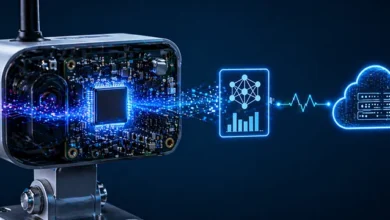
The data pipeline connecting a physical electrical panel to an enterprise cloud platform relies on established industrial communication hierarchies. Raw analog signals from shunts, CTs, and ZCTs are first digitized by local measurement modules. These smart modules compute RMS values, power metrics, and residual current thresholds locally before packaging the data into standard protocols—most commonly Modbus RTU transmitted via RS-485 serial communication lines—to an edge gateway device.
The edge gateway serves as the critical bridge between the localized electrical hardware and external enterprise software. Rather than continuously streaming raw, high-frequency telemetry to the cloud—which can saturate cellular data caps and overwhelm cloud storage architectures—modern edge gateways perform localized preprocessing. They filter routine operational data, monitor for localized anomaly thresholds, and maintain high-resolution circular data buffers surrounding electrical trip events. When an anomaly or breaker trip occurs, the gateway preserves the precise pre- and post-event data window, transmitting actionable diagnostic packages via MQTT or HTTPS protocols over IP networks.
Connectivity Trade-Offs and Physical Constraints
Selecting the appropriate IoT connectivity medium requires balancing data throughput, latency, power availability, and site topography. While wired Ethernet connections provide maximum reliability, industrial retrofits frequently demand wireless alternatives.
- LoRaWAN: Highly effective for transmitting periodic, low-volume sensor data and alarm notifications across sprawling industrial complexes, though restricted by strict duty-cycle limits and low data rates.
- NB-IoT (Narrowband IoT): Offers robust cellular coverage for moderate data volumes with excellent building penetration characteristics.
- LTE Cat 1 bis: Suited for higher-throughput applications requiring frequent, bidirectional communication and rich telemetry streaming.
Physical enclosure design presents a notoriously challenging variable for wireless deployments. Heavy metallic electrical distribution cabinets act as potent Faraday cages, severely attenuating radio frequency signals. Consequently, antenna placement strategies, remote antenna extensions, and rigorous site-surveillance testing must be integrated into the initial design phase. A gateway that communicates flawlessly during benchtop commissioning with the enclosure door open may experience total signal loss once sealed in a heavy steel operational cabinet.
Cybersecurity and Operational Resilience
Integrating core electrical distribution infrastructure into connected IoT architectures introduces significant cybersecurity vulnerabilities. To mitigate the risk of malicious intrusion or operational disruption, industrial gateways must enforce strict security protocols, including end-to-end authentication, encrypted data transmission, and role-based access controls for local configuration interfaces.
Furthermore, mission-critical distribution panels must maintain fault-tolerant resilience. If a wide-area network outage or cloud service interruption occurs, the edge monitoring hardware must continue to buffer critical event data locally and execute high-priority local alarm handling without depending on external server connectivity.
Strategic Guidelines for Selecting Current Sensors in IIoT Deployments
Industrial automation projects frequently falter during commissioning because engineering teams attempt to repurpose generic, readily available current transformers from warehouse stock, only to discover their chosen hardware lacks the requisite accuracy profile or sensitivity at the lower boundaries of operation.
Procurement specifications must prioritize several core technical parameters:
- Accuracy Class and Measurement Range: Revenue-grade billing, operational energy trending, and fault diagnostics impose vastly different accuracy requirements. A current sensor sized to match a massive upstream breaker rating may spend the vast majority of its operational lifecycle functioning at a tiny fraction of its nominal capacity. Consequently, low-end linearity and accuracy at fractional loads are often significantly more critical than headline maximum current ratings.
- Output Signal and Safety: Traditional secondary current-output CTs (rated at 1A or 5A) present severe safety hazards if accidentally left open-circuited while the primary circuit is energized, often generating lethal voltage spikes. For this reason, modern IoT monitoring installations increasingly favor voltage-output or millivolt-output CTs, provided they maintain strict compatibility with the designated measurement module’s input impedance.
- Aperture Geometry and Conductor Routing: When specifying zero-sequence current transformers, the physical inner diameter (aperture) must comfortably accommodate every live phase conductor and the neutral conductor simultaneously, while strictly excluding the protective earth (PE) conductor. Severe physical asymmetry or off-center conductor placement within the sensor aperture can induce magnetic flux imbalances, generating false error readings during high-load operations.
- Physical Form Factor: Split-core sensors allow non-invasive retrofits around existing cables without requiring costly plant shutdowns or cable disconnections. While closed-core toroidal sensors generally offer superior mechanical stability and baseline accuracy, they necessitate un-terminating cables during installation.
Industry standards and performance benchmarks for specialized sensors are thoroughly documented by established manufacturers, offering engineering references for zero-sequence applications.
Mitigating Common Installation Pitfalls
Field investigations into malfunctioning IoT monitoring deployments frequently reveal that persistent data inaccuracies stem from preventable installation errors rather than hardware defects. Common field oversights include:
- Enclosing the protective earth (PE) wire alongside phase and neutral conductors inside a ZCT aperture, which completely neutralizes earth-leakage detection capabilities.
- Incorrect phase-matching between voltage reference inputs and corresponding current sensor channels, resulting in wildly inaccurate power factor and real power calculations.
- Exceeding maximum cable run lengths between remote sensors and measurement modules, introducing excessive resistive signal degradation and electromagnetic interference (EMI).
Avoiding these costly field errors requires rigorous pre-commissioning validation, comprehensive technician training, and baseline testing against known electrical loads before an IIoT installation is signed off as operational.
Future Outlook: The Intersection of Edge Intelligence and Electrical Safety
As commercial and industrial facilities face mounting pressures regarding energy efficiency, decarbonization, and operational resilience, smart electrical distribution panels will continue to evolve. Emerging capabilities increasingly leverage edge-based machine learning models trained on multi-point sensor streams to detect subtle precursor signatures of electrical degradation long before human operators or standard threshold alarms intervene.
Yet, the fundamental rule of industrial telemetry remains unaltered: advanced analytics platforms cannot reconstruct data that was never physically captured at the measurement boundary. The subtle milliamps of leakage current escaping through aging insulation, the gradual thermal creep of a loosening terminal lug, or the complex harmonic distortions introduced by modern electric vehicle chargers all demand intentional, application-appropriate sensor engineering. Ultimately, the true intelligence of a modern electrical distribution panel is determined not by the sophistication of its cloud dashboard, but by the physical fidelity of its measurements at the terminal block.