Inkitt Automates Low-Risk Software Changes with Event-Driven One-Shot Pull Request Creator

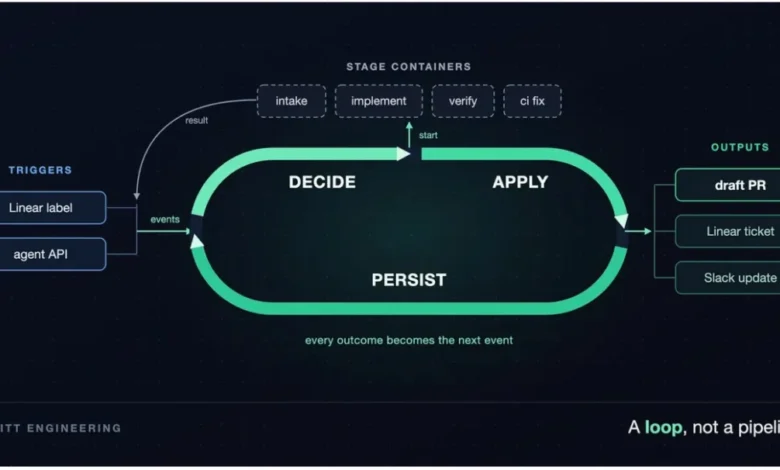
Inkitt, a prominent digital publishing and technology platform, has introduced a novel automated software development workflow designed to streamline minor engineering tasks. Known internally as the "one-shot pull request (PR) creator," the system successfully automates the lifecycle of low-risk software modifications—progressing seamlessly from initial task intake to the generation of a draft pull request ready for rigorous testing and human review. Powered by remote infrastructure and triggered via collaboration tools such as Slack, project management platforms like Linear, or direct API calls from external autonomous agents, this architecture removes the friction historically associated with developers manually configuring and supervising coding agents on local machines. According to technical documentation published by Inkitt Tech, the system has achieved daily production code deployment, signaling a maturation in how generative artificial intelligence and event-driven orchestration intersect within modern software engineering departments.
The Architectural Paradigm: Beyond Fixed Pipelines
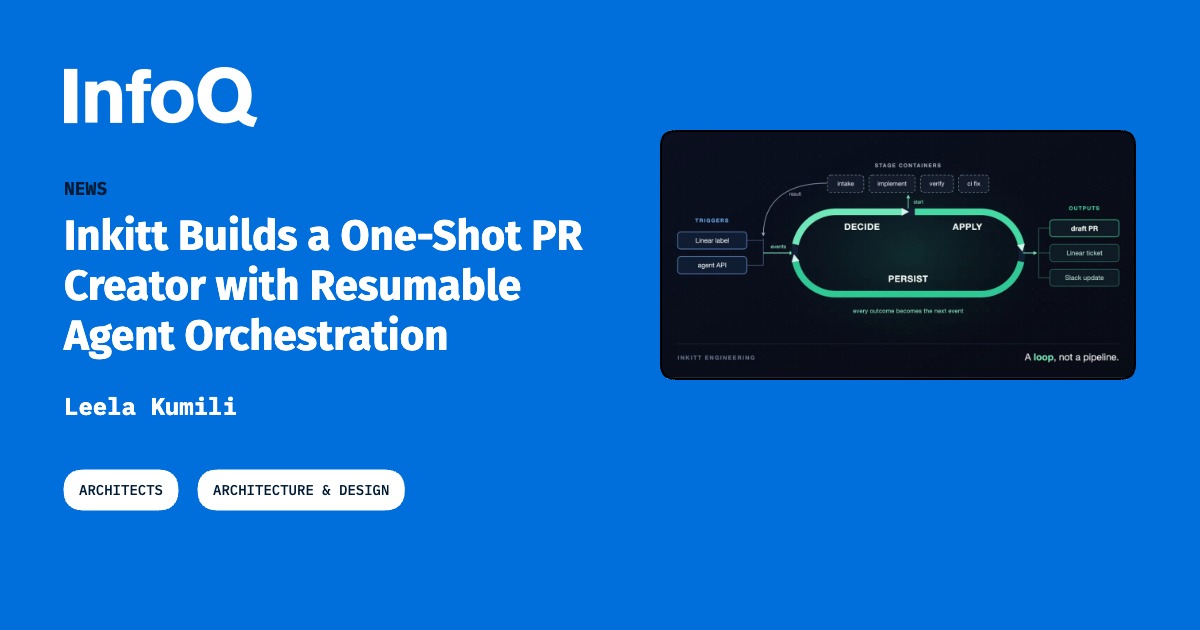
The technical foundation of Inkitt’s automation pipeline was detailed by Agi Letkiewicz Tanner, lead engineer at Inkitt, who characterized the infrastructure as an event-driven orchestrator designed to coordinate short-lived agent containers rather than depending on a rigid, linear pipeline. Traditional continuous integration and deployment (CI/CD) pipelines often break down when confronted with the probabilistic nature of large language models (LLMs). By moving away from deterministic step-by-step scripts, Inkitt’s orchestrator treats software generation as a dynamic state machine capable of adapting to intermediate failures.
Individual stages within this orchestrator manage distinct software engineering responsibilities, including technical specification writing, code implementation, automated verification, continuous integration (CI) failure repair, and merge conflict resolution. To ensure fault tolerance and system resilience, the orchestrator persists every execution run state within a robust database. This persistence layer guarantees that if a transient network error or API timeout occurs, execution can resume precisely from its recorded state without repeating expensive or completed computations.
Furthermore, the architecture enforces a strict separation of concerns by isolating decision-making logic from side effects. The core transition function maps the current run state and an incoming event directly to the next action. Crucially, this function operates in a pure context, without direct access to databases, external networks, or language model endpoints. Security is tightly managed: while the orchestrator retains administrative credentials for external systems, individual agent containers are provisioned exclusively with short-lived repository tokens and scoped model credentials. These containers lack direct access to enterprise messaging platforms like Slack, project tracking tools like Linear, cloud identity providers, or arbitrary external network connections. To prevent malicious or accidental code injection, a dedicated security validation check inspects the raw Git diff to ensure that changes never encroach upon sensitive or restricted code paths.
Rigorous Guardrails and Bounded Automation
While autonomous coding agents have gained widespread traction across the technology sector, organizations frequently struggle with the risks of hallucinated code, unintended regressions, and security vulnerabilities. Inkitt addresses these concerns by explicitly limiting automation to narrowly defined boundaries. The workflow automatically rejects tasks that introduce systemic risk, such as database migrations, schema or shared contract modifications, CI and container build configuration updates, authentication logic, payment processing code, or the addition and updating of third-party software packages.
To prevent infinite loops—a common failure mode for autonomous agents attempting to fix broken tests—Inkitt implements strict budgetary constraints. Verification, CI repair, and merge conflict resolution stages are each capped at a maximum of two automated retry attempts. Moreover, the system accounts for distributed systems anomalies, such as duplicate webhook deliveries, through robust event deduplication and conditional database write operations. This design adheres strictly to the principles of idempotent operations, ensuring that workflows receiving repeated events or executing retries maintain data integrity and consistent states.
In managing CI completion events, the orchestrator avoids the naive approach of treating every individual job notification as the final conclusion of the workflow. Instead, it actively queries GitHub to verify that all relevant, dependent build and test jobs have fully concluded before advancing the pull request state. Reflecting on the engineering hurdles encountered during development, Tanner observed that implementing the core language model functionality was deceptively straightforward, whereas mastering idempotency, distributed locking, retry budgets, and granular permission boundaries represented the true complexity of the project.
Comparative Industry Context and the Role of Human Oversight
Inkitt’s one-shot PR creator joins a rapidly expanding ecosystem of AI-driven development tools, yet its architectural choices distinguish it from existing solutions. For comparison, GitHub Copilot’s cloud-hosted agents similarly restrict agent permissions and mandate explicit human authorization before code can be merged into production branches. Meanwhile, projects like SWE-agent focus heavily on resolving complex repository-level issues through specialized, model-driven interfaces designed for code browsing, editing, and execution. Inkitt’s approach differs by prioritizing persistent workflow state management, strict retry budgets, and centralized, ironclad control over external side effects.
Despite the high degree of automation achieved by the system, human oversight remains a non-negotiable cornerstone of Inkitt’s engineering culture. The automated system is intentionally constrained: it can only open draft pull requests, lacks the permissions required to bypass branch protection rules, and is prohibited from merging its own code. Once the system verifies that CI checks have passed and changes have been successfully deployed to a staging environment, it notifies the requesting engineer. From that point onward, a human must formally review the changes, manage reviewer assignments, and ultimately approve the pull request for production integration. For larger, more complex architectural tasks that defy automated "one-shot" completion, Inkitt maintains traditional local workflows that keep human developers closely engaged at every stage of the development lifecycle.
Implications for the Future of Software Engineering
The deployment of event-driven, bounded-scope coding agents at companies like Inkitt points toward a broader evolution in software engineering productivity. By offloading repetitive, low-risk engineering tasks—such as boilerplate writing, minor bug fixes, and routine feature enhancements—to supervised autonomous agents, engineering teams can reallocate cognitive bandwidth toward complex architecture, system scalability, and innovative product development.
However, the primary takeaway from Inkitt’s engineering disclosures is that the viability of AI in production environments relies less on the raw intelligence of the underlying language models and more on the engineering rigor of the surrounding infrastructure. By enforcing strict permission boundaries, maintaining persistent state orchestration, and preserving the human-in-the-loop requirement for critical code merges, Inkitt has established a scalable blueprint for safely integrating generative AI into enterprise software delivery pipelines. As organizations globally seek to harness automation without compromising code quality or security, frameworks that prioritize defensive architecture and operational idempotency are poised to become the industry standard.