Opsera Relaunches as an AI-Native Software Factory to Bridge the Gap Between AI Code Generation and Enterprise Delivery

The software development landscape has undergone a seismic shift over the past 24 months. While generative AI tools have drastically accelerated the pace at which developers produce code, the operational reality for enterprises remains plagued by bottlenecks in delivery, security, and the modernization of legacy systems. Recognizing this disconnect, Opsera, a company long established as a leader in continuous orchestration for DevOps, has officially relaunched its identity as an AI-native software factory. At the heart of this strategic pivot is the release of Forge, an intent-and-context-aware platform designed to bring discipline, guardrails, and measurable outcomes to the AI-augmented software development lifecycle (SDLC).
This transformation marks a significant departure from traditional CI/CD orchestration. By integrating an "AI harness" into the development pipeline, Opsera aims to solve the primary friction point currently facing CTOs and engineering leads: the transition from AI-generated code snippets to production-ready, enterprise-grade applications.
The Evolution of Opsera: From DevOps Orchestration to AI-Native Factory
To understand the necessity of this relaunch, one must examine the state of the software industry in recent years. Historically, Opsera built its reputation on the concept of "continuous orchestration"—a methodology that allowed teams to integrate various DevOps tools into a single, cohesive workflow. This provided visibility and efficiency in a world where developers were often siloed by their toolchains.
However, the rapid adoption of large language models (LLMs) and AI coding assistants—such as GitHub Copilot, Cursor, and others—has fundamentally changed the velocity of code creation. Yet, the delivery mechanism remained stagnant. Organizations found themselves flooded with AI-generated code that lacked consistent security scanning, architectural alignment, or clear business context.
The timeline of Opsera’s shift began in early 2024, culminating in the April rollout of the Forge factory. The company identified that while AI solved the "writing" phase, it exacerbated the "delivering" and "modernizing" phases. By rebranding as an AI-native software factory, Opsera is attempting to move from being a tool that connects existing software to a platform that actively participates in the construction and governance of software.
Forge: Providing the Missing Guardrails
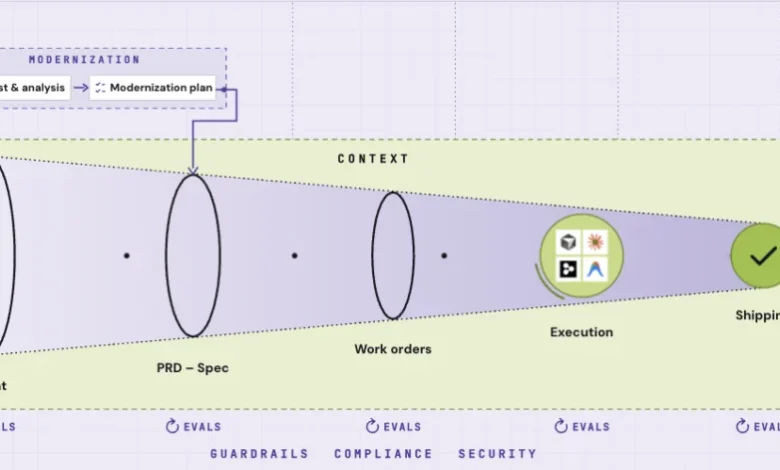
The centerpiece of this new strategy, Forge, is designed to act as an AI harness. In software engineering, "harnessing" refers to the ability to control and guide a process that might otherwise become unruly. Forge enforces spec-based development, meaning that before a single line of AI-generated code is committed, the platform ensures it aligns with the predefined architectural intent and business requirements.
This is a critical departure from the "wild west" of early AI adoption, where developers often utilized AI to write code without a holistic view of the system’s impact on technical debt. Forge provides the necessary traceability—a vital requirement for regulated industries—by linking legacy logic and business intent directly to the modern code being generated. This prevents the "black box" syndrome where engineers may not fully understand the implications of the AI-generated blocks they are integrating into their production environments.
Modernization and the ForgeScore Metric
A core component of the relaunch is the introduction of ForgeScore, a modernization assessment tool. For large enterprises, the most daunting task is not writing new software, but managing the massive, aging codebases that form the backbone of their operations. These systems are often brittle, poorly documented, and expensive to maintain.
ForgeScore evaluates these legacy codebases across several key performance indicators (KPIs):
- Security: Identifying vulnerabilities inherent in older coding standards.
- Maintainability: Assessing the "cognitive load" required for human engineers to understand and update the code.
- Semantic Quality: Determining if the code still aligns with current business logic.
- AI Readiness: Evaluating whether the codebase is structured in a way that allows LLMs to interact with it effectively for future refactoring.
Based on this evaluation, the platform generates a modernization blueprint. This data-driven roadmap allows organizations to prioritize their technical debt, focusing on high-risk, high-complexity areas first, rather than attempting a wholesale rewrite that often leads to project failure.

Addressing the Crisis of AI Spend and Visibility
Beyond the technical implementation, Opsera’s relaunch addresses a growing concern among financial stakeholders: the "AI tax." Many organizations have invested heavily in AI tools, LLM subscriptions, and cloud compute resources, yet they struggle to quantify the Return on Investment (ROI).
Opsera’s Unified Insights module is designed to provide a "single pane of glass" for engineering, security, and finance leaders. It bridges the gap between technical output and financial expenditure by mapping token usage—the currency of AI—to specific project outcomes. This level of granularity allows managers to see, for instance, which teams are using the most tokens and whether that usage correlates with improved delivery speed or reduced operational expenditure (opex).
By providing this transparency, Opsera enables organizations to govern their AI investment, ensuring that the technology is being used responsibly and that the business is not overspending on tools that fail to provide tangible performance gains.
The Strategic Shift: A CEO’s Perspective
Kumar Chivukula, CEO of Opsera, has been vocal about the limitations of the current AI hype cycle. In his assessment, the industry has successfully mastered the generation of code, but it has failed to modernize the systems that house that code.
"AI has changed how code gets written. It hasn’t yet changed how software gets delivered, how legacy systems get modernized, or how AI investment gets measured," Chivukula noted during the announcement. "We rebuilt Opsera to solve those three problems."
Chivukula’s perspective underscores a shift in industry sentiment. We are moving away from the era of "AI for the sake of AI" toward an era of "AI for business outcomes." For enterprises, the value of Opsera’s new direction lies in its ability to preserve the existing investments in tools, models, and code while layering on a system of intelligence that makes those assets more reliable and manageable.
Implications for the Software Industry
The relaunch of Opsera serves as a bellwether for the broader DevOps market. As software development becomes increasingly automated, the role of the "orchestrator" is being subsumed by the "factory."
Several implications arise from this shift:
- Shift to Intent-Based Development: We are likely to see more platforms requiring "specs" or "intent" before allowing AI to generate code. This moves the developer’s role from "writer" to "architect and auditor."
- Focus on Measurable AI ROI: As corporate budgets tighten, platforms that cannot demonstrate a clear link between AI spend and delivery metrics will likely face scrutiny. Opsera’s move to include tokenomics is a direct response to this financial pressure.
- Modernization as a Competitive Advantage: Organizations that can effectively leverage AI to modernize legacy code will gain a significant competitive advantage in agility. Those that cannot will remain tethered to the high maintenance costs of legacy infrastructure.
- Consolidation of Toolchains: By offering a unified view that spans finance, security, and development, Opsera is positioning itself as a central hub in the enterprise tech stack, reducing the need for disjointed point solutions.
Conclusion
Opsera’s transition into an AI-native software factory represents a mature step forward for the industry. By moving beyond the initial excitement of generative AI and focusing on the systemic challenges of delivery, security, and measurement, the company is addressing the real-world friction that enterprises face.
The Forge platform, with its emphasis on guardrails and context, acknowledges that while AI is an incredibly powerful tool, it is not a replacement for disciplined software engineering. Instead, it is a force multiplier that requires the right infrastructure to be effective. As organizations continue to integrate AI into their core operations, the need for platforms that can provide this level of oversight, governance, and insight will only grow, positioning Opsera at the center of the next generation of software development.
For those looking to integrate AI-driven development into their enterprise workflows, the current trajectory suggests that the focus must remain on the full SDLC—from the initial business intent to the final production delivery—ensuring that the speed of innovation does not come at the cost of stability or financial control.