The rapid democratization of artificial intelligence has created an unprecedented demand for large language model (LLM) training and fine-tuning. For years, conventional scaling laws have dictated that pre-training or executing full fine-tuning runs on multi-billion parameter foundation models requires massive enterprise clusters. These setups typically rely on arrays of high-end NVIDIA H100 accelerators interconnected by 3.2 Tbps InfiniBand fabrics. However, this compute-heavy paradigm creates a substantial barrier to entry for independent research laboratories, academic institutions, and enterprise engineering teams operating on localized, budget-capped hardware architectures.
In practice, these localized environments are constrained to dual or quad workstation graphics processing units—such as consumer-grade NVIDIA RTX 4090s, enterprise A10Gs, or L40Ss. These consumer and mid-tier enterprise devices are severely bounded by standard consumer-tier PCIe bandwidth and strict video random-access memory (VRAM) ceilings, usually ranging between 24 gigabytes and 48 gigabytes per device. As the artificial intelligence community pushes toward decentralized development, overcoming these localized hardware constraints has transformed from an academic exercise into a critical engineering necessity.
The Fundamental Memory Challenge in Model Training
Attempting to train modern large language models using a naive approach leads to immediate failure. Initializing a standard 16-bit model with traditional AdamW optimizers and default PyTorch autograd graph retention causes immediate out-of-memory (OOM) faults before the first training step even concludes.
To understand why, one must examine the static and dynamic memory footprint of a standard model. A modest 7-billion (7B) parameter model represented in standard FP16 or BF16 precision occupies approximately 14 gigabytes of VRAM purely for static weights. When developers introduce standard AdamW optimizer states—which require first and second moment estimates utilizing 8 bytes per parameter in FP32 precision—an additional 56 gigabytes of memory is demanded for a 7B model alone.
When compounding this with backward-pass gradient tensors taking up another 14 gigabytes in FP16, alongside dynamic activation memory that scales linearly or quadratically with context length, the total resource requirement vastly outstrips the physical VRAM capacity of standard workstation hardware. Consequently, modern machine learning engineering requires a systematic separation of Static Memory Overhead—encompassing weights, optimizer states, and persistent gradients—from Dynamic Transient Memory Overhead, which includes intermediate activation maps and scratchpad buffers. Engineers must also carefully diagnose whether their training bottlenecks are compute-bound, limiting Tensor Core utilization, or memory bandwidth-bound, restricting VRAM read and write round-trips.
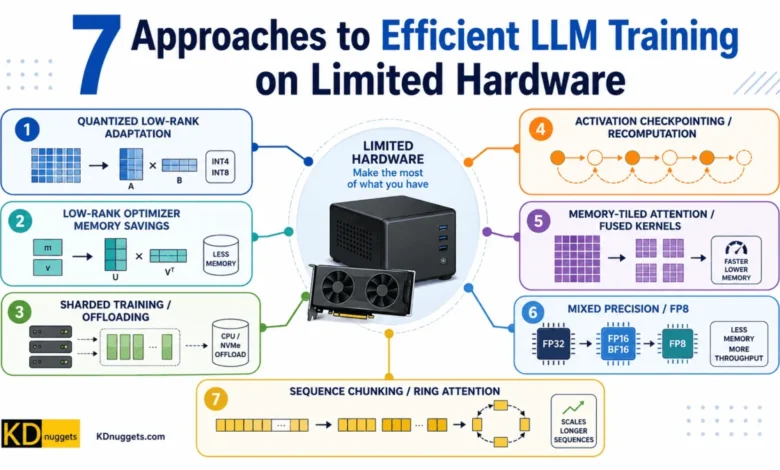
To bridge the gap between enterprise demands and localized hardware limitations, the machine learning community has developed seven sophisticated optimization approaches that enable efficient LLM training on limited hardware.
- Quantized Low-Rank Adaptation (QLoRA and DoRA)
Quantized Low-Rank Adaptation, widely known as QLoRA, addresses the massive memory footprint of base models by freezing their weights in an information-theoretically optimized 4-bit representation. Concurrently, it injects trainable low-rank, full-precision decomposition matrices directly into self-attention and feed-forward projection layers.
Under the hood, base parameters are quantized into 4-bit NormalFloat (NF4), a specialized distribution tailored specifically to normally distributed neural network weights. To maximize efficiency, Double Quantization (DQ) is applied to quantize the quantization constants themselves, saving an additional 0.37 bits per parameter. During the forward pass, base weights are dynamically dequantized into BF16 for compute, added to the low-rank update matrix, and promptly discarded from cache. Weight-Decomposed Low-Rank Adaptation (DoRA) extends this methodology further by decoupling magnitude and directional updates to mirror the gradient trajectories of full fine-tuning.
Despite its efficacy, QLoRA introduces a notable trade-off. Dynamic on-the-fly dequantization incurs compute overhead that degrades training throughput—measured in tokens per second—by 20% to 35% compared to native 16-bit training. Furthermore, merging adapter weights back into base models for zero-latency serving requires dequantizing the base model back to 16-bit, preventing direct deployment in native 4-bit environments without compound precision loss. This approach is ideally deployed when fine-tuning models ranging from 7 billion to 70 billion parameters on single or dual consumer-grade 24GB GPUs.
- Memory-Aware Low-Rank Optimizers (GaLore)
While parameter-efficient methods like standard LoRA freeze base weights, Gradient Low-Rank Projection (GaLore) achieves full-parameter learning by projecting high-dimensional gradient matrices into a compact low-rank subspace. This innovation drastically reduces optimizer state memory footprint without requiring layers to be frozen.
Standard AdamW maintains two FP32 states per trainable parameter, consuming 8 bytes per parameter. GaLore applies Singular Value Decomposition (SVD) or randomized orthogonal projections to the gradient tensor, tracking momentum and variance exclusively for projected matrices. To amortize the computational overhead of SVD factorizations, projections are updated periodically every T steps rather than on every iteration.
The primary challenge with GaLore lies in its hyperparameter sensitivity. Selecting an improper subspace update frequency or rank cutoff can destabilize the optimization trajectory, potentially triggering sudden loss divergence mid-training. Additionally, periodic SVD factorizations introduce compute stalls that cause step-latency spikes. GaLore is best utilized for full-parameter pre-training or aggressive domain adaptation on memory-limited setups where traditional parameter-efficient fine-tuning struggles with complex out-of-domain feature distributions.
- Fully Sharded Data Parallelism with Host Memory Offloading (FSDP and ZeRO-3)
When a model’s parameter count exceeds the aggregate VRAM of a multi-GPU workstation, Fully Sharded Data Parallelism combined with host memory offloading provides a viable scaling path. Under ZeRO-Stage 3 and PyTorch FSDP Full Shard implementations, each GPU holds only a fraction of the complete model state during idle intervals.
During the forward pass, an All-Gather collective communication reconstructs layer weights immediately prior to computation, deallocating them once execution advances to the next layer. In host-offload configurations, non-active parameter shards and optimizer states reside in pinned host CPU RAM, streaming asynchronously across PCIe buses via non-blocking CUDA streams concurrently with compute kernels.
However, offloading across consumer PCIe Gen4 or Gen5 lanes introduces severe input/output bottlenecks. If GPU compute finishes before host-to-device tensor transfers complete, streaming multiprocessors enter idle wait states, depressing GPU compute utilization below 30%. This approach is indispensable when scaling training runs for models whose parameter counts surpass the total aggregate VRAM of a multi-GPU node.
- Selective Activation Checkpointing and Recomputation
As context lengths expand, intermediate activation tensors consume a massive share of VRAM. Standard backpropagation stores every intermediate activation tensor generated during the forward pass to evaluate chain-rule gradients. Selective activation checkpointing identifies memory-heavy, compute-cheap operations—such as activation functions, layer normalizations, and dropout masks—and discards them immediately after forward computation. During the backward pass, these tensors are re-evaluated on the fly from the nearest retained checkpoint boundary.
While this drastically reduces memory consumption, full activation recomputation adds approximately 30% computational overhead to total floating-point operations per training step. Furthermore, naive implementations lacking careful profiling of tensor allocation lifecycles can provoke severe CUDA memory fragmentation. This frequently results in unexpected out-of-memory errors even when gross reported VRAM usage sits comfortably below hardware thresholds. This strategy is mandatory when training with extended context windows ranging from 8,000 to 32,000-plus tokens.
- Hardware-Aware Memory-Tiled Kernels and Fused Operations
Optimizing memory bandwidth rather than raw compute capacity is often the key to unlocking hardware efficiency. FlashAttention-2 and fused operations restructure attention computations and elementwise operations to execute entirely within high-bandwidth on-chip SRAM, bypassing redundant read and write cycles to high-latency GPU high-bandwidth memory.
Standard attention materializes massive attention matrices in global memory, generating heavy traffic. FlashAttention-2 tiles query, key, and value matrices into blocks that fit neatly within the GPU’s L1 cache and SRAM, computing softmax normalization incrementally via online scaling. Fused kernels similarly combine layer normalization, bias additions, and activation functions into single CUDA kernel launches.
The primary limitation of custom fused kernels is their tight coupling to specific GPU microarchitectures, such as Ada Lovelace, Hopper, or Ampere. Compiling FlashAttention in non-standard consumer drivers or containerized environments can trigger application binary interface incompatibility issues, silent fallbacks to slower native kernels, or precision underflow. Despite these challenges, hardware-aware memory-tiled kernels are essential for all modern transformer training workloads.
- Mixed-Precision Training with FP8 Formats
The integration of 8-bit floating-point representations represents a major leap forward in hardware efficiency. By running tensor contractions and matrix multiplications using FP8 formats (E4M3 for activations and weights, and E5M2 for gradients), machine learning engineers can cut memory bandwidth consumption and activation buffer sizes in half compared to 16-bit formats.
Dynamic scaling factors computed per-tensor or per-tile at runtime prevent numerical underflow and overflow before values are cast into FP8 Tensor Cores. Nevertheless, FP8’s narrow dynamic range requires rigorous delayed-scaling algorithms or per-channel quantization schemes. Without them, gradient vanishing occurs during backward passes on deeper layers, resulting in unrecoverable training divergence. FP8 acceleration is currently limited to modern microarchitectures including Ada Lovelace and Hopper.
- Sequence Chunking and RingAttention Over Commodity Interconnects
Handling ultra-long contexts on localized hardware often requires distributing sequences across multiple devices without high-end NVLink meshes. RingAttention splits long sequences along the temporal dimension across multiple devices. Each device computes attention locally before executing asynchronous peer-to-peer ring communications to pass key-value blocks.
On consumer hardware running over standard PCIe buses or local network interfaces, communication latency can outpace compute time for small batch sizes. If network transfer times exceed block compute processing times, pipeline stalls occur at every ring step, eliminating throughput gains. This approach is recommended when scaling training context windows beyond 32k tokens on distributed hardware lacking dedicated interconnect bridges.
Broader Implications and Industry Outlook
The maturation of these localized training methodologies marks a fundamental shift in how artificial intelligence research and development are conducted. Historically restricted to well-funded technology conglomerates with direct access to massive data centers, foundational model experimentation is increasingly accessible to decentralized engineering teams.
Industry analysts note that as software-level optimizations—such as quantization, memory offloading, and kernel fusion—continue to advance, the absolute dependency on proprietary enterprise hardware clusters is slowly decreasing. While enterprise-scale infrastructure remains paramount for training frontier models from scratch, localized hardware optimization enables targeted domain adaptation, specialized fine-tuning, and privacy-preserving on-premise model training.
However, engineers adopting these techniques must remain vigilant regarding hidden operational failure modes. Long-running training operations on constrained hardware frequently surface silent anomalies that standard benchmarks overlook, including non-deterministic CUDA kernel behavior across driver updates, thermal throttling under sustained maximum workloads, and checkpoint corruption caused by asynchronous disk input/output bottlenecks.
Consequently, establishing robust production pipelines requires continuous metric tracing. Teams must monitor floating-point underflow rates, GPU PCIe bus utilization counters, and automated gradient checkpoint verification hooks to ensure that weeks of localized compute time are not invalidated by silently diverged weights. Ultimately, successful LLM training on limited hardware is less a challenge of brute-force compute scaling and more an exercise in sophisticated memory hierarchy management.