Trezor Confirms Malicious Hardware Implants in Safe 5 Wallets Distributed by Southeast Asian Reseller

Cryptocurrency hardware wallet manufacturer Trezor has officially confirmed that at least three Trezor Safe 5 devices sold through the Southeast Asian third-party reseller CryptoBilis were intercepted and fitted with malicious hardware implants. These unauthorized modifications were specifically engineered to covertly capture sensitive wallet recovery phrases and exfiltrate the data to attacker-controlled infrastructure via cellular networks. The confirmation follows an exhaustive laboratory investigation into a sophisticated supply-chain attack that has sent shockwaves through the digital asset security community, prompting major operational overhauls across the cryptocurrency hardware sector.
The disclosure marks a critical escalation in an ongoing security crisis involving physical supply-chain vulnerabilities within the hardware wallet industry. While Trezor has reported that no customer funds have been lost to date, the discovery highlights the severe risks posed by compromised intermediary distribution channels and underscores the evolving sophistication of hardware-level cyber espionage targeting cryptocurrency holders.
Genesis of the Investigation: From Initial Suspicion to Laboratory Confirmation
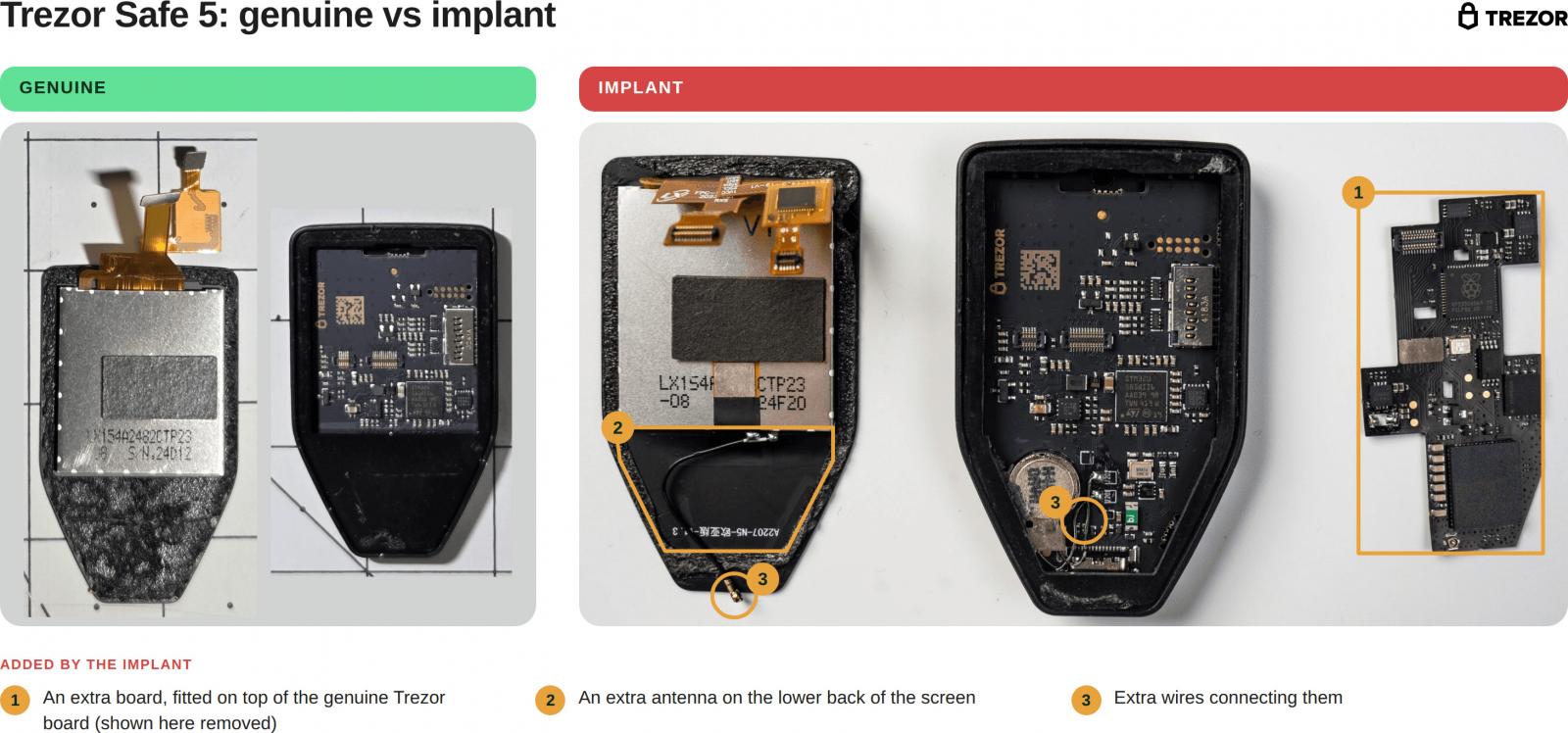
The incident first came to light in October when a vigilant customer in Indonesia purchased a Trezor Safe 5 hardware wallet from CryptoBilis, a regional reseller operating out of Southeast Asia. Upon inspecting the device, the user discovered an unauthorized, anomalous circuit board nestled inside the hardware casing. The customer immediately alerted the manufacturer and shared their findings online, sparking widespread concern regarding the integrity of third-party retail channels.
At the time of the initial report, Trezor engineers had not yet taken physical possession of the suspect device and were therefore unable to verify the exact operational capabilities of the mysterious internal circuit board. However, treating the alert with the utmost gravity, the company launched a comprehensive internal investigation, urging other customers
who had purchased devices through CryptoBilis to come forward for inspection.
In its latest investigative update, Trezor confirmed that its laboratory specialists have now thoroughly examined the original Indonesian device. Furthermore, by analyzing high-resolution photographs submitted by concerned customers, security analysts identified two additional compromised wallets. All three confirmed instances involved Trezor Safe 5 units purchased from CryptoBilis within a strict window between August 20 and September 23.
In total, 48 customers who purchased devices from the same reseller contacted Trezor following the initial October advisory. Trezor’s technical teams systematically evaluated these reports, inspecting physical devices shipped to their laboratories as well as detailed photographic evidence of internal components. Additionally, as part of a broader auditing sweep, Trezor inspected hardware stocks from various other regional resellers and found zero evidence of tampering outside of the CryptoBilis channel.
Anatomy of the Exploit: How the Hardware Implants Operate
Engineering analysis conducted by Trezor revealed a highly targeted and stealthy hardware architecture designed to subvert the device’s security model without triggering traditional software defenses. The malicious implant consists of a custom-engineered circuit board meticulously installed between the Safe 5’s primary circuit board and its visual display interface.
Because the modification bypasses neither the device’s legitimate firmware nor its dedicated Secure Element cryptographic chip directly, it operates as a silent observer. Its primary function is to monitor and record any sensitive information rendered on the wallet’s screen.
When a user initializes a new cryptocurrency wallet or restores an existing one, the device generates and displays a sequence of words known as the recovery seed phrase—the master key required to access all funds stored within the wallet. The hardware implant intercepts this visual data in real-time. Additionally, the rogue circuit board is capable of capturing user-defined passphrases entered or displayed during operational workflows.
Once harvested, the sensitive data is encrypted by the implant and prepared for exfiltration. The malicious hardware utilizes an integrated cellular module to transmit the stolen recovery phrases across mobile telecommunications networks directly to a remote server controlled by the attackers. To ensure data delivery even in areas with poor connectivity or network monitoring, the implant features onboard storage capability: if a network connection cannot be immediately established, the device retains the captured information locally, persistently attempting to transmit the data until the operation succeeds.
This sophisticated physical intercept mirrors a parallel security incident disclosed earlier in the year involving Ledger hardware wallets. In that prior supply-chain attack, Ledger devices distributed through the exact same reseller, CryptoBilis, were found to contain similar spy implants, which were subsequently linked to actual cryptocurrency thefts across the region.
Swift Mitigation: Firmware Updates and Defensive Measures

Recognizing the acute danger posed by these active physical implants, Trezor’s engineering team raced to develop a software-level countermeasure. On November 11, the company officially released firmware version 2.13.1, introducing critical architectural defenses designed to neutralize the threat.
According to official release notes, the updated firmware includes specialized protocols that actively prevent the known hardware implants from capturing data rendered on the device screen. Trezor stated that updating to version 2.13.1 effectively renders the current generation of malicious implants useless, as they are blocked from reading operational prompts and recovery sequences.
Nevertheless, company executives issued a vital caveat: while the firmware update stops active interception on supported devices, it cannot retroactively protect recovery phrases that may have already been captured and transmitted prior to the software installation. Consequently, Trezor strongly advises any customer who purchased a hardware wallet from CryptoBilis to immediately migrate their digital assets to a brand-new wallet initialized with a completely fresh recovery phrase, regardless of whether their specific device has been confirmed compromised.
Broad Industry Fallout: Trezor Cuts Global Reseller Network by 80%
The discovery of supply-chain interdiction within authorized retail channels has forced a radical restructuring of Trezor’s global business operations. In response to the CryptoBilis incident and broader industry vulnerabilities, Trezor has aggressively slashed its global third-party reseller network by approximately 80%.
The decision to scale back reliance on external distributors began taking shape in October, catalyzed by the initial revelations surrounding compromised Ledger inventory in Asia. Although Trezor emphasized that the vast majority of the terminated resellers were entirely trustworthy and posed no active security threat, the company determined that the traditional distribution model no longer met the rigorous security standards required in an era of advanced supply-chain attacks.
Under the new operational framework, the vastly reduced pool of remaining authorized partners must adhere to significantly tighter security controls. These enhanced regulations govern every phase of the hardware lifecycle, including how devices are sourced from manufacturing plants, securely stored in warehouses, and physically accessed prior to final consumer purchase.
Furthermore, to maintain consumer trust and account for potential undetected tampering, Trezor announced a comprehensive remediation program. The company is offering complimentary replacement hardware wallets to any customer who purchased a Trezor device through CryptoBilis since March, encompassing even those users whose devices have not shown definitive signs of physical modification.
Implications for the Cryptocurrency Ecosystem
The Trezor Safe 5 supply-chain incident highlights a fundamental and persistent vector of risk in the cryptocurrency security landscape: the physical supply chain. While digital security measures such as robust encryption, secure boot processes, and multi-factor authentication continue to mature, the physical journey of a hardware device from the factory floor to the end user remains vulnerable to interdiction by well-funded malicious actors.
Analysts note that hardware implants requiring physical tampering necessitate deep access to logistics and distribution networks, suggesting the involvement of organized criminal syndicates or state-sponsored actors capable of intercepting legitimate commercial shipments en route to regional hubs.
For the broader digital asset community, the episode serves as a sobering reminder that hardware wallets—long considered the gold standard for cryptocurrency storage—are not entirely immune to physical compromise if purchased through unverified or insufficiently vetted intermediaries. Industry experts increasingly recommend purchasing hardware wallets exclusively and directly from official manufacturer websites rather than third-party marketplaces or regional resellers, minimizing the risk of post-factory tampering.
As Trezor implements its sweeping supply-chain reforms and urges affected users to migrate their funds, the security community continues to monitor the situation closely. With no customer funds reported lost in connection with the Trezor implants, swift industry intervention, proactive firmware patching, and transparent corporate communication have thus far averted a widespread financial disaster, setting a new benchmark for corporate accountability in hardware security incident response.